
Why ‘AI advantage’ is the strategic priority for business leaders in 2026
Imagine a world where technology changes at lightning speed. That’s exactly what’s happening with Artificial Intelligence (AI) right now. In 2026, AI is bringing amazing new chances for businesses to grow and do things better. But it’s also creating new challenges. Leaders everywhere are trying to understand how to use AI well, while also following new rules and laws.
The world of AI is moving incredibly fast. This rapid progress means businesses can find smart ways to stand out. At the same time, governments are creating many new rules for AI. This makes the environment tricky for everyone involved. For example, the global rules for AI are changing quickly, with many updates happening just in the last year alone, and more expected to come into full effect soon in places like Europe AI Policy & Regulatory Landscape 2026. It’s a complex dance between innovation and control.
This mix of fast changes and new, complicated rules creates both big chances and big risks for how a business fits into the market. Even for a small or medium business (smb business), getting this right is key. That’s why having an ai advantage is the most important thing for business leaders to focus on in 2026.

It’s not just about having AI tools. It’s about using them smartly, responsibly, and in a way that truly sets you apart. Understanding these changes and the people making them is crucial for any business, especially when considering uncover the influential AI figures and labs driving global AI policy.
This guide offers a clear, step-by-step plan for business leaders, investors, and policy teams. It will help you understand the rules and turn AI capabilities into a strong competitive edge that other businesses, even big companies that own other companies or fast-moving upcoming companies, can’t easily beat. This is your playbook to help you make AI work for you, not against you, in today’s changing world.
To keep up with all the latest developments in AI policy and regulation, stay informed with daily updates.
The AI Newsletter Worth Reading
Defining ‘AI advantage’: dimensions and measurable outcomes
Now that we know an ai advantage is important, let’s talk about what it actually means. It’s more than just having fancy AI tools. It’s about using those tools in ways that truly make your business better than others. Think of it as having special powers that help you win the game.
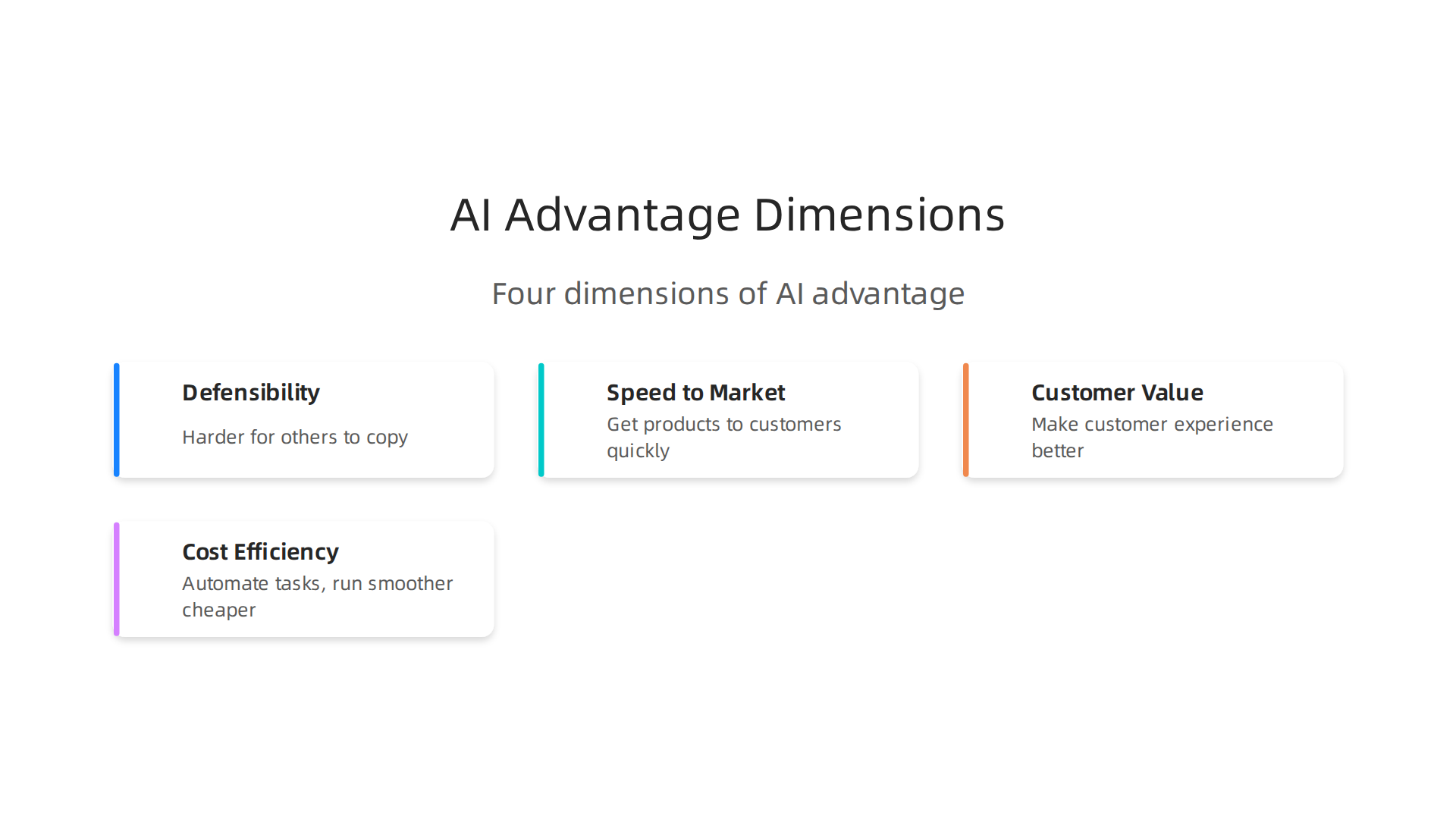
These powers show up in a few key ways:
- Being Hard to Copy (Defensibility): When your business uses AI in a unique way, it becomes much harder for others to copy what you do. This could be a special AI helping with customer service or a unique way to make products. It makes your company stand out, even against large companies that own other companies or quick-moving upcoming companies.
- Getting Things Done Faster (Speed to Market): AI can help you create new products or services and get them to customers much more quickly. This speed can give you a big lead over competitors. This means faster product releases and quicker entry into new markets When AI Readiness Meets ROI Reckoning.
- Making Customers Happier (Customer Value): AI can help you understand what your customers really want. It can make their experience better, from giving them personalized help to suggesting things they’ll love. Happy customers often stay longer and buy more.
- Saving Money (Cost Efficiency): AI can automate tasks that used to take a lot of time and money. This helps your business run smoother and cheaper, whether you’re a big company or a small business (smb business).
How to know if AI is truly helping your business
To see if you have an AI advantage, you need to look at how AI is changing your business. It’s like checking the score in a game. You track things called Key Performance Indicators (KPIs) and leading indicators. These are just ways to measure success.
Some key things to track include:
- Money Matters: Are you making more money? Are you spending less? AI should help with things like growing sales or cutting costs 2026 State of Data Integrity and AI Readiness. You can look at your return on investment (ROI) or how fast your money comes back after spending it on AI Measuring AI impact.
- How Things Run: Is work getting done faster? Are there fewer mistakes? AI can make daily operations much more efficient. For example, you can measure how much time is saved on tasks thanks to AI Measuring AI Adoption: Metrics for Business Impact in 2026.
- Customer Happiness: Are customers more satisfied? Are they staying with you longer? AI should lead to better customer experiences. You can track things like customer satisfaction and how often customers come back How to Measure Enterprise AI ROI.
- People Using AI: How many people in your company are actually using the AI tools? Are they using them often? These are called "leading indicators" because they tell you before the big results come in if your AI efforts are working. Things like how many active users you have each week or month show how well AI is being adopted Strategic AI Productivity Measurement Framework.
Understanding these numbers helps you know if your AI efforts are truly giving you an edge. For a more complete understanding of how to set up and manage these systems, consider exploring resources on AI agent governance.
To keep up with all the latest developments in AI policy and regulation, stay informed with daily updates.
The AI Newsletter Worth Reading
To truly gain an ai advantage, it’s not enough to just use AI smartly. You also need to understand the rules of the game. Just like a smart player knows the rules of a sport, a smart business knows the rules around AI. In 2026, these rules are changing very quickly all over the world, making it a tricky but important area to watch for any company, big or small AI Policy & Regulatory Landscape 2026.
Understanding AI Rules for Your Business Strategy
Imagine that different countries or even different states have their own sets of rules for how AI can be used. These are called "jurisdictional regulatory signals." Businesses must pay close attention to these signals. Why? Because these rules can create both limits and new chances.
For example, the European Union has a big set of rules called the AI Act, which is the first of its kind in the world and has many parts taking effect in 2026 AI Act | Shaping Europe’s digital future. In the United States, there’s a mix of federal ideas and state laws that are shaping how AI is governed State of AI Governance Regulations in the United States. If your business wants to launch a new AI product, knowing these rules helps you avoid problems and even find new markets where your compliant product can shine. You can learn more about how different regions compare in this global comparison of AI regulations.
Putting Policy Monitoring into Action
Keeping up with all these rules might sound like a big job. But it’s key for any company, whether it’s an smb business or a large corporation. Businesses need to set up ways to constantly watch for new AI laws and changes. This is called "operationalizing policy monitoring." It means your strategy teams need to:
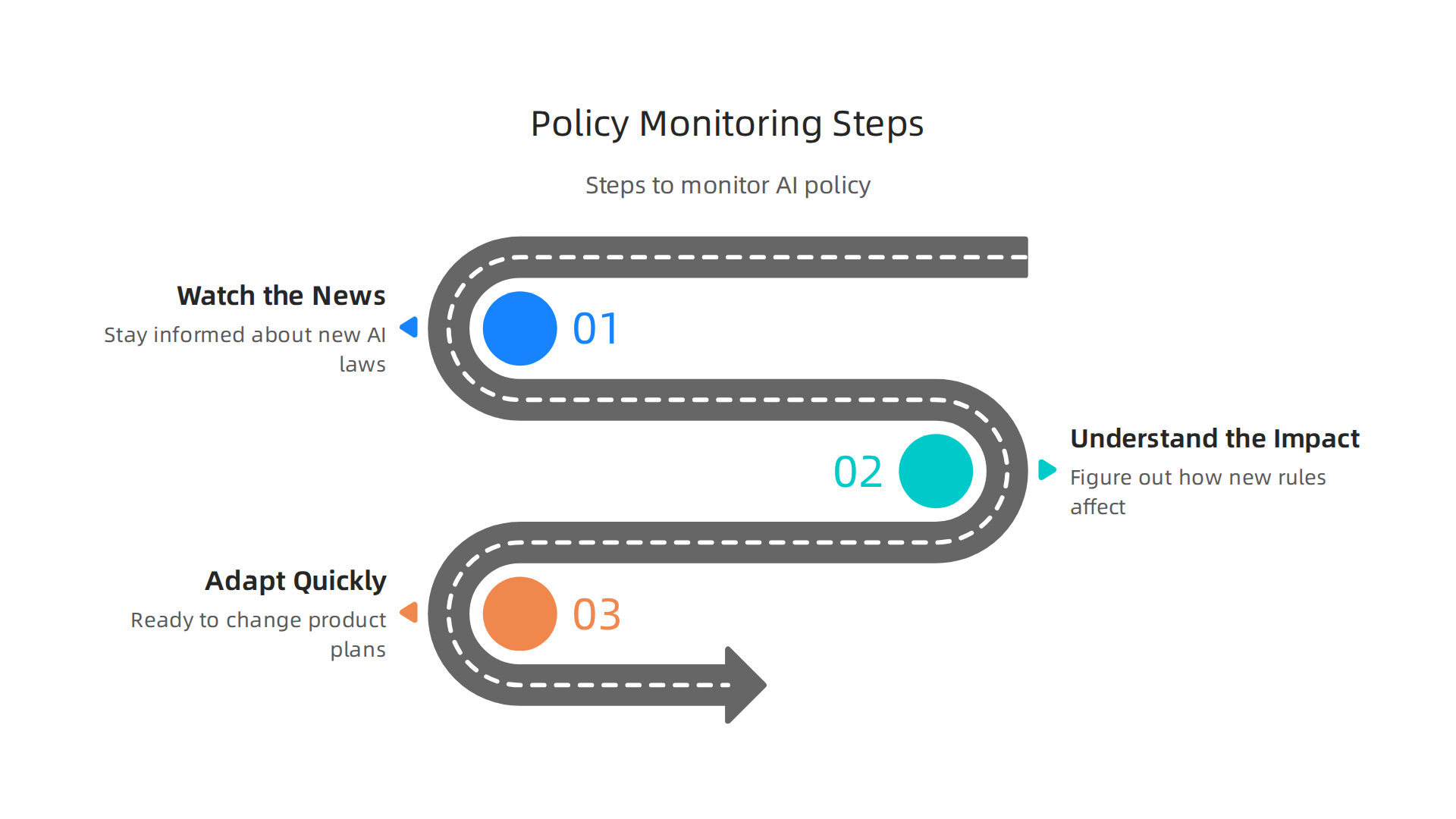
- Watch the News: Stay informed about new AI laws and proposed changes. The speed of AI regulation has picked up a lot, with many updates happening in 2025 and 2026 Governing AI in 2026.
- Understand the Impact: Figure out how new rules will affect your current products and your plans for the future. For example, some laws might limit how you use customer data with AI.
- Adapt Quickly: Be ready to change your product plans or how you enter new markets based on these rules. This helps you avoid legal trouble and keep your ai advantage.
By actively monitoring the regulatory landscape, your business can stay safe and find clever ways to use AI within the legal boundaries. This proactive approach helps an AI development company navigate regulation and opportunity in 2026. It makes sure your AI efforts are not just smart, but also responsible and compliant with the "new rules of AI" worldwide The New Rules of AI: A Global Legal Overview – May 2026.
Harmonizing cross-border compliance with product roadmaps
Now, let’s talk about how companies manage when AI rules are different in various places. This is a big challenge for businesses that want to sell their AI products all over the world. You might have an amazing new AI product, but if it’s okay in one country and not in another, you have a problem.
Companies need a smart way to decide which markets to focus on and what features to build. It’s like picking which roads to drive on when some have different speed limits. This careful planning helps a company keep its AI advantage. In 2026, the global AI regulation overview shows how quickly things are changing, making this planning even more critical 2026 AI Regulation Overview – Naaia.
When rules differ, businesses have two main paths:
- Launch as is (if possible): If the AI product meets the rules in a new market without changes, that’s great for speed.
- Adapt and then launch: More often, businesses need to change their product to fit local laws. This might mean removing a feature, changing how data is used, or even making the AI more explainable. This decision helps companies manage risks and avoids trouble down the road. For many, a 2026 AI Regulation Guide for Legal and Compliance Leaders helps make these tough choices.
For both big and small companies, knowing these options helps them move forward. It’s about balancing how fast you can get your product out there with making sure it follows all the rules. This helps ensure that even upcoming companies can grow safely in new regions. You can learn more about this balancing act in Navigating Global Tech Systems Policy in 2026.
To stay ahead of these changes and keep your strategy sharp, it is helpful to have easy access to the latest updates.
Get clear daily AI updates from The AI Newsletter Worth Reading.
To turn external policy knowledge into real action, companies need strong internal systems. This is what we call operational governance for AI. It’s about setting up rules, checks, and practices inside a company to make sure AI tools are used responsibly and follow all laws. This helps businesses, from a small smb business to larger companies that own other companies, keep their ai advantage by managing risks.
At its core, AI operational governance involves a few key parts:
- Policy and Legal Teams: These teams set the overall rules. They make sure that how the company develops and uses AI follows local and international laws. They also look at ethical guidelines. Understanding different AI Governance Frameworks Update is important for this.
- Technical Reviews: Engineers and AI experts check the AI systems themselves. They look for problems, biases, and make sure the AI works as expected. This helps ensure the technology is sound and safe.
- Risk Management: This part connects all the others. It’s about finding possible problems with AI, like privacy breaches or unfair decisions, and making plans to fix them before they happen. This includes working to manage risks, as outlined in a Unified Control Framework for risk management.
When these parts work together, they help build responsible AI. This means the AI is fair, open, and secure. This balance lets companies stay agile and quick while still being safe.
Practical Controls for Safer AI
To actually reduce business risk and protect your ai advantage, companies put in place clear controls, especially in three main areas:
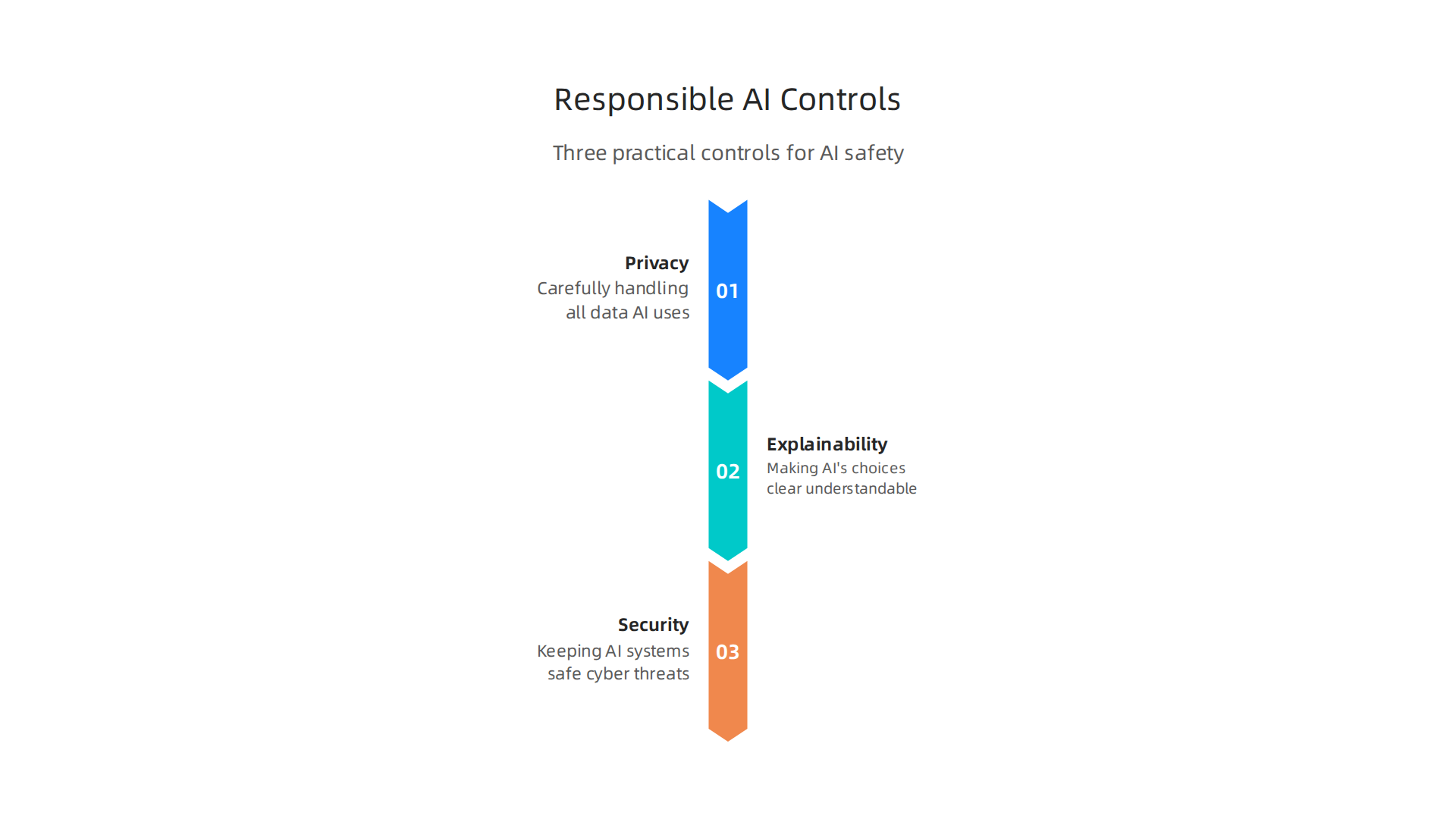
- Privacy: This means carefully handling all data that AI uses. Companies must make sure personal information is protected, anonymized when needed, and only used in ways that respect people’s privacy. For businesses, strong Data Governance Frameworks for AI Compliance are key. You can also explore how Privacy as the Foundation of Responsible AI Governance guides this work.
- Explainability: Sometimes AI makes a decision, but it’s hard to tell why. Explainability means making the AI’s choices clear and understandable. This is important for trust and for fixing errors.
- Security: Keeping AI systems safe from cyber threats is very important. This means protecting the data, the AI models, and the entire setup from attacks. Building AI securely and compliantly from the start is crucial, and you can learn more about how to build AI securely and compliantly. Proper Secure MLOps practices are essential for this.
By focusing on these practical controls, upcoming companies and established businesses alike can create AI that not only works well but also earns trust and meets all the rules. This careful approach helps avoid big problems and keeps your business moving forward responsibly.
Once a business has its AI systems running safely and following the rules, the next big step is turning that hard work into products that customers love.

This means figuring out how AI can make your offerings special and then telling people about it in a clear, honest way. This is how companies truly get an ai advantage in 2026.
Making Products Stand Out with AI
To really make a difference, businesses need to find key features for their products where AI can shine. Think about what makes your product better or different because of AI. This is called "differentiation." For example, AI can help products:
- Be More Personal: AI can learn what each customer likes and show them things they’re more likely to buy. Amazon, for example, uses AI to recommend products to its users based on their shopping habits, while Sephora’s Virtual Artist lets customers try makeup virtually and get advice, leading to more sales and engagement AI Business Use Cases in 2026 + Real-World Examples.
- Work Faster and Smarter: AI can automate tasks, making products quicker and easier to use. This can be a huge benefit for an
smb businessor even a largecompanies that own other companies. - Solve Problems Better: AI can analyze lots of information to find solutions or fix issues that people might miss. Walmart used AI to update huge amounts of product data, and Bank of America’s Erica chatbot cut service calls by half 8 Companies Proving AI Can Deliver Real ROI.
Finding these special AI features helps a company stand out in a busy market. It’s not just about having AI; it’s about using it in ways that solve real customer needs and offer unique value. Businesses can use AI to achieve dynamic product differentiation by identifying key goals and applying AI and analytics effectively Leveraging AI and Analytics for Dynamic Product Differentiation.
For more on developing unique AI products, explore AI in Product Development [10 Case Studies] [2026].
Telling Everyone About Your AI Advantage
Once you have great AI-powered products, the next step is to tell your customers, and even regulators, why they are special. This is your "go-to-market" strategy. It needs to be clear and trustworthy.
- Show, Don’t Just Tell: Instead of just saying "we use AI," show how it makes the product better. Give examples. Companies are using AI more and more in marketing campaigns to get real results AI Marketing Case Studies 2026: Real Examples, Real Results.
- Be Honest and Clear: If your AI has limits, be open about them. This builds trust. Regulators especially want to see that companies are transparent about how AI works.
- Focus on the Benefits: Explain how the AI helps the customer, not just what the AI does. Does it save them time? Money? Make their life easier?
For upcoming companies, getting this right can mean the difference between blending in and becoming a leader. It’s about showing that your AI is not just a demo, but a core part of what makes your product truly valuable. Understanding what makes a product stand out in the AI market is key to differentiation AI Product Differentiation: How to Stand Out in a Crowded AI Market. You can learn more about picking the right names and messages for your products by checking out Mastering Business Name Ideas For Brand Success In 2026.
By carefully designing products with AI and talking about them effectively, companies can keep their edge, build trust, and stay ahead in the fast-changing world of 2026. For a deeper dive into the most effective AI tools for strategic business development, explore this Top AI Tools 2026 Strategic Guide For Business And Policy Leaders.
Want to keep up with the latest in AI and technology policy?
The AI Newsletter Worth Reading
Building great AI products is only one part of the journey. To truly grow and keep an ai advantage, businesses often need to look beyond their own walls. This means working with other companies through partnerships, buying other businesses (called mergers and acquisitions or M&A), or using tools and services from outside vendors. These choices help companies scale their AI efforts effectively in 2026.
When to Build Versus Buy Your AI Tools
A big question for any business is whether to build AI features and tools themselves or to get them from outside. This "build versus buy" decision is important for an smb business and even for companies that own other companies. Here are some things to think about:
- What you’re good at: If your company already has skilled AI workers, it might make sense to build certain tools in-house. This gives you more control. However, if your team isn’t strong in AI, it could be faster and cheaper to buy a solution or partner with an expert. For more insights on how to secure your AI development, learn about how to build AI securely and compliantly.
- Time and money: Building something from scratch takes a lot of time and money. Buying an existing AI tool or company can speed things up. For example, an
upcoming companymight choose to buy a small AI startup instead of spending years developing the same technology. - Control and flexibility: Building your own AI gives you full control. But if you need a quick solution or want to try out new ideas without a huge investment, a partnership or vendor deal might be better. When thinking about big business changes like this, it’s wise to consider choosing the right business structure for your needs.
Sometimes, a pivot company might decide to buy another business that already has the AI they need. This can help them change direction quickly.
Smart Vendor Agreements for AI Growth
When a company decides to work with outside vendors for AI, the agreements they make are super important. These deals should allow the company to keep its options open and make sure everything follows the rules.
- Keeping options open: Technology changes fast. Your agreement with an AI vendor should let you switch to new technologies or partners later if you need to. You don’t want to be stuck with an old solution.
- Following the rules: AI comes with many rules about how data is used and how the AI makes decisions. Vendor agreements must clearly state how both sides will follow these rules. This helps with AI infrastructure 2026 navigating cost security and compliance while staying competitive.
- Data ownership: Be clear about who owns the data that the AI uses and creates. This is a big deal for privacy and future growth.
By thinking carefully about these partnerships and agreements, businesses can make sure their AI journey is strong and keeps them ahead. Learning how to navigate complex relationships is key, especially in mastering enterprise education partnerships to foster innovation.
When working with outside companies for AI tools, it’s super important to check them carefully. This is called vendor due diligence, and it helps businesses, from a small smb business to companies that own other companies, keep their ai advantage safe. Skipping these steps can lead to big problems later.
Vendor due diligence checklist for security, IP, and compliance
Before you pick an AI vendor, here’s a checklist of things to look for in their contracts and their technology:

-
Key Contract Terms:
- No Training Clause: Make sure your contract clearly says the vendor will not use your company’s data to teach their AI models. This is very important for keeping your information private and secure, as highlighted in an AI Vendor Due Diligence Checklist (2026).
- Data Ownership and Handling: The agreement must be clear about who owns the data used by the AI and how it will be stored, kept, and deleted.
- Privacy Rules: In 2026, there are many state privacy laws. Your vendor must show they can follow these rules to protect customer data. This includes proof of data processing agreements, as seen in advice for AI Vendor Risk and Multistate Privacy Diligence in 2026.
- Security Controls: The contract should require strong security measures like encrypting data and limiting who can see it.
-
Technical Assessments:
- Security Posture: Ask for proof of their security. Do they do regular checks to find weak spots? Do they encrypt data when it’s sitting still and when it’s moving?
- Compliance Documentation: They should have clear papers showing how they follow rules, like for data privacy or how they classify AI risks.
- Transparency: Can the vendor explain how their AI makes decisions? This is crucial for trust and understanding.
-
Red Flags to Watch For:
- Lack of Clear Answers: If a vendor can’t give clear answers about their data security or how their AI works, that’s a red flag.
- Vague Agreements: Contracts that are not clear about who owns data or how it’s used should be reviewed closely. For example, if you’re an
upcoming companyor apivot companymaking quick changes, clarity is king. - Missing Certifications: Ask if they have important security badges, like SOC 2 reports, which show they meet high security standards. For more details on checking AI systems, read about rigorous artificial intelligence review for policy compliance.
Staying on top of these checks helps you choose partners wisely and keep your business safe and thriving in the AI world.
To get clear daily AI updates and help you navigate the complex landscape of technology regulation, consider subscribing to The AI Newsletter Worth Reading.
After checking external partners, we also need to look at our own teams. To truly gain an ai advantage, a company needs the right people and the right way of working together. This is important for every kind of business, from a small smb business to companies that own other companies.
Talent, organizational design, and change management for AI-first teams
For businesses to really use AI well, they need strong teams. This means setting up groups that can work across different areas, like engineers, data experts, and people who understand the business. These "cross-functional" teams can help build AI products faster. Thinking about how to build AI models safely and securely is a big part of what these teams do, as outlined in the Secure AI Model Ops – OWASP Cheat Sheet Series.
Keeping good people is key. Companies need to make sure their best AI talent wants to stay. This might mean offering good projects, fair pay, and a helpful work environment. It also means helping staff learn new skills. The world of AI changes fast, so ongoing learning, called upskilling, is very important. This keeps everyone up-to-date and helps the company stay ahead.
When it comes to hiring, businesses should look for people who not only have AI skills but also fit into a team that’s always learning and changing. For an upcoming company or a pivot company that needs to adapt quickly, finding the right talent can make all the difference. It’s about building a workforce that can handle new AI tools and ideas. If you are planning to build your 2026 AI workforce strategy for policy compliance, it means thinking about how new rules affect the skills your team needs.
The way AI tech jobs in 2026 reshape hiring skills and regulations is always changing, so companies must keep up. By focusing on smart team setups, keeping good people, and always teaching new skills, businesses can make sure they hold onto their ai advantage for a long time.
Once a business has its expert AI teams in place, the next big question is: how do we know if all this AI work is actually helping? This is where measuring things like ROI and KPIs comes in. ROI means "Return on Investment," which just asks if the money you put into AI is coming back to you, plus some extra. KPIs are "Key Performance Indicators," which are like scorecards that show if you are hitting your goals. For any company, big or small, understanding these numbers is key to knowing if your ai advantage is real.
Practical Ways to Measure AI Success
Measuring how well your AI is doing happens in steps. It changes from when you first try out an AI tool to when it’s fully running in your business.
1. For Early Tests (Pilots):
When you first try an AI idea, you are checking if it even works. At this stage, you might look at:
- How many people try it? Are employees or customers willing to use the new AI?
- Does it do what it’s supposed to? For example, if it’s an AI that helps write emails, does it save time or make the emails better?
- What do users think? Get feedback on if the AI is easy to use and helpful.
- A framework for measuring AI impact suggests tracking metrics related to how many employees are experimenting with AI and their participation in AI events and training during the exploring phase of an AI project Stop guessing at AI ROI: A four‑stage framework for real ….
2. As You Grow (Scaling Adoption):
If a pilot works well, you’ll want more people to use it. Here, you look at:
- How many people are actively using it? Not just trying it once, but using it often.
- Is it saving time or money? Can you see clear improvements in how quickly tasks are done or how much money is spent?
- How deep is the use? Are people using all the features of the AI, or just a little bit? For example, Measuring AI Adoption: Metrics for Business Impact in 2026 talks about tracking active users as a percentage of licensed seats and task-level time savings.
3. After It’s Fully Running (Post-Deployment):
Once AI is a regular part of your business, you want to see the big picture impact. This is where the real ROI comes in.

- Money Saved: Is the AI reducing costs? Maybe it cuts down on needing to hire more people for certain tasks, or it finds cheaper ways to do things.
- Money Earned: Is the AI helping to bring in more sales or find new customers?
- Better Decisions: Is the AI helping leaders make smarter choices that lead to more success?
- Companies should focus on financial outcomes, operational metrics, and how people behave with the AI to truly measure its value, as outlined in one AI ROI framework for 2026. This applies whether you are an smb business or one of the companies that own other companies.
Setting Goals for Investors and Boards
When you talk to investors or your company’s board, they want to see clear results. You need to show them how AI helps the business grow or saves money. This means connecting your AI projects to big business goals like:
- Making more money: How much extra revenue will this AI bring in?
- Cutting costs: How much will this AI save us each year?
- Making customers happier: Will AI improve customer service scores or loyalty?
- Getting products out faster: Will AI speed up how quickly we can create new things?
For example, a CFO’s dashboard for measuring AI ROI in 2026 might include metrics like reducing how long it takes to close the books, saving hours on processing tasks, and improving how accurate forecasts are AI Automation ROI Benchmark Report 2026. These kinds of clear numbers help show the value of AI. Whether you are a pivot company changing direction or an upcoming company trying to make a mark, being able to show real value from your AI efforts is essential for getting support and funding. To dive deeper into how policies shape businesses, consider:
The AI Newsletter Worth Reading
The previous section talked about seeing if your AI efforts are working right now. But what about tomorrow? The world of AI is always moving fast. New rules come out, technology changes, and what customers want can shift. To truly keep an ai advantage, businesses need to look ahead. This means planning for different futures and keeping a close eye on what’s happening.
One smart way to do this is called "scenario planning." Imagine you’re writing a few different stories about your business’s future. One story might be if new AI laws make things harder. Another might be if a new technology suddenly makes your AI much stronger. And a third could be if customer needs change completely. By thinking about these different "what if" situations, you can get ready for them. This helps you navigate big shifts in policy, market signals, and how technology is adopted Navigating the 2026 Tech Exchange Policies Market Signals and Strategic Adaptation. This kind of planning is key for any company, even a pivot company that is changing its path.
Beyond just planning for what might happen, it’s also important to watch what is happening right now. This is called "horizon scanning." Think of it like looking out for early signals of change. New laws about AI are coming out all the time in 2026, both in the US and around the world, as explored in the report Governing AI in 2026. By setting up a simple way to track these changes, you can spot new rules or important tech trends early on. For example, the EU’s AI Act | Shaping Europe’s digital future is becoming a major force, and other regions are following suit. This early warning system helps you turn small signals into big, smart choices for your business. It allows you to adjust your plans before changes become problems.
Putting these two ideas together, scenario planning and horizon scanning, gives businesses a huge ai advantage. It means you’re not just reacting to what happens, but actively shaping your future. This approach helps all kinds of businesses, from upcoming companies trying to make their mark to bigger businesses. It ensures that your AI investments always align with what the future might hold, helping you stay competitive and safe. For a deeper look at the rules, check out this Tech Policy 2026: Global Comparison of AI Regulations Across the US, EU, China, and Beyond. Understanding the wider AI Policy & Regulatory Landscape 2026 is no longer an option, it’s a must.
After looking ahead and planning for different futures, the next step is to put those ideas into action. Knowing what might happen is only half the battle; actually doing something about it is how businesses truly build an AI advantage. This calls for a clear plan, like a 90-day playbook, to turn strategy into real results.
From strategy to action: a 90-day playbook to start building AI advantage
A 90-day playbook helps businesses, big or small, move quickly from thinking to doing. It is all about setting up smart goals and taking small steps that add up to big wins. This plan covers reviewing rules, picking pilot projects, setting up guidelines, and measuring success.
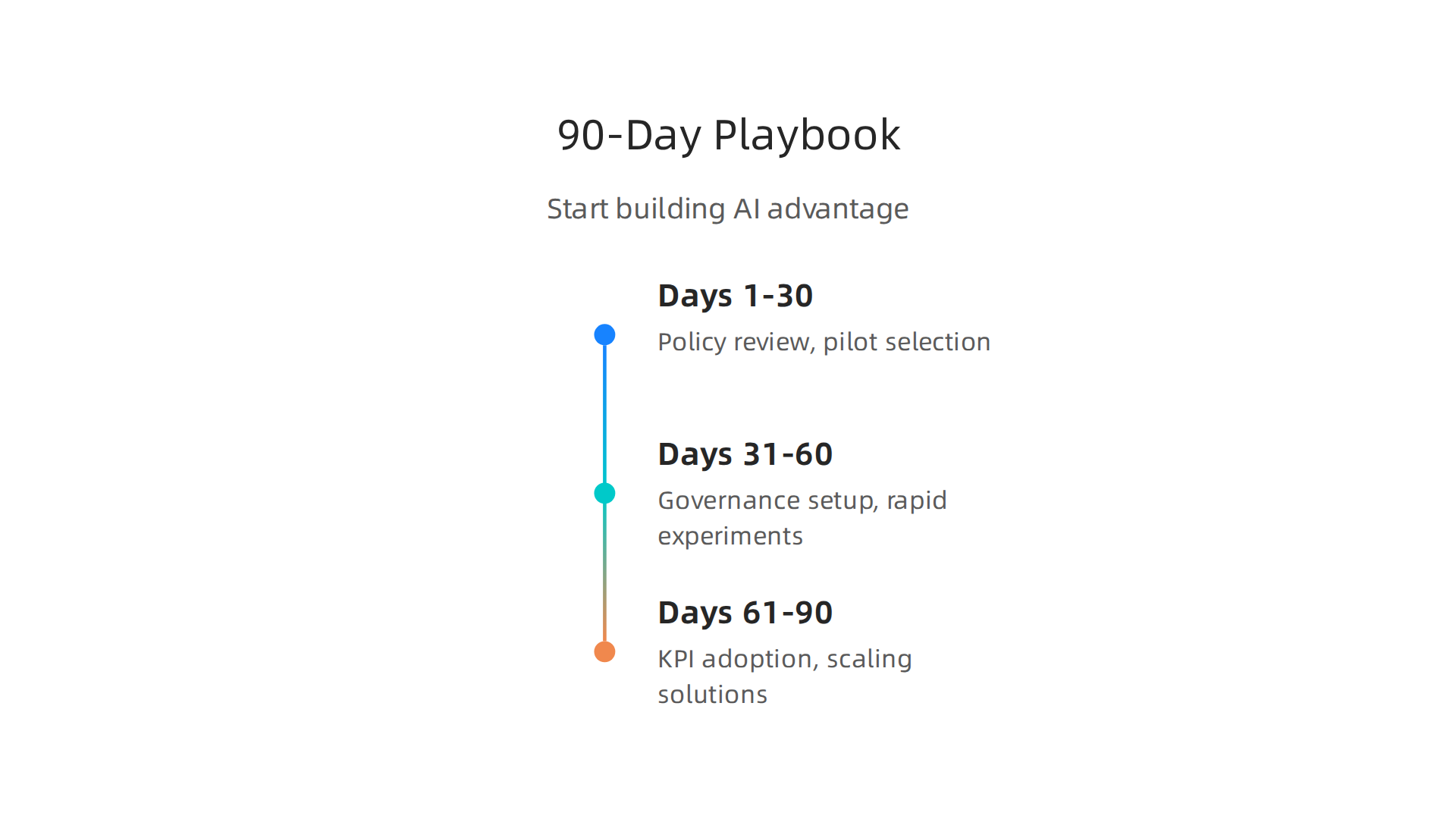
Days 1-30: Policy Review and Pilot Selection
Start by quickly reviewing important AI policies that might affect your work. This builds on the idea of horizon scanning from earlier, making sure your plans align with the latest laws. After that, choose a small, focused AI project to test. Think of it as a pilot project. This could be for an smb business looking to automate customer service or an upcoming company wanting to make their product smarter. The goal is to pick something with a clear problem to solve and a good chance to show real value. Companies like Walmart and Bank of America have shown AI can deliver real returns on investment even in early stages, boosting customer satisfaction and cutting service calls by a lot, as highlighted in "8 Companies Proving AI Can Deliver Real ROI" from Forbes in 2026.
Days 31-60: Governance Setup and Rapid Experiments
With your pilot project in mind, set up some basic rules for how your AI will be used. This is called governance, and it makes sure your AI is fair, safe, and works as it should. It is a key part of building AI Agent Governance. For a deeper dive, "The ROI of AI Governance: A 2026 Executive Playbook" offers a great framework for this step. Next, run rapid experiments. This means testing your AI idea quickly, learning from the results, and making changes fast. This approach helps you learn what works and what does not without risking too much time or money, effectively helping to de-risk your investments. You are essentially testing your guesses and making sure they are correct.
Days 61-90: KPI Adoption and Scaling
The last part of the playbook is about measuring how well your AI pilot worked. You will do this by looking at Key Performance Indicators (KPIs). These are clear ways to see if your AI project is meeting its goals, like saving time or making customers happier. For useful ways to measure AI success, refer to "Stop guessing at AI ROI: A four‑stage framework for real …" from Atlassian. If your pilot project is a success, you can then think about how to grow it. This might mean making the AI available to more people in your company or even sharing it across different companies that own other companies in a larger group. Even a pivot company can use these findings to guide its next big move, ensuring every step is backed by real data.
By following this 90-day playbook, any business can start its journey to an AI advantage with clear steps and measurable outcomes.
For even more detailed insights and daily updates on AI and technology policy, consider joining our community.
The AI Newsletter Worth Reading
Summary
AI advantage is the strategic priority for business leaders in 2026 because rapid technological progress and shifting regulation create both major opportunities and risks. This article defines what an AI advantage looks like—defensibility, speed to market, customer value, and cost efficiency—and explains how to measure it with KPIs and ROI at pilot, scale, and post‑deployment stages. It outlines the changing global regulatory landscape and shows how to operationalize policy monitoring, cross‑border compliance, and internal governance (privacy, explainability, security). The guide covers product differentiation, go‑to‑market messaging, build‑versus‑buy decisions, vendor due diligence, and how to structure AI talent and teams. It also recommends scenario planning and horizon scanning to future‑proof strategy, and provides a practical 90‑day playbook to move from strategy to measurable action. Read it to learn how to turn AI capabilities into a defensible, compliant, and scalable competitive edge.