

Introduction: Why AI Literacy Is Now a Policy Imperative
If you work in policy, you have probably noticed something. The conversations around you have changed. Your colleagues are talking about training data, model bias, and inference. Lawmakers are debating rules for systems that did not exist five years ago. And every week brings a new headline about AI in government, defense, or public services.
The reason is simple. AI and machine learning are no longer niche technologies. They are reshaping industries, governments, and entire societies. In 2026, the OECD reported that 97 percent of its member countries now use AI in at least one area of government. Even the definition of what counts as an AI system keeps evolving. The OECD recently updated its definition, a move that is shaping new laws around the world. You can learn more about the OECD AI definition update and how it affects EU regulation.
For policy professionals, the learning curve is steep. AI systems come with their own language, risks, and rules.

To make sound decisions on privacy, national security, or market competition, you need more than surface level knowledge. You need an AI toolkit of core concepts. You need to know when AI was invented and how it got here. Every day, regulators face choices about AI systems that can affect millions of people. Without a solid grasp of the basics, those choices become guesses.
This guide covers the essential concepts and regulatory context you need in 2026. We will look at how different countries define AI, what the latest OECD guidance says, and how new rules like the EU AI Act are changing the game for everyone involved.
Understanding AI is no longer optional. From national security to privacy, the ability to parse AI issues has become a core job skill.
For a broader view, check out this global comparison of AI regulations across the US, EU, China, and beyond.
And if you want to stay ahead of daily changes, The AI Newsletter Worth Reading delivers clear updates straight to your inbox.
What Are AI and Machine Learning? Core Definitions and Concepts
Let us start with a simple way to think about this. Artificial intelligence is the big umbrella. It covers any machine that can perform tasks we normally think of as needing human smarts. Things like understanding speech, making decisions, or recognizing a face.
Machine learning is a smaller, very important slice under that umbrella. Instead of giving a computer step-by-step rules, you give it lots of examples. The machine finds patterns on its own. Over time, it gets better at its job without a human rewriting the code.
Think of it like teaching a child to identify cats. You do not give them a biology textbook. You show them lots of pictures. Eventually, they figure out the pattern. That is what machine learning does, just with data instead of photos.
The Main Ways Machines Learn
Most machine learning falls into three buckets. Each one works differently and solves different problems.
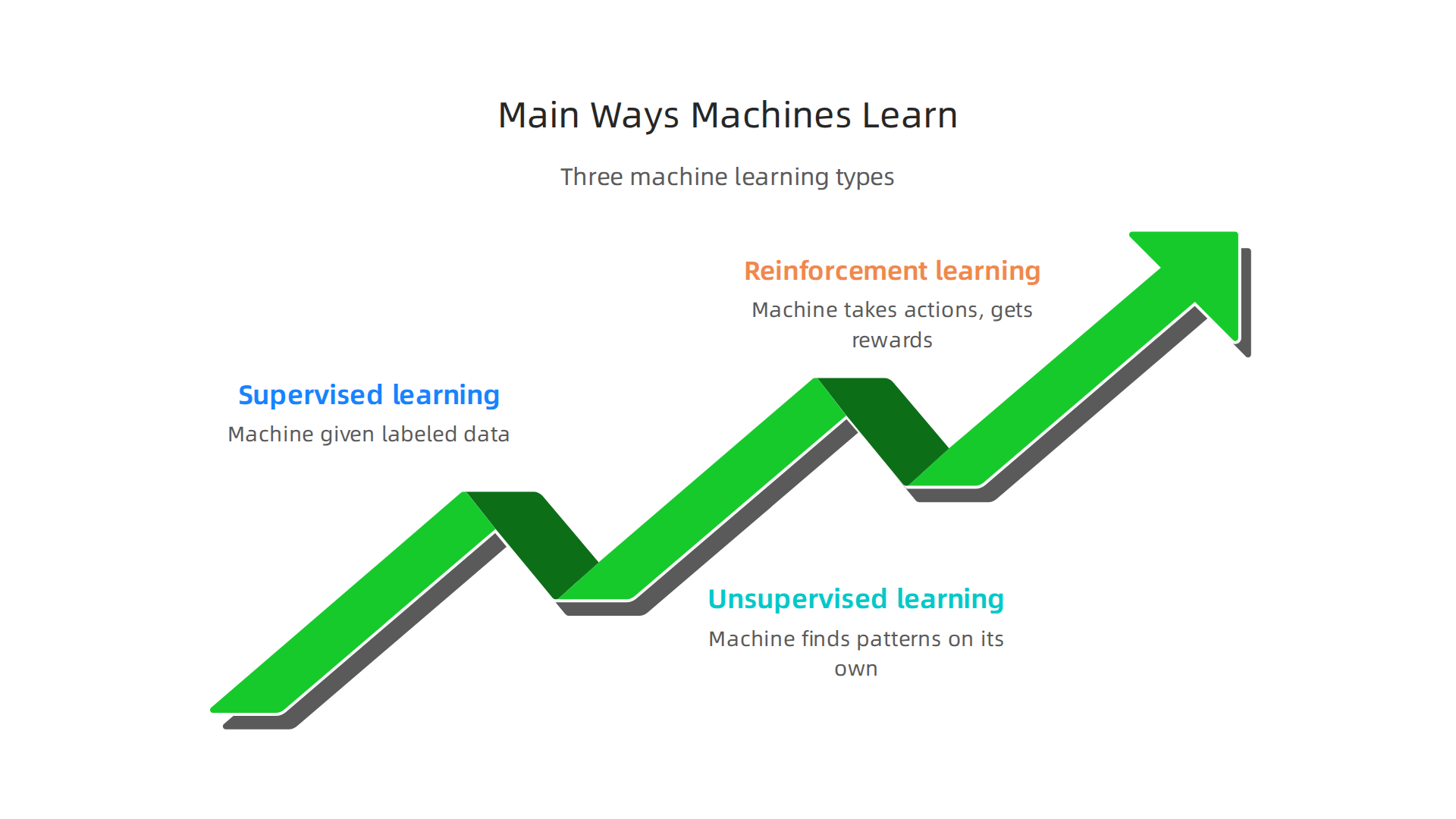
Supervised learning. This is the most common type. You give the machine labeled data. For example, you show it thousands of emails marked "spam" or "not spam." It learns the pattern and can then flag new emails. Governments use this for things like detecting fraud in tax returns or sorting public comments on new rules.
Unsupervised learning. Here, the machine gets no labels. It must find patterns on its own. Imagine you give it customer records without telling it anything. It might group people who buy similar products. Policymakers use this to spot unusual activity in financial systems or to cluster regions with similar health needs.
Reinforcement learning. This one works like training a dog. The machine takes actions and gets rewards or penalties. Over many tries, it figures out the best way to get the most rewards. Self-driving cars and game-playing AIs use this approach.
You can read a detailed breakdown of these techniques and how they map to regulation in this global AI trends analysis.
Terms You Will Hear in Every Policy Debate
Neural networks are computing systems inspired by the human brain. They use layers of connected nodes to process information. When you stack many layers together, you get deep learning. That is what powers most modern breakthroughs.
Natural language processing (NLP) is what lets machines read, write, and understand human language. Think of your email’s smart reply suggestions or a chatbot that answers citizen questions.
Large language models (LLMs) are the stars of 2026. These are deep learning models trained on enormous amounts of text. They can write essays, summarize laws, and even generate code. Models like GPT-4 and its successors are the foundation for many government and business AI tools.
The OECD defines an AI system as "a machine-based system that, for explicit or implicit objectives, infers, from the input it receives, how to generate outputs such as predictions, content, recommendations, or decisions that can influence physical or virtual environments." This definition, adopted in 2023, is the baseline for most new regulations. You can find the full text in the OECD legal instrument.
Why This Matters for Policy Work
When you hear a lawmaker talk about regulating AI, they are usually talking about machine learning systems. Understanding the difference between supervised and unsupervised learning helps you grasp why some models are more transparent than others. Knowing what an LLM is helps you understand debates around disinformation, copyright, and election security.
If you want to build on these fundamentals, check out this roadmap for learning AI in 2026. It lays out the next steps for anyone in policy who wants to go deeper.
In the next section, we will look at how different countries actually define AI in their laws and why those differences matter for international cooperation.
The Business Impact of AI and ML: Why Executives and Investors Must Pay Attention
The numbers are hard to ignore. In 2026, AI is no longer a future prediction. It is happening right now, and it is reshaping entire industries.
According to the 2026 AI Index Report from Stanford HAI, organizational adoption of AI reached 88% in 2025.

That is almost nine out of every ten companies. Private AI investment in the United States hit $285.9 billion. To put that in perspective, that is more than 23 times what China invested.
But here is the thing. Not everyone is winning.
The Winners and the Rest
A PwC study from 2026 found that nearly three-quarters of AI’s economic value goes to just one-fifth of organizations. That is a stunning gap. A small group of AI leaders is pulling ahead while most companies stay stuck in pilot mode.
What do the winners do differently? They move fast. They invest in the right tools and the right people. They do not just layer AI on top of old processes. They redesign how work gets done.
Where AI Is Making the Biggest Dent
Let us look at three sectors where AI is changing the game.
Healthcare. AI is helping doctors read scans faster and more accurately. It is predicting patient outcomes and personalizing treatment plans. Hospitals that adopted AI early are seeing better patient results and lower costs.
Finance. Banks use AI to catch fraud in real time. Investment firms use it to spot market trends. The speed of analysis has jumped dramatically. What used to take days now takes minutes.
Manufacturing. Factories use AI to predict when machines will break down. They optimize supply chains and reduce waste. The NVIDIA State of AI Report shows that 42% of companies list optimizing AI workflows as their top spending priority in 2026.
The same report found that 88% of businesses say AI has increased annual revenue. Nearly a third saw a jump of more than 10%. And 87% say AI helped reduce costs.
The Hard Truth About Jobs
Here is where it gets complicated. AI is great for productivity, but it also displaces workers. A detailed analysis of AI’s impact on the US economy shows that 55,000 to 120,000 jobs may be lost in 2026 alone because of AI. The economy is still growing, but the gains go to capital owners first. Workers feel the pain later.
Goldman Sachs estimates that about 63% of US work hours are exposed to AI. And 25% to 50% of tasks could be automated directly. That is a lot of change in a short time.
The World Economic Forum’s blueprint for the AI workforce says that 1.1 billion jobs could be transformed by technology over the next decade. But they also say AI can create more jobs than it displaces. The catch? Companies must invest in people and redesign work, not just add AI on top.
If you want to dive deeper into how job shifts are playing out, check out this analysis of AI job displacement statistics and the policy roadmap for 2026.
What This Means for Leaders
If you are an executive or an investor, the message is clear. AI is not optional anymore.

The gap between leaders and laggards is growing fast. You need a strategy that covers both the upside and the downside.
The upside is huge. Productivity gains, cost savings, new revenue streams. The downside is real too. Workforce disruption, regulatory risk, and the danger of falling behind.
The smartest leaders in 2026 are the ones who look at the whole picture. They invest in AI, but they also invest in people and policy.
If you want to stay ahead of these trends without getting lost in the noise, The AI Newsletter Worth Reading delivers clear daily updates straight to your inbox. It is built for busy professionals who need to know what matters and what does not.
Regulatory Landscape for AI: A Global Overview in 2026
AI and machine learning are not just changing business. They are changing how governments regulate technology. In 2026, the global rulebook for AI is taking shape. And it is happening fast.
The biggest story is the EU AI Act. This is the world’s first comprehensive AI law. It entered into force in August 2024, but most rules hit companies starting in August 2026. That date is here now. Under the EU AI Act regulatory framework 2026, the law uses a risk-based system.

If your AI system is low risk, you have fewer rules. If it is high risk, you face strict requirements for data governance, human oversight, and transparency.
Some AI uses are banned outright. Things like social scoring, harmful manipulation, and emotion recognition in workplaces. Those bans came into effect in February 2025. Now in 2026, the next big wave of rules applies to high-risk systems. Companies must complete conformity assessments, affix CE markings, and register in an EU database by August 2. As explained in a detailed what is the EU AI Act overview, fines can reach 35 million euros or 7% of global annual turnover. That is serious money.
Transparency is a huge part of the EU AI Act. Article 50 requires that users know when they interact with AI. Chatbots, virtual assistants, and generative AI tools must clearly label their outputs. The EU AI Act transparency rules for Article 50 apply to all AI systems in four situations: direct interaction, synthetic content, emotion recognition, and deepfakes. This means if your company uses AI to create text, images, or audio, you must mark it. Deadlines start August 2026, with a small extension for existing systems until December 2026.
Different Paths in Different Countries
The EU is setting the pace, but other major players are taking their own routes.
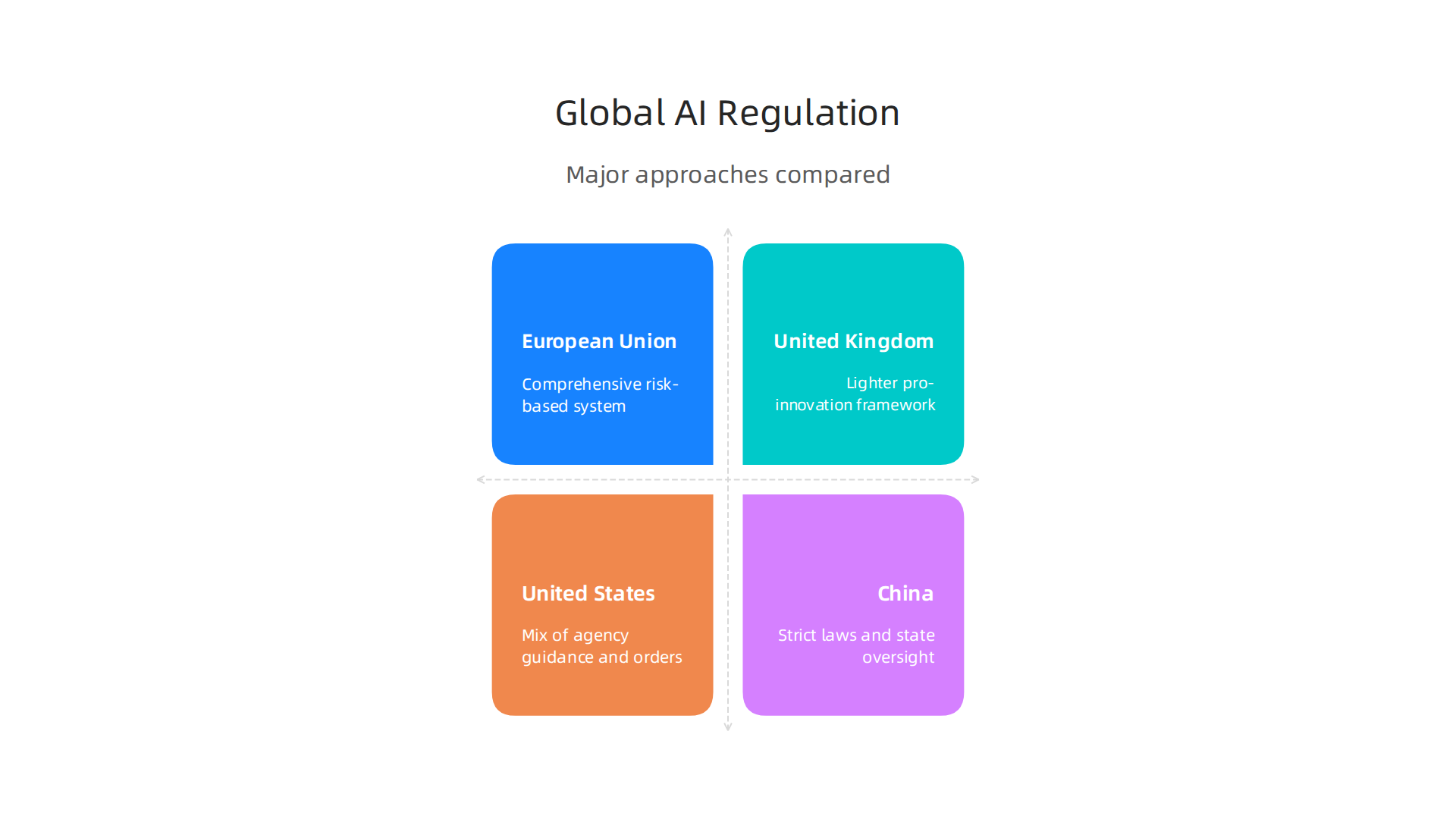
The United Kingdom has chosen a lighter approach. It uses existing regulators across sectors to oversee AI, rather than a single new law. The UK government calls this a pro-innovation framework. Companies operating there need to follow guidance from regulators like the Information Commissioner’s Office and the Competition and Markets Authority.
The United States has no federal AI law yet. Instead, it relies on a mix of executive orders, agency guidance, and sector-specific rules. The White House has pushed for voluntary commitments from major AI companies. Meanwhile, states like California and Colorado are enacting their own AI laws. This patchwork makes compliance tricky for businesses that operate across state lines.
China takes a different path. It has strict laws for generative AI, deep synthesis, and algorithmic recommendations. The Chinese approach favors state oversight and control. Companies must register their AI models and pass security assessments before releasing them to the public.
For anyone working in policy or compliance, understanding these differences is critical. The same AI tool might need very different documentation in Brussels versus Beijing. If you want a deeper look at how rules compare across regions, check out this global comparison of AI regulations across the US, EU, and China.
What This Means for Policy Professionals
The message is clear. Regulation is not coming. It is already here. Companies that wait until the last minute to comply risk heavy fines and reputational damage. The smartest move is to start classifying your AI systems now, map them to risk categories, and build compliance into your product development cycle.
The EU AI Act’s deadlines for high-risk systems are active. August 2026 is the key date. If you are not ready, the penalties are steep. And regulators are watching.
Understanding AI Governance and Ethics: From Principles to Practice
Rules are only half the picture. Knowing what the law says is important. But knowing how to actually build AI that is fair, accountable, and transparent is where the real work happens. That is the difference between compliance and governance.
Governance is the system of policies, processes, and people that guide how AI is built and used. Ethics is the set of values that sits underneath it. In 2026, companies are finally moving from talking about principles to putting them into practice.
From High-Level Values to Operational Frameworks
For years, companies published AI ethics statements full of nice words like fairness, transparency, and accountability. But a values page on a website does not prevent a biased algorithm from harming real people. What does is a structured framework that turns those values into concrete actions.
The most widely adopted tool for this in 2026 is the NIST AI Risk Management Framework (AI RMF). Published by the U.S. National Institute of Standards and Technology, this framework gives organizations a repeatable process for managing AI risks. As explained in a detailed NIST AI Risk Management Framework overview, it is built on four core functions: Govern, Map, Measure, and Manage.
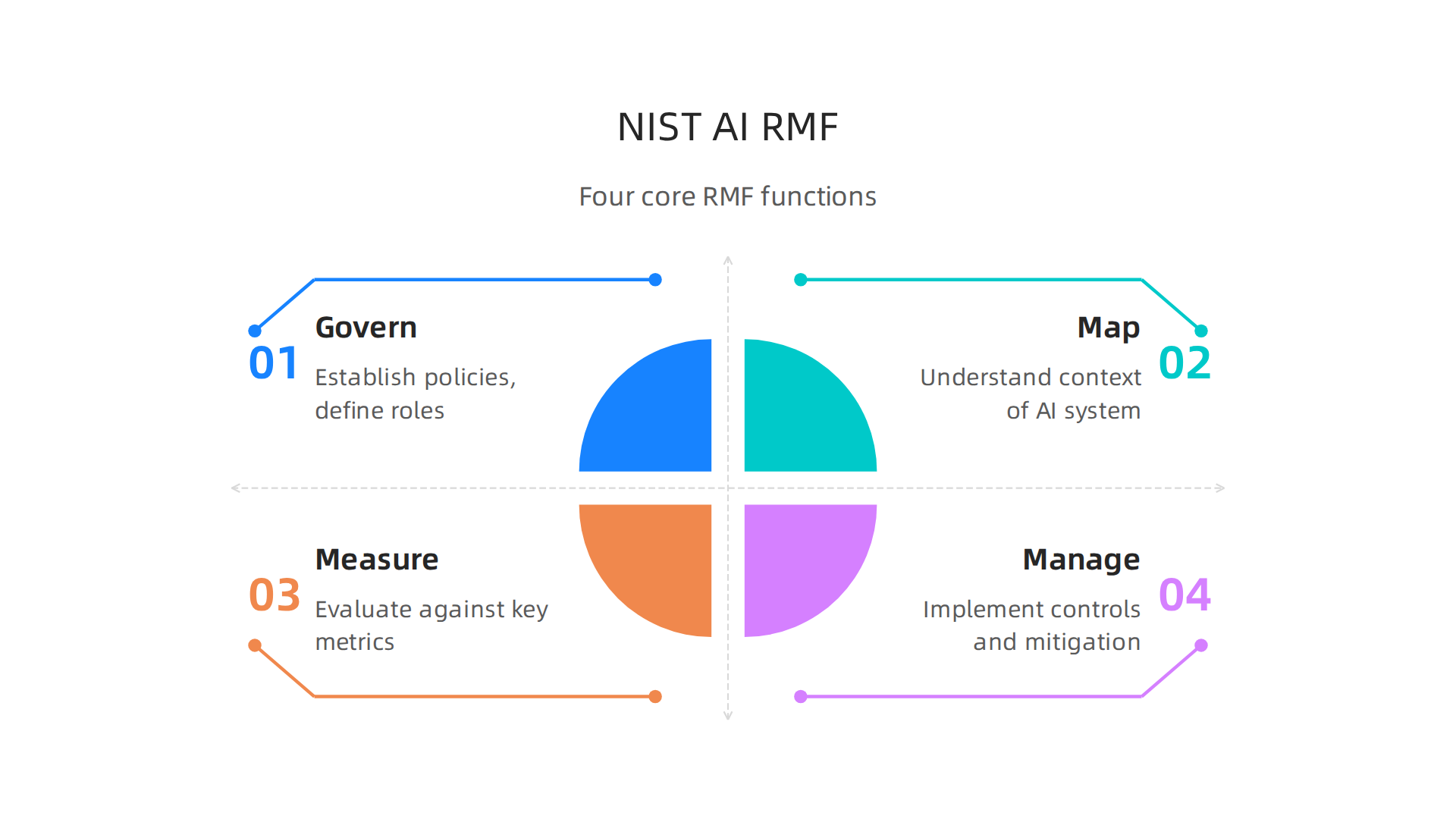

The Govern function is where ethics becomes operational. It requires organizations to establish clear policies, define roles and responsibilities, and set risk tolerance levels. Without this foundation, the other three functions have no direction. A team that has not defined what "fair" means for their specific use case cannot measure whether their AI is actually fair.
The Map function helps teams understand the context of their AI system. Who will use it? Who might be harmed by it? What data is it trained on? The Measure function then evaluates the system against concrete metrics for accuracy, bias, reliability, and transparency. Finally, the Manage function puts controls in place to address the risks that were identified.
The Hardest Problems: Bias, Explainability, and Oversight
Even with a good framework in place, three challenges keep coming up.
Algorithmic bias is the most visible. An AI system that screens job applications might favor one demographic group over another. A facial recognition tool might work well for lighter skin tones but fail for darker ones. The root cause is almost always in the training data. If the data does not represent the real world, the AI will not either. Fixing this requires ongoing testing, diverse datasets, and a willingness to retrain models when bias is found.
Explainability is another tough one. Many of the most powerful AI models are black boxes. They produce accurate outputs, but nobody can fully explain how they got there. This is a problem when regulators ask you to justify a decision. In high-stakes areas like healthcare, lending, and criminal justice, the ability to explain why an AI made a particular recommendation is not optional. It is a legal and ethical requirement.
Human oversight ties it all together. No AI system should run completely on its own in situations that affect people’s rights or safety. The EU AI Act requires human-in-the-loop checkpoints for high-risk systems. But good governance goes beyond what the law requires. It means having real humans who understand the system, can override its decisions, and are accountable for its outcomes.
Building Governance Structures That Last
Companies that take AI governance seriously are building dedicated structures to manage it. The most common approach is an AI ethics board or oversight committee. These groups include people from data science, legal, cybersecurity, risk management, and sometimes outside experts. They review new AI use cases before deployment, investigate incidents when something goes wrong, and update policies as the technology evolves.
Internal review processes are also becoming standard. Before any AI system goes live, it goes through a staged review. First, the team documents the system’s purpose, data sources, and intended users. Then they run bias tests and security checks. Finally, a governance board signs off before deployment. This takes time, but it catches problems early when they are cheap to fix.
For a deeper look at how these governance structures are evolving alongside the technology, check out this analysis of governance challenges of new AI trends.
What This Means for You
The message is simple. Ethics is not a separate thing from your AI. It is the thing. If you wait until after deployment to think about bias, explainability, or oversight, you are already behind. Build governance into your process from the start. Classify your systems. Measure your risks. Put humans in the loop.
And stay informed. The landscape is shifting every week. If you want to keep up without drowning in noise, there is one resource that cuts through the clutter. Get clear daily AI updates from The AI Newsletter Worth Reading. It delivers the insights you actually need, straight to your inbox.
Building AI Literacy for Policy and Legal Teams: A Practical Roadmap
You are sitting in a meeting. The engineering team is talking about fine-tuning a large language model. Someone mentions vector databases and retrieval-augmented generation. Your policy director looks at you with a question in their eyes. Neither of you knows what those words mean.
This happens more than you think. In 2026, the gap between what AI can do and what most policy and legal teams understand about it is still huge. The 2026 NVIDIA State of AI Report found that the top barrier to AI adoption is a lack of AI experts across organizations. Not technology. Not budget. People.
If your team cannot talk about ai and machine learning basics with confidence, how can you govern it? How can you spot risk? How can you write rules that actually work?
The answer is simple. You cannot. So let us walk through a practical roadmap to fix that.

Start with a Baseline Assessment
Do not guess what your team knows. Measure it. Send out a short survey. Ask questions like: What is training data? What is a model? When was AI invented in its modern form? You might be surprised by the answers.
Some people will know nothing. Others will surprise you with deep knowledge. The point is to find the starting line for each person. That way you do not waste time teaching things people already know or skip things they need.
Identify the Critical Domains
Not every policy professional needs to learn how to build a neural network. But everyone needs to understand the basics that affect their work. Break your training into focus areas:
- AI fundamentals: How models learn from data and make decisions
- Bias and fairness: Why biased data creates biased outcomes
- Explainability: How to ask for and understand model explanations
- Legal frameworks: How regulations like the EU AI Act apply to real systems
- Security and risk: How AI tools can be attacked or fail under pressure
Map each role to the domains that matter most. A privacy lawyer needs the fundamentals and legal frameworks. A policy analyst working on ethics needs bias and explainability. Match the training to the job.
Assign Learning Champions
Do not try to make everyone an expert. That is not realistic. Instead, pick one or two people who are naturally curious about AI. Give them time and resources to go deep. Let them become the go-to resource for the rest of the team.
These champions can run lunch-and-learn sessions, answer questions in Slack, and keep everyone updated as the field changes. They are your internal engine for building literacy over time. A full guide on how to learn AI and build a future-ready career can help you get them started.
Use the Best Free Resources Available
You do not need a big training budget. Some of the best AI courses in the world cost nothing. The University of Helsinki offers Elements of AI, a six-hour course designed for complete beginners. Google AI Essentials teaches practical workplace skills. Both require zero technical background.
For teams that want to go deeper, platforms like Coursera and DeepLearning.AI offer specialized courses on prompt engineering, model evaluation, and AI safety. Many can be audited for free.
There are also free options designed specifically for professionals. The list of best free AI courses for beginners in 2026 covers everything from the basics to more advanced topics. Share this with your team and let them choose their own path.
Make Learning a Habit
A single workshop will not change anything. The teams that build real AI literacy are the ones that make learning a habit. Set up a weekly reading group. Share one article every Friday. Discuss how it applies to your work. Over time, these small habits compound into real expertise.
An AI toolkit does not sit on a shelf. It lives in the minds of your people. The teams that invest in literacy today will be the ones writing the rules tomorrow.
Summary
This guide explains why AI literacy is now essential for policy, legal, and compliance professionals and gives a practical path to get there. It defines core concepts—AI, machine learning, supervised/unsupervised/reinforcement learning, neural networks, NLP, and large language models—and shows why those distinctions matter for regulation, procurement, and oversight. The article surveys business impacts and workforce shifts, summarizes the 2026 regulatory landscape with a focus on the EU AI Act and international differences, and translates ethics and governance frameworks into operational steps. It outlines how to assess team knowledge, assign learning champions, apply the NIST AI RMF functions, and run staged internal reviews to catch bias, explainability, and oversight problems early. Readers will finish with a clear checklist for classifying systems, meeting imminent compliance deadlines, and a roadmap of practical training resources to build durable AI literacy across their organization.