

Why ‘Death Clock’ AI matters now: scope, stakes, and what this article will deliver
Imagine a computer program that could guess how long you might live. This idea, often called "death clock AI," is becoming a big topic in 2026. A "death clock calculator" is a special kind of program. It uses your personal information, like your age or health data, to guess your lifespan and when you might pass away Death clock calculator – Wikipedia. While this might sound like science fiction, these kinds of tools are real. They bring up many questions about fairness, privacy, and who is in charge of such powerful technology.

This is why death clock AI is now a big deal for people who make rules and lead companies.
Leaders in business, law, and government are watching death clock AI very closely. They worry about several big things:
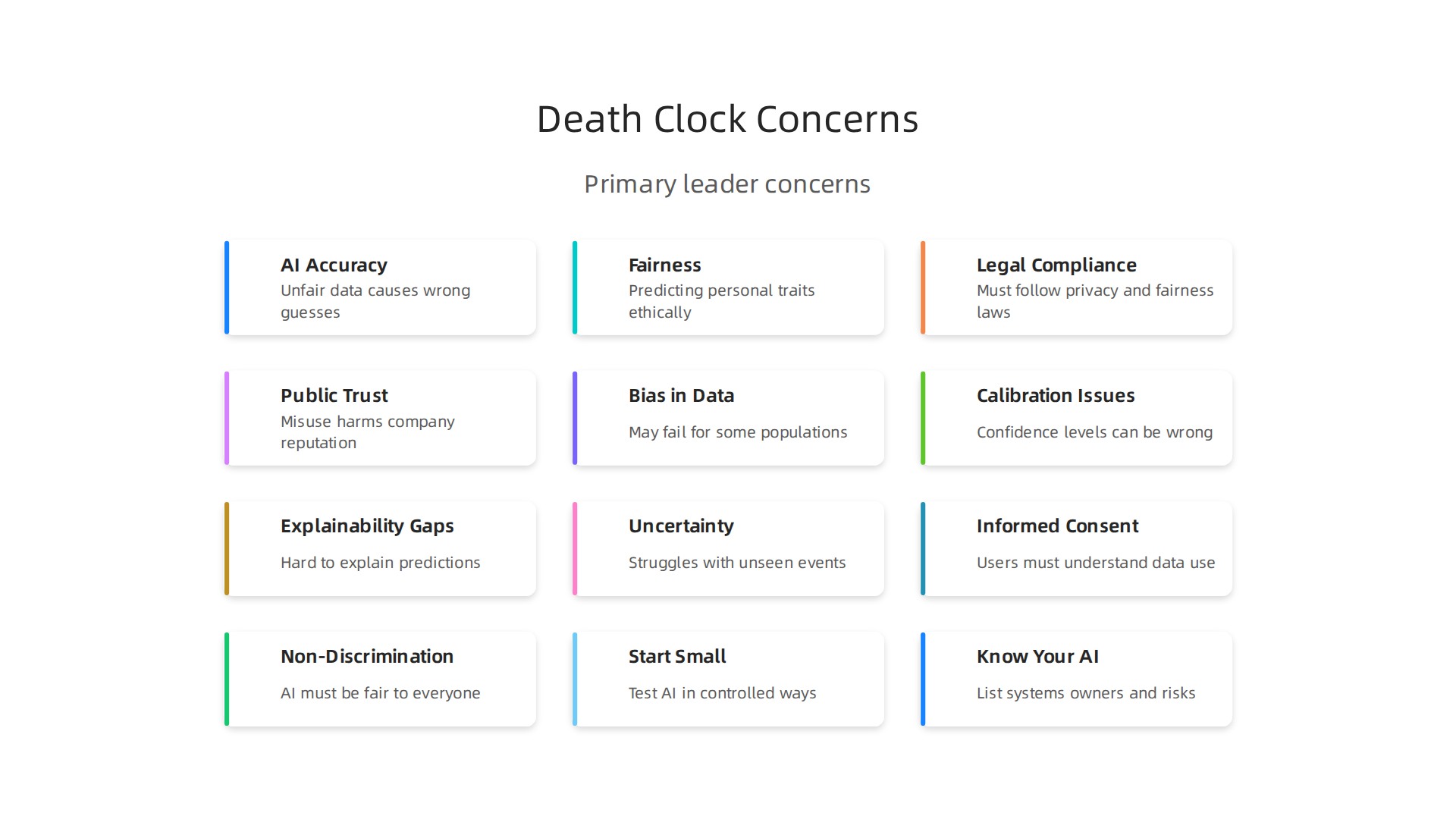
- Is the AI right? First, there’s a concern about how accurate these AI programs truly are. If the information used to teach the AI is not fair or complete, the AI’s guesses can be wrong or even harmful to certain groups of people. Data used to create these tools can contain bias, which means the AI might not work well for everyone Bias in artificial intelligence algorithms and recommendations. In fact, studies show that machine learning models predicting life span can have serious equity gaps and may not work as well for all populations Global performance of machine learning models to predict all-cause mortality.
- Is it fair to use? Second, there are big ethical questions. Is it right to use AI to predict something so personal? What if these predictions lead to unfair treatment in areas like healthcare or insurance?
- What about the laws? Third, companies must think about laws and rules. Using this kind of AI might get them into legal trouble if they don’t follow privacy laws or rules about fairness.
- Will people trust us? Lastly, there’s the risk to a company’s good name. If a company uses death clock AI in a way that people don’t trust, it can hurt their reputation badly.
This article is here to help you understand all these important points. If you are on a policy team, work in law, invest in new tech, or lead a technology company, you will find clear answers here. We will show you:
- How to understand the tricky parts of this technology.
- What rules and laws apply now in 2026.
- How to make good decisions to use AI safely and fairly.
- We’ll also look at related topics like how autonomous AI agents are changing things and what we can learn from AI coding agents about building responsible AI. We’ll even touch upon how things like AI noise removal bring up new privacy questions.
Stay on top of all these fast changes in AI. Get daily updates and deep analysis right to your inbox by subscribing to The AI Newsletter Worth Reading.
Now, let’s look closer at how these "death clock" models actually work. These special computer programs, also known as mortality prediction models, try to guess how long a person might live. They are built using advanced computer science, often with methods called machine learning. Think of machine learning as teaching a computer to find patterns in huge amounts of data.
How Death Clock AI Models Are Built and What They Predict
To make a guess, these AI models need a lot of information about people. This "input data" can include things like a person’s age, gender, and past health records. It can also use details from hospital stays or special medical scans. Some models might even look at lifestyle habits, like if someone smokes or exercises. Large datasets, like MIMIC-IV, which holds lots of patient information, are often used to train these models Interpretability and fairness evaluation of deep learning models on MIMIC-IV dataset.
Once trained, these models give a prediction. Some might give a single number, like "You will live exactly 15 more years." This is called a deterministic output. But most advanced death clock AI models give a probabilistic output. This means they tell you the chance of something happening. For example, "You have a 70% chance of living for at least 10 more years." This type of prediction is more common because life has many unknowns.
What Makes Death Clock Models Tricky
Even with all the data and smart computer programs, these models have real limits:
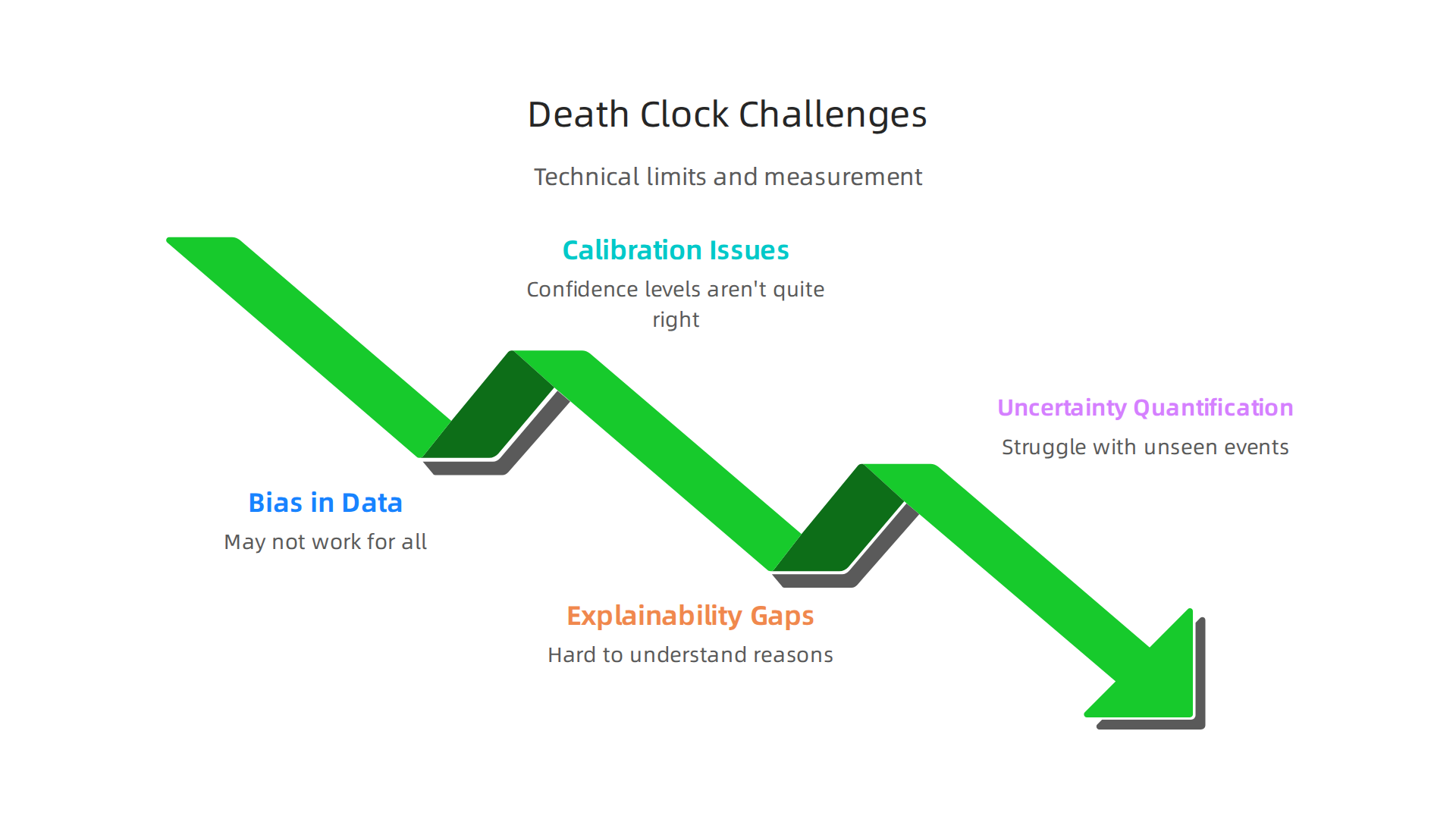
- Bias in Training Data: A big problem is unfair data. If the information used to teach the AI is mostly from one group of people, the AI might not work well for others. For instance, if the data has fewer details about certain ethnic groups or people with lower incomes, the AI’s guesses for those groups can be wrong or unfair Machine Learning–Based Short-Term Mortality Prediction. This is a key concern in healthcare AI.
- Calibration Issues: Sometimes, an AI model might say there’s a "50% chance" of something happening, but in the real world, it only happens 30% of the time when the AI makes that prediction. This means the AI isn’t accurately calibrated, or its confidence levels aren’t quite right.
- Explainability Gaps: It can be hard to understand why a death clock AI made a certain prediction. The model is like a "black box" where you put in data and get an answer, but you don’t see the steps it took. Knowing the "why" is important, especially for things as serious as health predictions.
- Uncertainty Quantification: These models struggle with things they haven’t seen before. They can’t perfectly predict unexpected life events or new medical breakthroughs.
How We Check if They Are Good
When we use death clock AI models, we need to know if they are reliable. Here are some ways we check them:
- Accuracy: How close are the predictions to what actually happens?
- Calibration: Do the chances the AI predicts truly match the real-world chances?
- Fairness Across Subgroups: It’s vital to check if the AI works just as well for all different groups of people. A model that is accurate for one group but not another is a problem Predicting Mortality and Algorithmic Fairness of ICU. This helps us avoid creating unfair systems.
- Robustness: Does the model still give good answers even if the input data has small mistakes or changes?
Learning about these technical parts helps policy teams and business leaders make smart decisions.

It also helps in understanding how to drive policy decisions with AI ethics and performance evaluation to ensure responsible use of this powerful technology.
Even when we know how to check if death clock AI models are working correctly, there’s a bigger picture to think about. Who sets the rules for these powerful tools? What happens if they make a mistake? And how do we make sure they are fair and ethical? These are big questions for policy makers and leaders in 2026.
Policy Implications: Regulation, Liability, and Ethical Guardrails
The use of AI, especially in sensitive areas like predicting life expectancy, calls for clear rules. Different countries and organizations are working on ways to control these new technologies. For example, in Europe, rules like the EU AI Act classify AI systems used in clinical settings as "high-risk." This means they need to be looked at very carefully by ethics groups and government bodies Ethical and Regulatory Frameworks for Artificial Intelligence in …. The World Health Organization (WHO) also gives guidance on the ethics and governance of AI for health Ethics and governance of artificial intelligence for health: WHO guidance.
However, current rules don’t always fully cover the unique challenges of death clock AI. Many existing frameworks were not designed for tools that make such personal and life-altering predictions. This leaves gaps where new policies are needed.
Who is Responsible When Things Go Wrong?
A big question for companies and hospitals that use death clock AI is about responsibility. If a prediction is wrong and causes harm, who is to blame? Is it the company that made the AI, the hospital that used it, or the doctor who relied on its advice? Figuring out who is legally responsible for errors from these high-risk AI systems is tricky. This idea of "liability exposure" is a key concern for any organization thinking about using such tools, as detailed in reports like the 2026 Data Security and Compliance Risk Forecast Report.
Building Ethical Rules into Policy
For any death clock AI model to be accepted, it needs strong ethical rules. These rules aren’t just good ideas; they need to become part of the law. Some key ethical ideas include:
- Informed Consent: People should fully understand how their data will be used by a death clock AI and what the predictions mean. They should agree to it freely.
- Non-Discrimination: As we talked about earlier, these models must be fair to everyone. Policies need to prevent the AI from giving different or unfair predictions based on a person’s race, income, or other background details. This is a major concern when using AI for sensitive predictions Predictive analytics and the collective dimensions of data protection.
- Transparency: It should be clear how the death clock AI makes its predictions. We need to avoid the "black box" problem where no one understands why an AI reached a certain conclusion. People need to know the why behind the how.
- Privacy: Because death clock AI uses very personal health information, keeping that data safe is extremely important. Rules must protect people’s privacy. In 2026, concerns about privacy when using AI are still very high among the public Australians more concerned about privacy as trust in AI ….
The White House National Policy Framework for AI from March 2026 also discusses legislative recommendations for AI. These kinds of policy efforts help ensure that AI tools, including death clock AI, are developed and used in a way that benefits everyone and respects important human values. As the world of AI grows with things like ai agents examples and autonomous ai agents, policy must keep up.
To stay on top of these fast-changing rules and developments in AI, consider subscribing to our newsletter.
Get clear daily AI updates from The AI Newsletter Worth Reading.
While clear rules and ethical guidelines are super important, we also need strong technical solutions to make sure death clock AI works safely and fairly. This means building in safety measures right from the start, testing them thoroughly, and keeping a close eye on them.

In 2026, technology leaders and policy makers are focusing on how to put these technical guardrails in place.
Technical Risk Management: Safety Frameworks, Testing, and Auditability
Just having rules isn’t enough; we need concrete technical steps to manage the risks that come with powerful tools like death clock AI. These steps help prevent problems before they happen and address them quickly if they do.
Making AI More Trustworthy
One key technical step is to make sure the AI knows when it’s not sure about a prediction. This is called uncertainty estimation. Imagine a weather report that not only tells you it will rain but also how confident it is about that rain. For death clock AI, knowing how sure the prediction is can help doctors decide how much to rely on it.
Another important step is adversarial testing. This means trying to "trick" the AI with unusual or difficult data to see where it might fail. By finding these weak spots, developers can make the AI stronger and less likely to make mistakes in real-world situations. Think of it like a superhero training by fighting tough opponents.
To fight unfairness, fairness-aware training is used. This involves special ways of teaching the AI so it doesn’t learn bad biases from the data it’s given. The goal is to make sure the death clock AI gives fair predictions to everyone, no matter their background. Developing these models responsibly is a key part of modern AI work Understanding Responsible Development in AI-Based Clinical ….
Finally, continuous monitoring means watching the AI closely after it’s being used. This checks if the AI is still performing well and staying fair over time. It’s like regular check-ups for the AI system. This is especially true as more complex tools like autonomous ai agents become common.
Building Transparency and Trust
To really trust death clock AI, we need to understand how it works. That’s where transparency comes in.
- Third-party audits are like getting an independent expert to check the AI system. These experts look at the data, the code, and the results to make sure everything is working as it should. The International AI Safety Report 2026 highlights the importance of such external reviews for AI safety.
- Model cards are like nutrition labels for AI models. They explain what the AI does, what data it was trained on, how well it performed, and any known limitations. This helps people understand what they are using.
- Standardized evaluation means using the same set of tests for different AI models. This helps compare them fairly and makes sure they all meet a certain level of quality and safety.
These steps help us move away from a "black box" where no one knows how the AI makes its decisions. For more insights into how to build AI securely and meet compliance standards, you can read our guide on how to build AI securely and compliantly.
Keeping Things Under Control
Even with good design and testing, we need ways to manage AI when it’s actually being used.
- Deployment gating means putting a series of checks in place before a death clock AI is ever used with real people. It’s like a final inspection before a product goes to market.
- Human-in-the-loop processes ensure that people always have the final say. For something as sensitive as a death clock AI, doctors or other experts should review the AI’s predictions before making any final decisions or giving advice. This ensures human judgment and empathy remain central.
- Incident response plans are about knowing what to do if something goes wrong. If the AI makes a bad prediction or causes a problem, there needs to be a clear plan to fix it, understand why it happened, and prevent it from happening again.
By combining strong policies with these technical risk management strategies, we can build a future where death clock AI and other advanced AI agents are helpful tools that are used safely and ethically. This balance is key as we continue to see more ai agents examples in various fields.
Now, let’s talk about the business and legal side of things. Even with all the smart technical solutions in place, companies still need a clear plan for how to handle risks and follow rules when using powerful tools like death clock AI. This plan is like a playbook for businesses, helping them understand what could go wrong, how to stay on the right side of the law, and what investors will care about.
Business & legal playbook: assessing risk, compliance, and investor impact
When a company uses or develops something like death clock AI, it’s not just about making the technology work. It’s also about figuring out all the possible problems that could pop up for the business, for the law, and for how people see the company.
Understanding Company Risks
Every company needs to look at risks across its whole business. For tools like death clock AI, this means thinking about:
- Product Risks: What if the AI makes a wrong prediction? This could lead to bad health advice or unfair outcomes.
- Legal Risks: Could the company get sued if the AI causes harm or breaks privacy rules? By the end of 2026, experts believe there will be over 2,000 legal claims linked to AI incidents worldwide Gartner forecasts surge in AI-related legal claims and urges stronger insurance strategies. This shows how serious legal risks can be.
- Public Relations (PR) Risks: How would people react if the AI is seen as unfair or unsafe? A bad reputation can hurt a company a lot.
These risks are not just for death clock AI. They apply to many other advanced tools, including autonomous AI agents that act on their own or even AI coding agents that write computer programs. Every part of a business, from creating the product to how it’s talked about, needs to be aware of these dangers. If you’re running an AI development company, understanding these rules is key to success and avoiding problems, as explained in our guide on how an AI development company navigates regulation and opportunity in 2026.
Legal Steps and Sharing Responsibility
Companies must do their homework, also called "legal due diligence," when getting involved with predictive AI models. This means carefully checking all the legal details. Here’s how companies can protect themselves:
- Contractual Agreements: When working with others on AI, companies can write special agreements. These contracts can spell out who is responsible for what, helping to shift or reduce liability if something goes wrong. This is especially important for high-risk AI systems like death clock AI.
- Following Regulations: Laws like the EU Artificial Intelligence Act, fully in effect by August 2026 for high-risk systems, demand that companies set up risk management systems and prove their AI meets certain standards Ten AI Predictions for 2026: What Leading Analysts Say …. If not, they could face huge fines. The law aims to regulate the risks of AI, ensuring safety and fairness Regulating the Risks of AI.
It’s also important to stay updated on privacy laws, especially for tools that handle sensitive health data. You can learn more about how different countries are handling these challenges in our guide on a global comparison of AI regulations across the US EU China and beyond.
What Investors Look For
Investors who put money into companies using death clock AI or other advanced AI agents also need to be careful. They look at several things:
- Scenario Analysis: Investors want to know what could happen in different situations. What if new laws come out? What if the AI makes a public mistake? They want to see that the company has thought about these possibilities.
- Reputation vs. Rules: How important is the company’s good name compared to regulatory fines? Often, losing public trust can be more damaging in the long run than a one-time penalty.
- Monitoring Signals: Investors keep an eye on how the company handles these risks. Are they being open? Are they quickly fixing problems? Strong risk management signals to investors that a company is well-run.
Understanding these detailed reports and ongoing policy changes can feel like a lot to keep up with.
Get clear daily AI updates from The Deep View Newsletter. The AI Newsletter Worth Reading
The last section talked about the money and legal rules companies need to follow when using advanced AI, like death clock AI. But even if a company follows all the laws, how people feel about the technology matters a lot. Public opinion can change how laws are made and how well a product does in the market.
Public reaction, communications strategy, and digital rights considerations
When a new technology like death clock AI comes out, how the public sees it is a huge deal. It’s not just about what the AI does, but also how the media talks about it and how people react. These things can put pressure on lawmakers to create new rules and can affect whether people choose to use the technology.
How Public Opinion Shapes AI’s Future
People’s feelings about AI can be quite strong, especially when it deals with very personal things like health or life predictions. For example, a death clock AI that predicts when someone might die can stir up a lot of worry about its accuracy and fairness. Studies in 2026 show that many people are concerned about privacy when it comes to AI. For example, a survey in Australia found that people were more worried about their privacy, and their trust in AI was falling, according to the Australians more concerned about privacy as trust in AI languishes, survey finds. This general public concern can quickly turn into calls for stricter rules and laws, influencing how even sophisticated ai agents examples or ai coding agents are developed and used. The public’s views on AI also vary a lot, with some Americans still getting their news from AI chatbots in 2025, but many expressing concerns about privacy and job loss due to AI, as noted in Key findings about how Americans view artificial intelligence.
Talking Honestly About AI
Companies that make or use controversial AI tools need to be very clear and honest in how they talk about them. This means:
- Being open: Explain how the AI works in simple terms, what data it uses, and what its limits are. Don’t hide important details.
- Avoiding big promises: Don’t say the AI can do more than it really can. Misleading claims can break trust quickly.
- Respecting choices: Users should always feel like they have a say in how their data is used and whether they want to use the AI tool. This is about respecting their "autonomy," meaning their right to make their own choices.
A communications strategy like this helps build trust, which is super important for any company working with advanced AI, including autonomous ai agents.
Protecting Your Digital Rights and Privacy
One of the biggest worries with tools like death clock AI is what happens to sensitive personal information. If an AI uses health or other private data to make predictions, there are serious questions about privacy and digital rights. People want to know their information is safe and won’t be used in ways they didn’t agree to.
For instance, when AI models try to predict someone’s death, they often use a lot of personal health information. This raises big privacy concerns, similar to those seen in genetic testing, as discussed in An Artificial Intelligence (AI) Model Can Predict When You Will Die and general predictive health tools, according to What Genetic Testing Teaches About Long-Term Predictive Health Analytics Regulation. There’s also the risk of unfairness or "bias" in these systems, where the AI might treat certain groups of people differently. Surveys across Europe in 2026 show high concern for digital rights, including fake content created by AI and hate speech, as outlined in the AFCO Eurobarometer briefing June 2026. Companies must put strong protections in place to guard this data. This includes making sure AI noise removal techniques don’t accidentally reveal private details and that all data handling follows strict privacy rules. Learning more about how to handle privacy in the age of AI can be found in our guide on how to navigate AI privacy, cybersecurity, and antitrust changes.
Ensuring digital rights means people should have control over their personal data, especially when it’s used by powerful AI systems that can make life-changing predictions.
The public cares a lot about their digital rights, especially when advanced AI makes big predictions. So, how do we make sure powerful AI, like a death clock AI, is used safely and fairly? It’s all about governance, which means having clear rules for how AI works.
Ways to Guide AI Use
There are a few main paths to guide how AI is used:
- Rules and Laws (Regulation): Governments can make laws to control AI. For example, in 2026, the European Union’s AI Act has strict rules for "high-risk AI systems." This includes systems affecting health or safety, making them subject to careful checks Regulation 2024/1689 of the Eur. Parl. & Council of June 13, 2024 …. Countries like the US also have specific rules developing for AI US AI regulations 2026.
- Shared Standards: These are like best practices that different groups agree on. Some groups create AI Safety Frameworks & Standards to help guide responsible AI use.
- Company Promises (Voluntary Codes): Companies can choose to follow their own rules to show they are serious about safe AI. These often involve setting up ways to be accountable and manage risks Voluntary AI Safety Standard (10 Guardrails).
- Marketplace Choices: People can simply choose which AI products to use or not use. If a death clock AI is seen as unfair or unsafe, people might avoid it, pushing companies to make better tools.
All these ways have good and bad points. Stricter laws can make AI safer but might slow down new ideas. Voluntary rules are quicker but might not be strong enough.
What Policymakers and Teams Can Do Now
For both governments and companies, here are some smart steps:
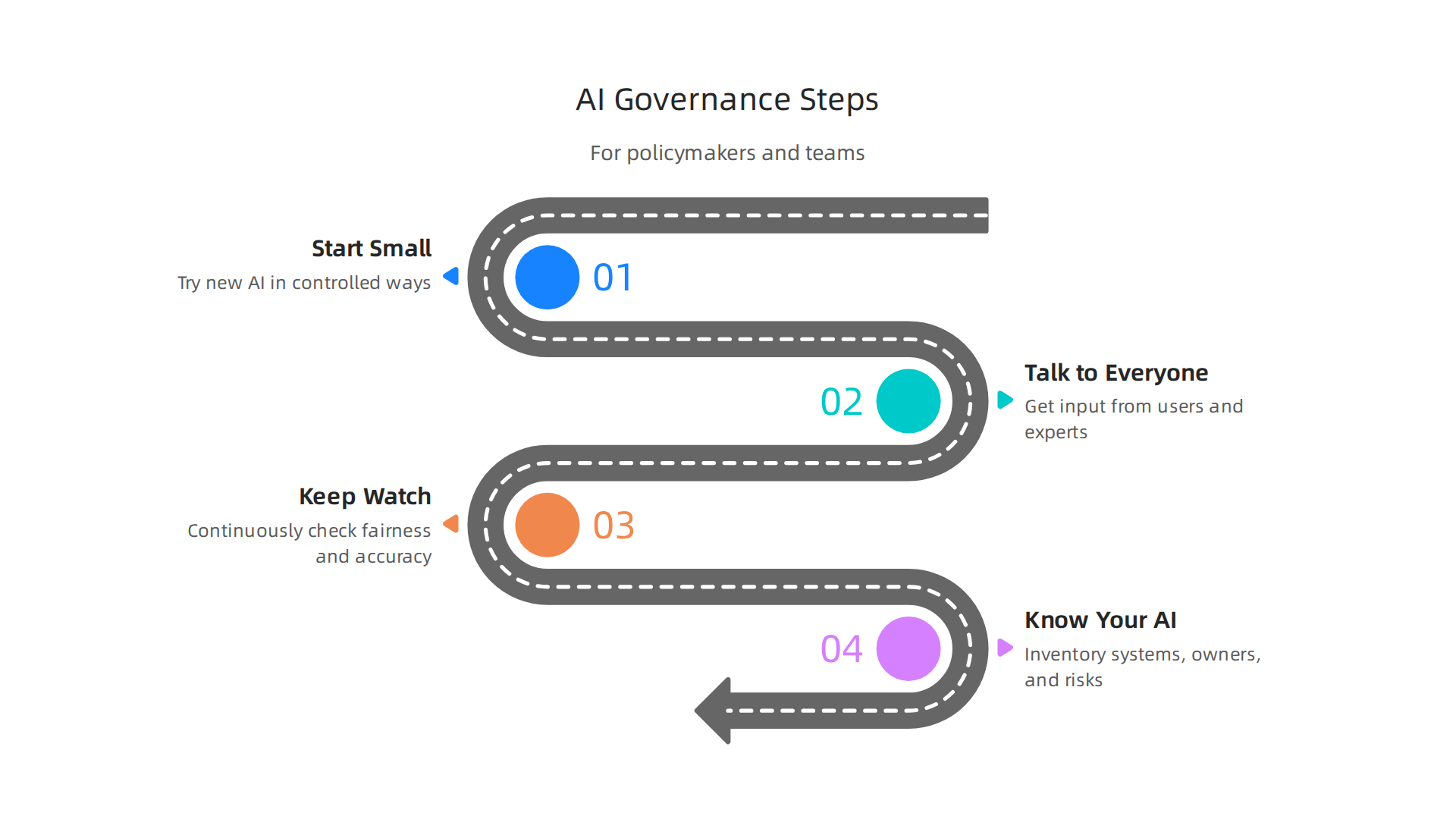
- Start Small and Test: Try out new AI systems, even powerful ones like autonomous ai agents, in small, controlled ways first. This helps find problems early.
- Talk to Everyone: Get input from users, experts, and those worried about AI. This helps shape better rules and designs for all kinds of AI governance.
- Keep Watch: Always check how the AI is working to ensure it’s fair and accurate. If something goes wrong, report it. Reports of "death by AI" legal claims are expected to surge to over 2,000 worldwide by the end of 2026, showing the urgent need for strong risk protections AI Risk Guardrails Crucial by 2026.
- Know Your AI: Companies should list all their AI systems, who owns them, and their risks. This is key for rigorous artificial intelligence review for policy compliance and part of a strong Risk Management in the Artificial Intelligence Act.
These steps help build safe and trusted AI systems. To dive deeper into the legal aspects, consider learning how an AI development company navigates regulation.
Where We Need More Work
Even with good steps, more effort is needed:
- More Research: We need to learn more about how AI affects people, especially with sensitive tools like death clock AI.
- Better Standards: We need clearer ways to check for unfairness or "bias" in AI and ensure accuracy. This includes stronger "guardrails," as noted in the International AI Safety Report 2026, and ways to fight health misinformation from AI Generative AI and health misinformation.
- Working Together: Governments, companies, and experts should keep talking and working together. This "cross-sector collaboration" is key to making sure AI helps everyone safely.
Staying on top of these complex changes is crucial for anyone working with AI. For daily updates and deep dives into AI policy, make sure to get The AI Newsletter Worth Reading.
Summary
This article explains why