

Why mapping AI research roles matters for policy, industry, and public interest
Today, in 2026, artificial intelligence (AI) is everywhere. From helping doctors find sicknesses to making smart cars, AI plays a big part in our lives. Many different kinds of AI people work on this technology. Each AI researcher has their own goals. Some work at big companies, some at universities, and others for governments. Because of these different groups, they often have different ideas about what AI should do and how it should be used. This mix of ideas can make things tricky for everyone.
It’s really important to understand who these different AI research actors are. Each group has its own reasons for doing research and its own ways of sharing what they find. For example, a company might want to create a new AI product, while a university might want to explore new theories. These different aims mean their research outputs look different and have different effects on society. Many countries are already thinking about how to set rules for AI. For instance, the Chinese Academy of Social Sciences recently shared guidelines for how AI should be used in research to make sure it’s done fairly and openly CASS releases provisional guideline on AI-assisted research- CHINESE SOCIAL SCIENCES NET. Also, in academic settings, it’s vital that researchers are clear about when and how they use AI tools in their work to keep things honest and trustworthy Generative AI in Academic Research.
Knowing who does what in AI research helps a lot of people.
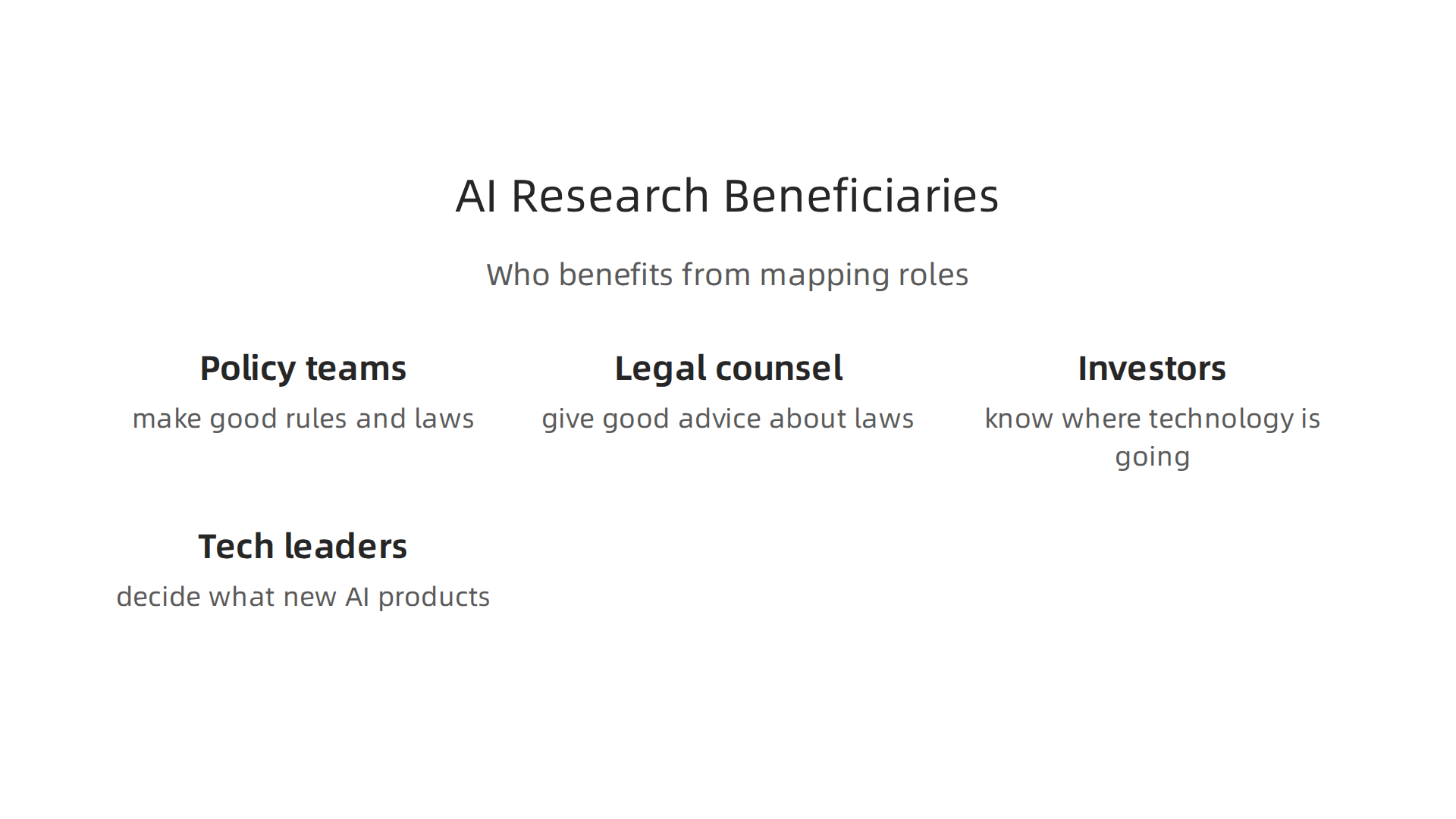
- Policy teams need to make good rules and laws for AI.

If they know who is doing what kind of AI research, they can make smarter rules that fit different situations. This helps them cover AI challenges properly.
- Legal counsel needs to understand these roles to give good advice about AI laws, like how to protect new ideas or follow privacy rules.
- Investors who put money into AI companies want to know where the technology is going and if it will follow new rules. A clear map of AI roles helps them make better choices.
- Tech leaders in companies can use this information to decide what new AI products to make and how to work with others in the AI world.
Understanding these roles helps everyone work together better. It makes it easier to set clear expectations and rules for how AI is developed and used. If you are a policy professional, getting a handle on these complex topics is key to making informed decisions. To dive deeper into how policy experts navigate the world of artificial intelligence, explore our guide on AI literacy for policy professionals.

Staying updated on all the fast changes in AI and its rules can be hard.
Do you want clear, daily updates about AI and tech policy straight to your inbox? The AI Newsletter Worth Reading offers simple, detailed insights to help you keep up.
Academic AI Researchers: Advancing Theory, Benchmarks, and Open Science
While businesses and governments have their own AI goals, academic [ai researcher]s form another very important group. These [ai people] work at universities and research centers. Their main goal is to push the boundaries of what AI can do, often focusing on new theories rather than making a product right away.
Academic [ai researcher]s create many different types of outputs.
They write lots of peer-reviewed papers, which are like reports on their new ideas and discoveries. These papers are checked by other smart people in the field before they are published. They also often create public datasets that anyone can use. These datasets are like big collections of information that help train and test AI systems.
Another key thing they do is create "benchmarks." These are standard tests that show how well an AI system performs a certain task. This helps everyone understand how good new AI models really are. Academic researchers also believe in "open science," which means they share their computer code and findings openly. This helps other researchers learn from their work, check their results, and build new things on top of what’s already been done. This idea of open science helps make AI research more trustworthy and fair. You can learn more about open science and its importance.
The reasons why academic AI researchers do their work are different from companies. A big reason is to publish their findings. When they publish, it helps them get more research money from grants and grow their careers. They get funding, often from government groups or special foundations, which allows them to explore new and sometimes risky ideas. This means they are not always focused on making money, but rather on making discoveries that benefit everyone.
However, academic [ai researcher]s also face certain rules and challenges. A big one is making sure their work is ethical and transparent. In 2026, there are clear guidelines about how AI should be used in research. For example, if a researcher uses AI tools that greatly affect their work, they must openly and transparently disclose it. This means they need to tell everyone exactly how they used the AI and what parts of the research it touched. It is even said that AI tools cannot be listed as authors on research papers.
This push for openness covers AI tools like generative AI. New guidelines help researchers understand the responsible use of generative AI in research. These guidelines say researchers should share the "prompts" (the instructions given to the AI) and the AI’s "output" when possible. This helps maintain trust and makes sure research is honest. Academic research provides the academic foundations guide strong AI governance for all other sectors.
Even though AI has become popular more recently, academic research has been important since the early days, sometimes traced back to things like [artificial intelligence 1956]. Their work helps set the standards for how AI is developed and used, making sure it benefits society in safe and helpful ways.
Now, let’s look at AI research done in companies, not just in schools.

These are called industry research labs. Here, [ai researcher]s work for businesses like Google, OpenAI, or Microsoft. Unlike academic researchers who focus on new theories for everyone, these [ai people] often aim to create products or services that their company can sell. Their work is still about discovery, but it’s guided by what the company needs and wants to offer to customers.
These labs have a special way of working that mixes sharing and keeping secrets. Sometimes, they share their new ideas through "preprints" or research papers, much like academic researchers. This helps everyone learn and shows off their smart work. But a lot of their work is kept private. This is because they develop special computer models and training data that are like secret recipes. These private tools help them create unique products that no other company has. This mix of open and closed research is a key part of how industry labs operate. In 2026, companies often keep their model architecture and training methods secret to stay ahead of others, as discussed in an overview of The AI Patent War of 2026.

A big part of industry AI research is about "Intellectual Property" or IP. This is about protecting their new ideas and inventions, like patents or trade secrets. For example, the special ways they train their AI models, the data they use, and how their systems work are all very valuable. Companies protect these things so others can’t just copy them. This focus on IP means that product goals heavily shape what research topics an [ai researcher] will work on. Their research agenda is about making better products and finding new ways to protect those products. Strong AI transforms intellectual property in 2026 by making data and models core IP assets.
Safety work is also a big deal in these labs. Because their AI systems might be used by many people, companies spend time making sure these systems are fair, safe, and reliable. This [covers ai] use in many different ways, from helping cars drive to giving customer service. Companies need to think about all the possible risks before they put their AI products out into the world.
So, for industry [ai researcher]s, the goal is often to find new ways to use AI that also help the company grow and stay special in the market. They navigate the challenge of sharing enough to help the broader AI community while also protecting their own valuable ideas. This balance is tricky, but it’s how many new AI tools and services come to be. To learn more about how companies handle these complex issues, explore how an AI development company navigates regulation and opportunity in 2026.
Stay informed about the latest developments in AI and technology policy by subscribing to: The AI Newsletter Worth Reading. You’ll get clear daily AI updates directly to your inbox.
While industry research labs often balance open sharing with protecting their own secrets, government labs and national research organizations have a different main goal. Here, an [ai researcher] focuses on creating AI tools and knowledge for the good of everyone. Their work helps build a strong foundation for artificial intelligence that benefits society as a whole.
These government and national labs play a big part in setting standards.

They work to make sure AI systems are fair, safe, and can work together smoothly. This means they might create guidelines for how AI data should be organized or how AI models should be built so they are reliable. By doing this, they help prevent problems and make sure AI can be used safely in many different areas, from healthcare to transportation.
Another important job for these [ai people] is creating what are called "public goods datasets." These are large collections of high-quality data that are made available for anyone to use. Think of them like public libraries of information. Researchers, students, and even small companies can use these datasets to train their own AI models, helping everyone develop better AI systems. For example, the UK government has worked on a plan for making government datasets ready for AI. They want to make sure public data is clean, well-organized, and easy for AI to understand. The US government also lists many high-quality accessible AI-ready datasets that are helpful. Sometimes, though, government data, like certain defense information, is not made public, as seen in the Department of Homeland Security Artificial Intelligence Research Guide.
Public funding is a major driver for the research done in these labs. Governments decide what AI projects get money based on what they think is most important for the country. This can lead to research focused on big problems like climate change, health improvements, or disaster prediction. This policy-oriented research helps leaders understand how AI can help or harm people, leading to better laws and rules for AI. This [covers ai] issues across all parts of public service. Understanding how these policies change is vital for many professionals, and you can learn more about it in tech policy 2026 how to navigate AI privacy cybersecurity and antitrust changes.
How governments buy AI systems also shapes research. When a government agency looks to buy AI tools, they often ask for ones that meet certain safety or ethical rules. This makes companies want to build AI that follows those rules. So, public spending helps guide AI development toward more responsible and beneficial uses. For instance, there’s a push to kickstart collaborative, AI-ready datasets in the life sciences to speed up medical discoveries.
In short, government labs and national research groups make sure that AI growth serves the public’s best interests. They focus on creating shared resources, setting common rules, and guiding AI development to solve important societal challenges.
Beyond what governments and big companies do, there are other important groups that help make sure AI is safe and fair. These are independent researchers, groups that help people (NGOs), and civil society organizations. They play a special role by looking at AI systems from the outside, like a careful watch dog.
Auditing and Red Teaming: Checking AI Systems
One big job for these [ai people] is to audit AI systems.
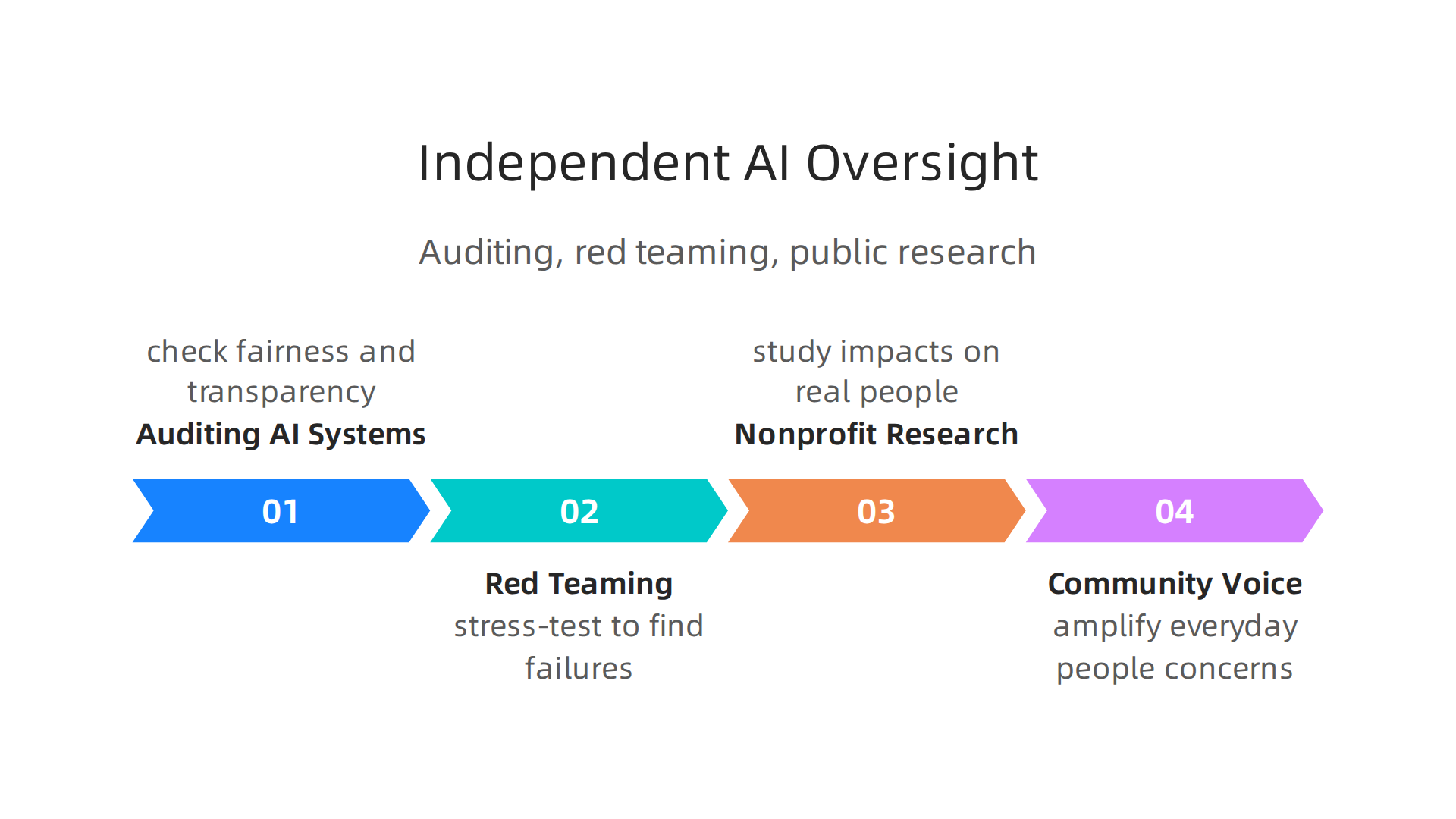
Think of an audit like a thorough check-up. Independent experts or groups look at how an AI system works to find any problems. They want to see if the AI is fair, honest, and does what it’s supposed to do without causing harm. These checks often happen after an AI model is made, by people who didn’t build it. This is sometimes called a "third-party audit." These kinds of audits help uncover hidden flaws and make sure the AI is good for everyone, as explained in reports on assessing AI systems.
Another key method is "red teaming." Imagine a group of clever people trying to break into a secure building. That’s a bit like what AI red teaming is. An independent [ai researcher] or team tries to find ways to make an AI system fail or act in harmful ways. They give the AI tricky questions or tasks to see if it can be fooled or misused. This helps the people who made the AI fix those problems before the system is widely used. It’s a structured way to find weak spots, often by trying to behave like an adversary to uncover harmful behavior, as described in guides like Red Teaming Artificial Intelligence for Social Good. Red teaming helps ensure AI tools are strong and safe for public use.
Independent groups, like those at universities or special research centers, often do this kind of evaluation. They are free from the pressures that companies or governments might have. This lets them be very open and honest about what they find. They are crucial for creating a safe harbor for AI evaluation and red teaming for outside experts.
Nonprofits and Civil Society: Giving Communities a Voice
Nonprofit organizations and civil society groups also do a lot of important work. They often act as a bridge between communities and the big tech companies or governments that make AI. These groups help make sure that the voices of everyday people are heard when AI systems are being designed or used.
They often do research that looks at how AI affects real people. For example, they might study if an AI system is unfair to certain groups of people or if it protects privacy well. They work to make sure AI systems are transparent, meaning we can understand how they make decisions. This helps everyone hold powerful groups accountable. These organizations also provide public-interest research and push for better rules that truly [covers ai] ethical questions. For example, they might guide communities on community-led AI audits to help local groups check AI systems used in their areas.
By doing these audits, red teaming, and public-interest studies, these independent groups add another layer of safety and trust to the world of AI. They work to make sure that as AI grows, it truly helps people and is used in a way that is fair and good for society. Staying on top of these developments can be a challenge, but you can always find reliable information.
Get clear daily AI updates from The AI Newsletter Worth Reading.
Understanding how these groups contribute is vital for strong academic foundations guide strong AI governance. Their work complements the efforts of government labs by providing an unbiased view and helping to make AI more responsible for everyone.
Beyond what governments and big companies do, there are other important groups that help make sure AI is safe and fair. These are independent researchers, groups that help people (NGOs), and civil society organizations. They play a special role by looking at AI systems from the outside, like a careful watch dog. Their work complements the efforts of government labs by providing an unbiased view and helping to make AI more responsible for everyone.
Cross-disciplinary Roles: Social Scientists, Ethicists, and Policy Researchers in AI
Building safe and fair AI is not just a job for computer scientists. It also needs many different kinds of experts, especially social scientists, ethicists, and policy researchers.

These [ai people] bring special skills to the table that help us understand how AI affects humans and society.
Social Scientists and Ethicists: Understanding People and AI
Social scientists and ethicists study how AI technologies change our lives. They look at things like fairness, privacy, and if AI systems treat everyone equally. For example, they use methods like talking to people, doing surveys, and looking at case studies to see how AI impacts different groups. They ask important questions: Does an AI system create unfair results? Does it respect our personal information? This human-centered approach is very important for making AI helpful and not harmful. These experts help make sure that when AI is used in areas like healthcare or hiring, it does not lead to bad outcomes for certain groups of people.
An [ai researcher] in these fields might focus on the ethical rules for using AI, making sure that it always puts human well-being first. They also help create guidelines for responsible AI, as seen in important discussions about the ethics of using artificial intelligence in scientific research. Their work helps us figure out what is right and wrong when we use powerful AI tools. For instance, open science efforts are working to build trust around AI, as highlighted in the Open Science in a World of AI, Trust, and Sovereignty discussion from 2026. This focus on clear communication and ethical behavior is key for all AI research.
Policy Researchers: Turning Ideas into Rules
Policy researchers take the findings from social scientists and ethicists and turn them into practical advice for leaders. They help governments and companies create good rules for AI. They might look at new AI tools and think about what laws are needed to protect people’s rights or encourage fair competition. For example, they study how to make sure companies are open about how their AI works. They make sure new rules truly [covers ai] ethical questions and protect everyone.
These researchers are vital for making sure that as AI changes quickly in 2026, the rules keep up. They help write reports and give suggestions to lawmakers, explaining complex AI ideas in simple terms. This helps decision-makers create clear guidelines, such as those that guide the responsible use of generative AI in research. Their work can lead to new standards for AI Tools and Academic Integrity in Postgraduate Research or even national guidelines, like the CASS provisional guideline on AI-assisted research in China.
These different experts work together to make sure that AI is not just smart, but also good for society. They are key players in shaping a future where AI helps everyone fairly. Understanding how these roles connect can help policy professionals stay updated on the latest changes and guide their own organizations. To learn more about how to navigate these changes, consider enhancing your AI literacy for policy professionals.
Working with AI is a big team effort. It is not just about what governments and companies do, but also how different kinds of groups and people work together. This includes teams of scientists, thinkers, and rule-makers. These different experts help guide how AI is made and used.
Collaboration Models, Career Paths, and Hiring for AI Research Teams
To make AI systems that are both smart and good for everyone, many different groups need to work together. This means people from schools, businesses, and governments often join forces.
How AI Research Teams Work Together
There are a few main ways that AI teams collaborate in 2026:
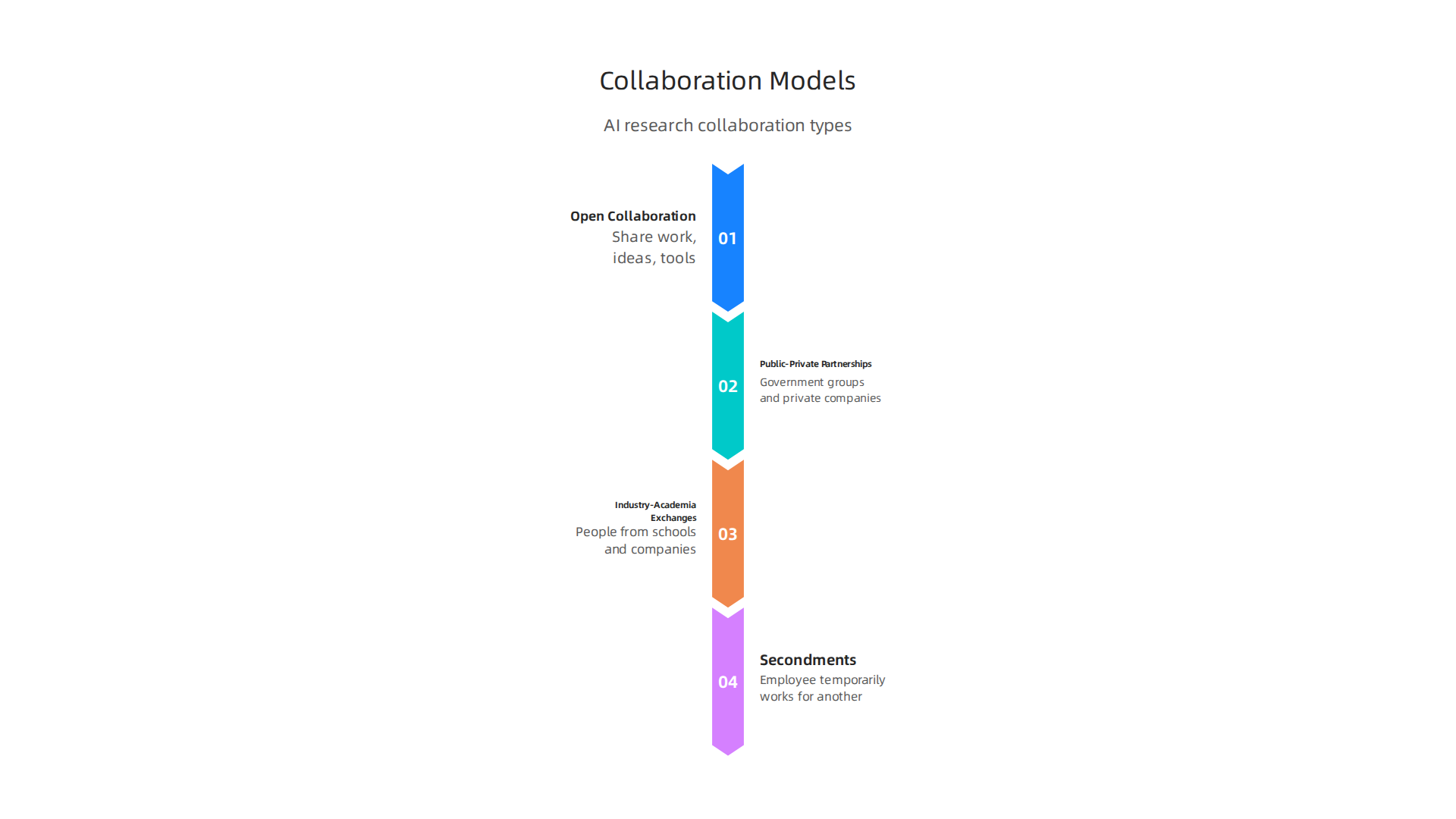
- Open Collaboration: This is when different groups share their work, ideas, and even some tools with everyone. It helps new ideas spread quickly and lets many people build on each other’s work.
- Public-Private Partnerships: Here, government groups and private companies work together. For example, a government might fund a company to develop AI for public services. These partnerships often need clear rules about who owns the new ideas. Actually, creating shared intellectual property (IP) is a key part of these collaborations, as seen in the growth of partnerships between universities, small companies, and big industries in 2026 to prevent conflicts over ownership and usage rights IP Trends in RDI: 2026 Outlook.
- Industry-Academia Exchanges: This is when people from schools and universities work with people from companies. Professors and students might help solve real-world problems for businesses, and company experts might teach at universities.
- Secondments: This is when an employee from one group, like a government office, temporarily works for another, like a private AI company. This helps them learn new skills and share knowledge.
These types of teamwork make sure that the best minds from different fields can contribute to AI. To make sure these partnerships work well, companies and schools need to understand how to team up for new ideas and growth. Learn more about mastering enterprise education partnerships for growth and innovation.
Jobs in AI Research: Finding Your Path
The world of AI jobs is growing fast in 2026. If you want to be an [ai researcher] or work with [ai people], there are many paths you can take. These roles can be in schools, businesses, government, or groups that help people.
- Academic Research Roles: In universities, an [ai researcher] might focus on making new discoveries and teaching. They often publish papers and work on long-term projects to understand how AI works at its core. You might start with a computer science degree and then go on to do more specialized research, as highlighted in guides about Artificial Intelligence (AI) Career Roadmap: Jobs.
- Industry Research Roles: In companies, AI researchers work on making products better or creating new technologies that can be sold. Their work needs to cover AI that solves real-world problems for customers. These jobs often pay well, with some of the highest-paying AI positions being in specialized technical roles, according to insights into 10 Highest-Paying AI Jobs & Salaries in 2026.
- Government Research Roles: People working for the government might research how AI can be used for public good, like in healthcare or national safety. They also help make sure AI follows rules and laws.
- Nonprofit Research Roles: These groups often focus on making AI fair and ethical. An [ai researcher] here might study how AI affects people and work to prevent any harm.
No matter where you choose to work, a strong background in science, math, or computer programming is a good start. Many roles need you to understand how to build AI systems, analyze data, or even think about the ethical questions AI brings up. You can find many kinds of jobs, from creating new AI systems to applying AI to specific fields, as seen in various AI Career Paths: Explore Roles & Specializations.
If you are looking to get into these fields, there are many guides on how to learn AI to build a future-ready career. As AI grows, so does the need for skilled people. This means understanding the different career paths is key for anyone interested in this exciting area. If you want to keep up with all the big changes in AI and how they affect policy, it can be hard to sift through everything.
Get clear daily AI updates from The Deep View Newsletter.
The AI Newsletter Worth Reading
Summary
This article explains why mapping the different roles in AI research is essential for policy, industry, and public interest. It describes the major actor types—academic researchers, industry labs, government and national labs, independent auditors and NGOs, and cross-disciplinary experts like social scientists and ethicists—and shows how their goals, outputs, and incentives differ. The piece outlines how academics push theory, benchmarks, and open science; companies balance openness with intellectual property and product safety; governments build public goods and shape procurement; and independent groups provide audits and red teaming. It also covers collaboration models, career paths, and hiring considerations so policy teams, legal counsel, investors, and tech leaders can make smarter decisions. After reading, you’ll understand who produces what in AI research, why those differences matter for regulation and procurement, and how to use role maps to inform governance, funding, and hiring choices.