

Why neural network architectures matter for policy, tech, and strategy
In 2026, artificial intelligence (AI) is everywhere. From the smart helpers in our phones to complex systems that predict weather, AI helps us every day. At the heart of many of these AI systems is something called an ai neural network. Think of an ai neural network like a brain made of computer parts. It has many simple "neurons" or nodes that work together to solve problems, much like how our own brains work. These neurons pass information between layers, starting with an input layer, going through hidden layers, and ending with an output layer that gives a result. Each connection between neurons has a "weight" that shows how important that connection is, and they use "activation functions" to decide what information to pass on, which helps the network learn complex patterns APS360 Fundamentals of AI. This whole setup of how these neurons are connected and layered is called the ai neural network’s architecture.
Understanding these architectures is more important now than ever before. Why? Because the way an ai neural network is built directly impacts what it can do, how well it does it, and what risks it might carry. For people working on policy, technology, or business strategy, knowing about these different designs is key.
For policy makers, the architecture affects how we create rules for AI.

For example, some designs might be easier to understand than others, which is important for making sure AI is fair and safe. How an ai neural network is put together can also change how we look at its capabilities and risks. This means that rules about AI governance and safety need to consider these different design choices.
For technology leaders, choosing the right architecture is crucial for building powerful and reliable AI tools. Different types of AI, such as agentic ai vs generative ai, have very different structures. An agentic AI might be designed to take actions on its own, while a generative AI focuses on creating new content. The choice of architecture affects how these systems behave and what they can achieve. To dive deeper into specific network designs and their policy implications, you might find it helpful to learn how GPT-3 architecture and capabilities still drive AI policy in 2026.
For those setting strategy, understanding ai neural network architectures helps in deciding where to invest time and money. It helps them see what new things AI can do for their business and how to manage the challenges that come with new AI technologies. For instance, the number of layers and how they are connected can change a network’s ability to learn complex tasks or how much data it needs to be effective An Introduction to Deep Learning.
In the sections to come, we will look at the basic ideas behind these architectures. This will help you understand how to evaluate different ai neural network designs across various uses and within the rules that guide them. You’ll learn what makes different ai systems unique, and why these technical choices have big effects on our world.
Get clear daily AI updates from The AI Newsletter Worth Reading.
To truly understand why different AI systems act the way they do, we need to look at the basic parts that make up an AI neural network. It’s like learning about the gears and levers inside a complex machine. By understanding these core concepts, you can better see how changes in design influence how an ai neural network works and what it can achieve.
Neurons and Layers: The Building Blocks
At its simplest, an ai neural network is a collection of connected "neurons," often called nodes. Imagine each neuron as a tiny decision-maker. These neurons pass information from one to the next, much like brain cells do. Each connection between neurons has a "weight," which tells the network how important that piece of information is. Think of weights as adjustable knobs that fine-tune the data as it moves through the system Neural Network 101.
These neurons are organized into layers:
- Input Layer: This is where the raw data, like an image or text, first enters the ai neural network.
- Hidden Layers: After the input, information goes through one or more hidden layers. These layers do the heavy lifting, processing the data and finding patterns that are not obvious at first glance.
- Output Layer: This is the final layer, where the network gives its answer or result.
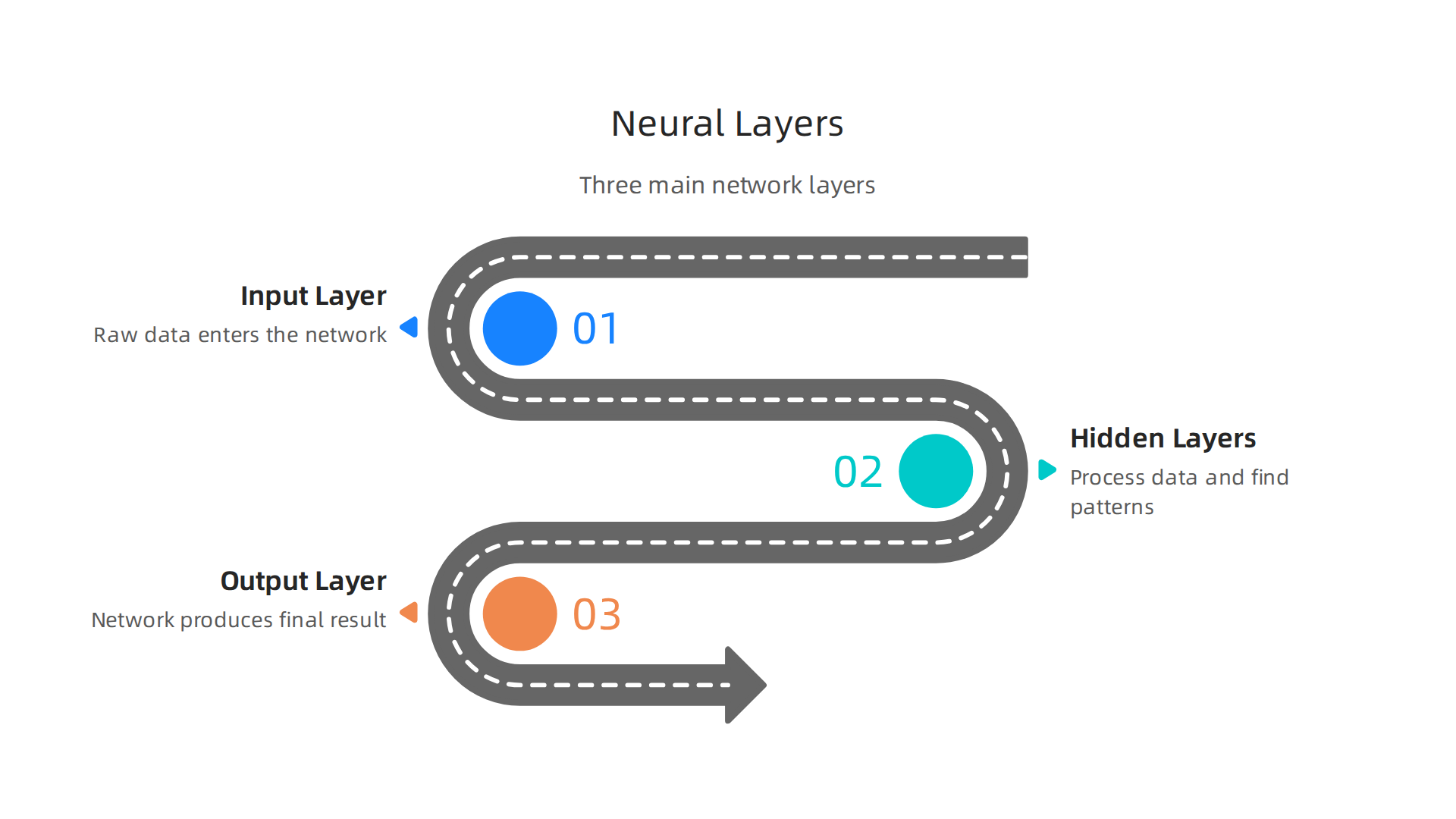
For example, if the network identifies an animal in a picture, the output layer tells you which animal it thinks it is.
Activation Functions: Adding Complexity
After a neuron receives information and applies its weight, it uses something called an "activation function." This function decides whether the neuron should "activate" and pass the information on to the next layer, and how strongly. A very important thing about these functions is that they add "non-linearity" to the network. This means the ai neural network can learn much more complex patterns than if it just used simple straight lines, making it powerful enough to handle tasks like understanding speech or recognizing faces Activation Functions in Data Mining. Without activation functions, an ai neural network, no matter how many layers it has, would only be able to learn very simple relationships.
Loss and Training: How Networks Learn
How does an ai neural network get better at its job? It learns through a process called "training." Training involves feeding the network lots of examples and letting it try to make predictions.
- Loss Function: First, the network compares its prediction to the correct answer. The difference between what it predicted and what it should have predicted is measured by a "loss function." This loss tells us how wrong the network was. The goal is to make this loss as small as possible Neural Networks II – University of Maryland.
- Adjusting Weights: If the loss is high, the ai neural network knows it made a mistake. It then goes back and slightly changes the weights of its connections. This adjustment happens in many small steps, slowly making the network more accurate over time. This continuous process of trying, checking the error, and adjusting weights is how the network learns to perform its task well.
For those interested in the computer science for artificial intelligence and how these learning processes unfold, learning how to learn AI can offer a comprehensive path to understanding.
How Choices in Architecture Influence Performance
The way you design an ai neural network’s architecture directly impacts what it can do and how well it performs.
- Depth (Number of Layers): Networks with many hidden layers are called "deep" networks. They can learn very complex ideas and patterns from data. However, they also need more data and more computing power to train.
- Width (Neurons per Layer): Having more neurons in each layer (making the layer "wider") can also help the network learn more intricate details, but again, it can make training slower and more complex.
- Activation Function Choices: The specific activation functions used can affect how quickly and effectively a network learns. Different functions are better suited for different kinds of problems.
These choices are critical when deciding if an ai neural network is best for a generative AI task, like creating new images, or an agentic AI task, like making decisions in a game. Understanding these core concepts is a foundational step towards achieving AI Literacy for Policy Professionals, as it helps in evaluating the capabilities and limitations of different AI systems. By carefully choosing the design, engineers can build different ai networks that are just right for their specific jobs.
Different kinds of AI systems are built for different jobs. Just like you would pick a hammer for nails and a screwdriver for screws, AI engineers pick different types of ai neural network designs based on what they need the AI to do.

These designs are called architectures. Let’s look at some common ones and what they are best at.
Common Architectures: MLPs, CNNs, RNNs, and Transformers & what they do best
When we talk about the big names in ai neural network design, we often hear about MLPs, CNNs, RNNs, and Transformers.
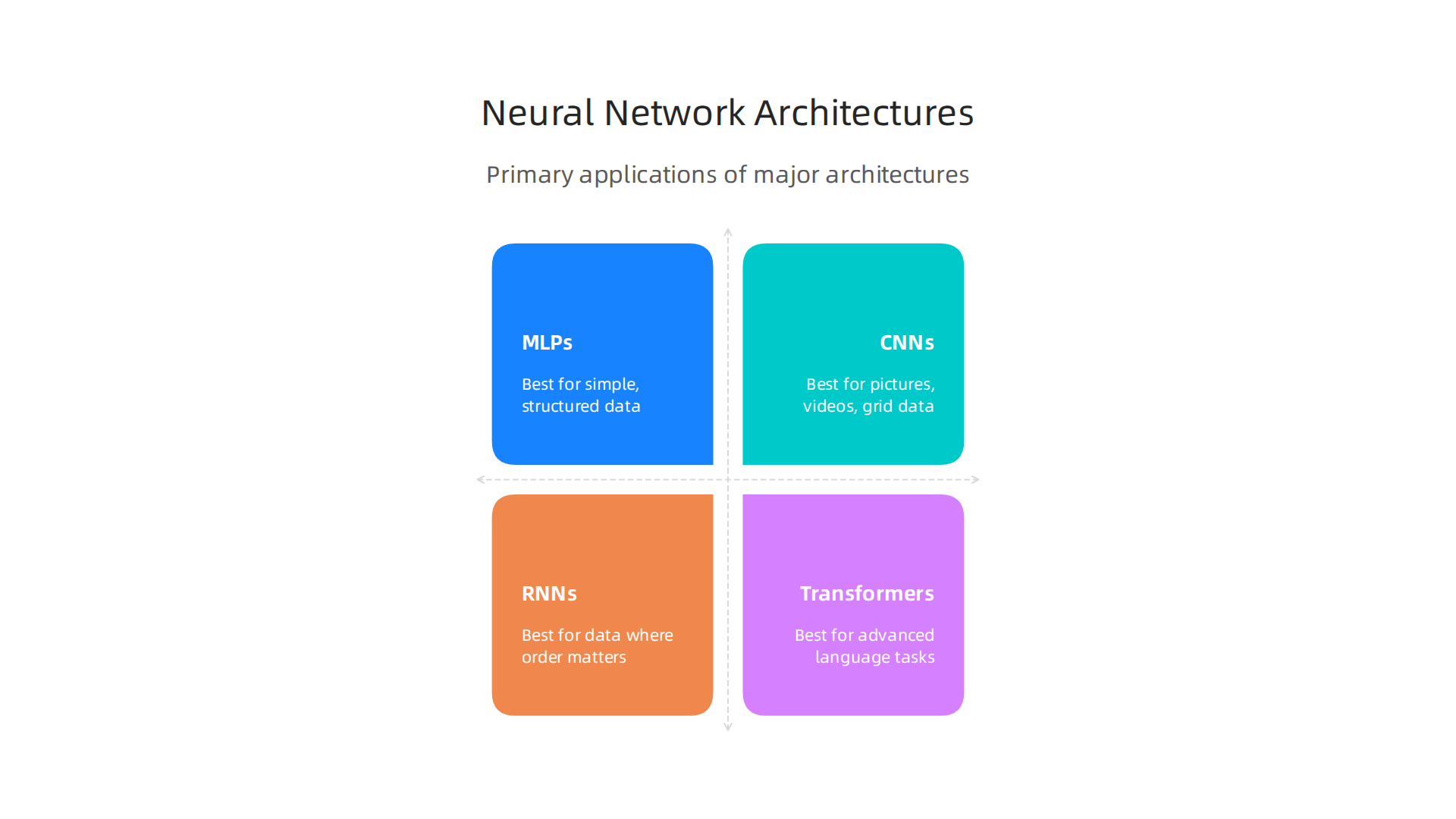
Each one has a special way of handling information, making them good at different tasks.
Multi-Layer Perceptrons (MLPs)
The simplest type of ai neural network is the Multi-Layer Perceptron, or MLP. These are the basic networks we talked about before, with input, hidden, and output layers where every neuron in one layer connects to every neuron in the next.
- Best for: Simple, structured data. Think of things like predicting if a customer will buy a product based on their age and income, or classifying emails as spam or not spam using basic features. They are also used as parts within bigger, more complex networks.
- Why they work: MLPs are good at finding patterns in data that is already neat and tidy. They learn direct relationships between different pieces of information. A 2026 survey of neural network methods found MLPs still play a role, often in hybrid models, for tasks like predicting token prices Survey of neural network methods for predicting token prices.
Convolutional Neural Networks (CNNs)
CNNs are a special kind of ai neural network that really shines with image data.
- Best for: Pictures, videos, and anything that looks like a grid. This includes tasks like telling a cat from a dog in a photo, recognizing faces, finding objects in street scenes for self-driving cars, or even analyzing medical scans.
- Why they work: CNNs use "filters" that slide over the image, looking for specific patterns like lines, corners, or colors. They can find these patterns no matter where they are in the picture. This makes them very efficient for visual tasks. In 2026, CNNs are still a core part of image and video analysis A Survey of Deep Learning Architectures in Modern …. They’re also used in more complex ways, such as in 3D deep point cloud models for scene understanding A Comprehensive Survey on 3D Deep Point Cloud Models.
Recurrent Neural Networks (RNNs)
RNNs are known for having a "memory." They are designed to process sequences of information.
- Best for: Data where the order matters a lot. Think of sentences, spoken language, or time-series data like stock prices or weather patterns. RNNs can predict the next word in a sentence, translate languages, or even write music.
- Why they work: Unlike MLPs or CNNs, RNNs feed some of their output back into themselves. This loop lets them remember past information when making decisions about current data. This is super helpful for understanding how words connect in a sentence. A survey on deep learning for time series forecasting highlights how RNNs and their advanced versions (like LSTMs and GRUs) are great for sequence data A Survey of Deep Learning for Time Series Forecasting.
Transformers
Transformers are newer and very powerful ai neural networks that have changed the game for many tasks, especially those involving language.
- Best for: Advanced language tasks like writing articles, creating summaries, translating complex texts, or powering chatbots. They also excel in multimodal learning, which means they can handle different types of data at once, like text and images together Multimodal Learning with Transformers: A Survey. Many of today’s best generative AI tools are built using Transformers.
- Why they work: Transformers use something called "attention." This allows them to look at all parts of a sequence at the same time and decide which parts are most important. This helps them understand long sentences or documents much better than RNNs, which sometimes forget what happened earlier.
Practical Trade-offs: What to Consider
Choosing the right ai neural network architecture means looking at a few key things:
- Accuracy vs. Compute Power: Generally, more complex networks like Transformers can be more accurate for tough problems. But they also need a lot more computer power and time to train. Simple MLPs are faster to train but might not be as smart for very complicated tasks.
- Latency (Speed): How quickly the AI gives an answer is important. For real-time applications like a voice assistant, a faster, simpler model might be preferred over a super accurate but slow Transformer.
- Data Needs: Powerful ai neural networks, especially the deep ones and Transformers, usually need huge amounts of data to learn effectively. If you don’t have much data, a simpler model might be a better choice.
- Task Fit (Generative AI vs. Agentic AI):
- Generative AI often uses Transformers because they are excellent at creating new, original content like text, images, or even code. They learn patterns and then generate things that fit those patterns.
- Agentic AI, which focuses on making decisions and acting in an environment (like a smart assistant planning your day or an AI playing a game), might use a mix of these architectures. The parts that understand the environment could be CNNs, while decision-making parts might involve MLPs or specialized networks. Understanding the difference in these models helps in understanding AI agents explained: how autonomous systems work and why they matter.
The world of AI is always changing, with new types of ai neural networks appearing often. For example, recent developments in 2026 also mention Kolmogorov-Arnold networks (KANs) and Graph Neural Networks (GNNs) as important new architectures being compared and researched A Comprehensive Overview and Comparative Analysis on …. Staying informed about these various models and their uses is key for anyone involved in computer science for artificial intelligence.
To keep up with the latest advancements and what they mean for policy and business, make sure you’re getting trusted insights. Get clear daily AI updates from The AI Newsletter Worth Reading.
After looking at how different ai neural network designs work, it’s really important to see how these choices affect big issues like privacy, fairness, and safety.
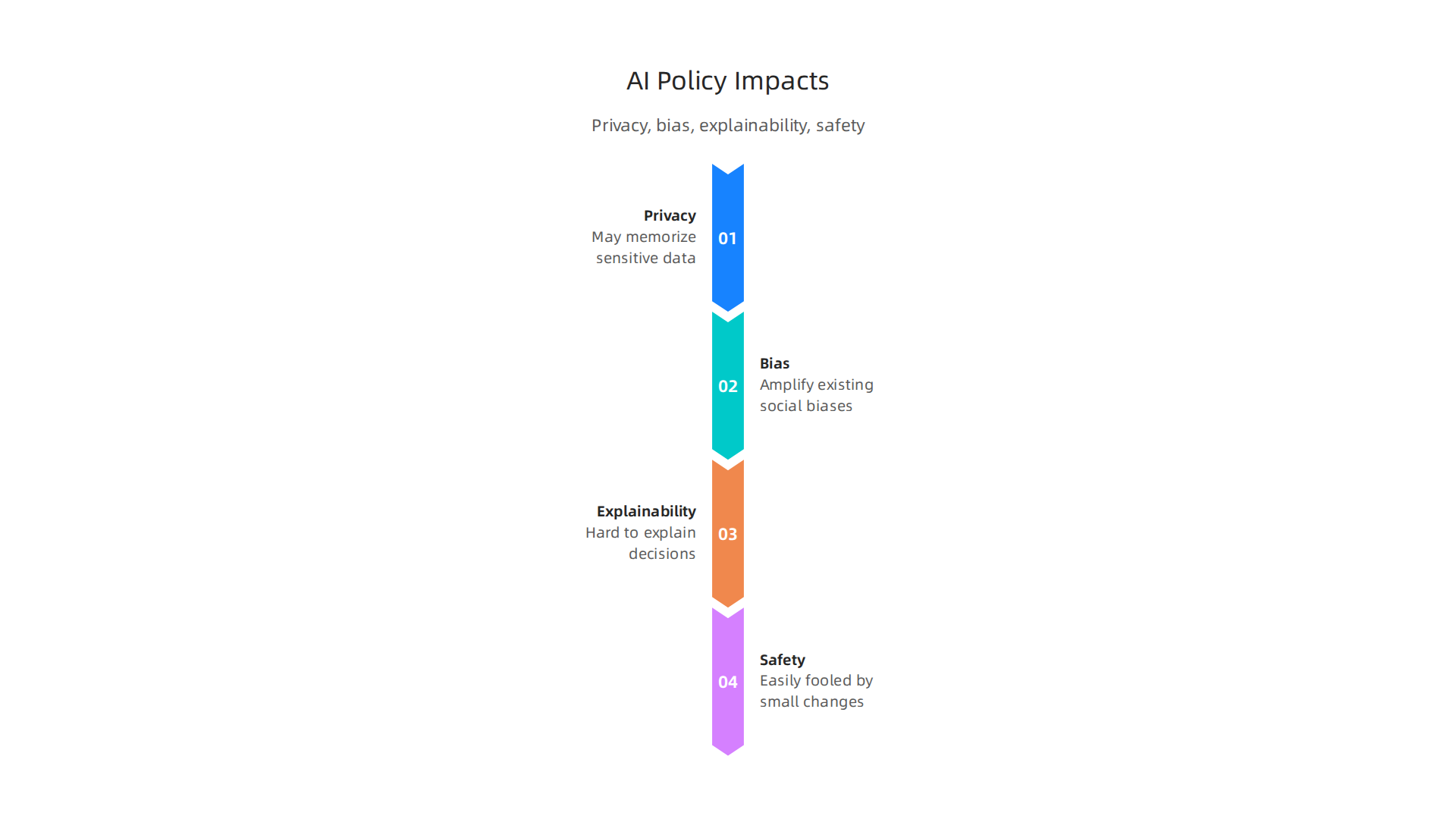

The way an ai neural network is built can either help these problems or make them worse. This is a key part of computer science for artificial intelligence that policy makers think about every day.
Privacy and Data Protection
Complex AI systems, especially those using Transformer architectures, learn from vast amounts of information. Sometimes, this means they can accidentally "memorize" parts of the data they were trained on, including personal or sensitive details. This can lead to privacy risks, especially with large language models, or LLMs Privacy-Data-Protection-Risks(LLMs). While new ways to protect privacy are being developed, like special privacy methods, they can sometimes make the AI less accurate or harder to understand. This shows a tough choice between protecting data and making sure AI works well Privacy-Preserving Robustness Verification for Neural ….
Bias and Fairness
The architecture of an ai neural network doesn’t create bias on its own. But it can make existing biases in the training data much more obvious. For example, if a CNN used for recognizing faces is mostly trained on pictures of one type of person, it might not work as well for others. Different ai models can pick up on these unfair patterns, leading to biased results. This is a big challenge to ensure that AI systems are fair for everyone.
Explainability and Transparency
Many advanced ai neural networks, especially deep learning models and Transformers, are often called "black boxes." This means it’s hard to understand exactly why they make a certain decision. Simpler networks, like MLPs, are generally easier to explain. For policy makers and everyday users, being able to understand how an AI came to an answer is very important for trust and accountability. It helps with auditing and making sure the AI is doing what it’s supposed to. Building trust in AI means aiming for transparent and secure training data Opening the black box. Learn about explainable AI tools. Getting to this level of understanding is a key focus for those investing in AI Interpretability, Control, and Robustness.
Safety and Robustness
How an ai neural network is built also affects its safety. Some architectures can be easily fooled by tiny, hidden changes to their input data. This is known as "adversarial vulnerability." Imagine a self-driving car (an agentic ai) that misidentifies a stop sign because of a sticker you can barely see. This is a major concern for AI safety. Researchers are working on making ai neural networks more robust so they can resist these attacks and behave reliably. It’s about ensuring these systems are trustworthy Trustworthy Machine Learning through the Lens of …. For more on how to approach these challenges, explore how to build AI securely and compliantly.
Understanding the specific features of different ai architectures is key for creating good AI policy. These choices directly impact the privacy of data, the fairness of decisions, how easy it is to understand the AI, and its overall safety. This makes rigorous artificial intelligence review a must for responsible development. For policy professionals aiming to understand these complex dynamics, gaining AI literacy for policy professionals is more important than ever.
Understanding how an ai neural network grows and gets better is a big topic, especially in 2026. This is where "scaling laws" come in. These laws help us predict how much an AI system’s performance will improve as we give it more resources. Think of it like a recipe: the more good ingredients and oven time you give it, the better the cake might turn out.
How AI Models Grow
Scaling laws show that the performance of an ai neural network, especially large language models, improves in a very predictable way. This improvement happens when you increase three main things:
- Model Size (Parameter Counts): This refers to how many "knobs" or "settings" the ai neural network has to learn from data. More parameters generally mean a more complex model that can learn more intricate patterns. Researchers have seen that the performance loss decreases in a power-law relationship as model size increases Scaling Laws for Deep Learning.
- Dataset Size: This is the amount of information the AI learns from. The more diverse and larger the dataset, the more the ai neural network can understand about the world. Better data quality can also significantly impact how these scaling laws work How Text Quality Interventions Reshape Neural Scaling Laws for….
- Compute Budget: This is the amount of computing power (like from special computer chips) used to train the AI. Training very large ai neural networks needs a lot of electricity and time.
These three factors often work together, meaning you need to scale them all up for the best results. The relationship between these elements is a core part of computer science for artificial intelligence Scaling Laws for Neural Language Models – arXiv. Scientists are even finding ways to combine these ideas into "Unified Neural Scaling Laws" to better predict how deep neural networks behave when many things change at once Unified Neural Scaling Laws.
Architecture and Trends
While scaling laws show general trends, the specific architecture of an ai neural network still matters. For example, large Transformer models, which are a kind of generative ai, have shown impressive scaling properties. Different ai models might scale slightly differently, but the core idea remains: bigger models, more data, and more compute usually lead to better performance. In 2026, we see a constant push to make these models even bigger and more capable.
What Scaling Means for Governance
The massive scale of today’s AI models has big effects for policy makers:
- Compute Concentration: Training huge ai neural networks requires a lot of specialized computer hardware and energy. This means only a few large companies or nations can afford to build and train the most powerful AI systems. This "compute concentration" raises questions about who controls the most advanced AI and how that power might be used.
- Disclosure: With such powerful AI, there’s a growing need for transparency. Policy makers are asking companies to share more information about their large AI models. This includes telling people about the data used for training, the compute power involved, and what the models can and cannot do. This helps with monitoring and making sure these powerful tools are used responsibly.
- Monitoring: Keeping an eye on how these large, complex ai neural networks are developed and used is a major challenge. Because they are so powerful, small changes or misuse could have big impacts. This means there’s a focus on figuring out ways to check these systems’ safety and fairness as they get bigger. Understanding these complex systems is a key part of navigating AI infrastructure 2026.
As we continue to build bigger and more capable AI, understanding these scaling laws helps everyone, from engineers to policy makers, make better decisions about how to develop and control this powerful technology. Staying on top of these fast-moving changes is critical.
To get clear daily AI updates and help make sense of all these developments, consider subscribing to The AI Newsletter Worth Reading.
Even though making an AI neural network bigger with more data and computing power often helps it do better, that’s not the whole story. When teams build or choose an AI system, they face important choices. These choices are called "design trade-offs," and they mean you might have to give up a little bit of one good thing to get more of another. It’s like building a car: you can make it super fast, but it might not be very good on gas or comfortable to ride in.
Here are some common trade-offs in building an ai neural network:
Interpretability vs. Performance
Sometimes, the best-performing AI models are like a "black box." This means they can give great answers, but it’s very hard to understand how they got that answer. This is called interpretability. For some tasks, like recommending a movie, it might not matter if we don’t know exactly why the AI suggested it. But for important tasks, like a doctor AI helping with a diagnosis or a system deciding on a loan, knowing the "why" is super important. We need to be able to explain the decisions.
The challenge is that making an ai neural network more explainable can sometimes mean it doesn’t perform quite as well, or it needs more effort to build. In 2026, there’s a big push to "open the black box" and create more explainable AI tools, especially for trustworthy AI Opening the black box. Learn about explainable AI tools.
Robustness vs. Efficiency
Robustness means how well an AI works even when it sees things it hasn’t been specifically trained on, or if the input is a little bit different than expected. A robust AI won’t break down or give strange answers easily. For example, an autonomous car’s ai neural network needs to be very robust to handle all kinds of unexpected road conditions.
Making an AI super robust often requires more complex designs or more training, which can make it less efficient. Efficiency usually means it runs faster or uses less computing power (and electricity). So, teams have to decide how much robustness they need versus how fast and cheap the AI should be to run. Experts often look at these aspects together Investing in AI Interpretability, Control, and Robustness.
Compute Cost vs. Data Efficiency
As we learned, training huge AI models takes a lot of computing power. This directly leads to high compute costs. If you want an AI to do many things or learn very complex ideas, you might need a lot of data. This is about data efficiency: how well an ai neural network can learn from a smaller amount of good data. Some advanced AI models can learn a lot from less data, but they might still need a lot of compute power to do that learning. Other models might need huge amounts of data, which also costs a lot to gather and process. So, it’s a balance between how much data you have and how much computing you can afford.
Decision Framework: Balancing Policy and Product
When picking or changing an AI design, teams need to think about two big things:
-
Policy Constraints: These are the rules, laws, and ethical guidelines that say how an AI should work.
- Privacy: Does the AI protect personal information? Techniques like privacy-preserving methods can affect how robust or explainable an AI can be Privacy-Preserving Robustness Verification for Neural ….
- Fairness: Does the AI treat everyone equally without bias?
- Accountability: Can we figure out who is responsible if the AI makes a mistake?
- Safety: Is the AI safe to use, especially in critical situations?
- To learn more about setting up these systems, check out guides on how to build AI securely and compliantly.
-
Product Requirements: These are what the business or user needs the AI to do.
- Performance: How well does the AI complete its task?
- Speed: How fast does it need to respond?
- Cost: How much does it cost to build and run?
- Scalability: Can it handle more users or more data in the future?
For example, an agentic AI that controls a robotic arm in a factory might prioritize robustness and interpretability heavily, even if it means slightly higher compute costs. This is because safety and understanding mistakes are critical. On the other hand, a generative AI that creates images for marketing might prioritize performance and data efficiency to produce high-quality images quickly, where explaining every creative step is less important.
Balancing these trade-offs is a core part of modern computer science for artificial intelligence. It helps ensure that different AI applications are not only powerful but also trustworthy and useful in the real world. This helps drive policy decisions with careful thought for both ethics and performance Driving Policy Decisions with AI Ethics and Performance Evaluation.
Beyond the basic ways of building an AI, computer science for artificial intelligence has grown to create special kinds of ai neural network models. These new designs are made to handle very specific types of data or tasks really well. Let’s look at some of these different AI models and what makes them unique, along with the new rules and worries they bring up.
Graph Neural Networks (GNNs)
Imagine data that’s connected like a map, such as social networks where people are linked, or molecules where atoms are connected. Regular AI models don’t always do a good job with this kind of linked data. That’s where Graph Neural Networks (GNNs) come in. They are a special kind of ai neural network designed to understand relationships between different pieces of information. For example, GNNs can help with understanding how things are organized in an image or in 3D shapes A Comprehensive Survey on 3D Deep Point Cloud Models.
The special thing about GNNs is how they look at both individual data points (like a person) and how they connect to others (like their friends). This helps them find patterns that other AIs might miss. But with this power comes new questions about how they make decisions, especially when those decisions affect groups of linked people or systems. It’s important to know if a GNN’s recommendation is fair for everyone in the network, not just one person.
Diffusion Models
Then we have diffusion models. These are a type of generative AI that have become very popular for creating new things. Instead of just sorting or predicting, diffusion models are really good at making brand new images, sounds, or even text that looks real. Think about AI tools that can turn a few words into a beautiful picture or a realistic video. These models start with noise and slowly "denoise" it until a clear image appears Survey on Remote Sensing Scene Classification.
The amazing ability of diffusion models to create new content also brings big questions for rules and safety. For example, how do we know if an image or video was made by a diffusion model (called "synthetic content") or if it’s real? This is about knowing the provenance, or where the content came from. We also worry about deepfakes, which are fake images or videos that look very real. Rules around text-to-video artificial intelligence policy in 2026 are becoming very important to manage these powerful tools.
Multimodal Systems
Finally, there are multimodal systems. Most AI models used to work with just one type of data at a time, like only text or only images. But humans experience the world using many senses at once. Multimodal systems try to do the same thing. They combine different kinds of data, like text, pictures, and sounds, to understand things in a much richer way. For instance, an AI might look at a picture of a cat and read a description of it to get a fuller understanding Multimodal Learning with Transformers: A Survey.
These different AI models are very powerful, but also raise new challenges for how we control them. When you mix different types of data, it’s harder to check for fairness or bias. You need to make sure the AI isn’t showing favoritism based on one type of input over another. Understanding these new challenges is a key part of AI trends in 2026, covering multimodal models, autonomous agents, and the governance challenge. The field of computer science for artificial intelligence keeps growing, and so do the ways we need to think about policy.
To keep up with the latest in AI and technology policy, make sure you get clear daily AI updates.
The AI Newsletter Worth Reading
As different types of AI neural network models grow and become more complex, it’s super important to have good ways to check and audit them. This helps make sure they work how they should, are fair, and keep our data safe. Think of it like a strict quality check for all the smart AI tools we use today in 2026.

Why We Need to Check AI Architectures
When we talk about computer science for artificial intelligence, it’s not enough to just build fancy models. We also need to know if they are trustworthy. This means asking questions like:
- Does the AI always give fair answers, or does it favor some groups?
- Can we understand why the AI made a certain choice, or is it a "black box"?
- Is the AI strong enough to handle tricky situations or bad data without breaking down?
- Does the AI protect our private information?
These questions are at the heart of evaluating and auditing AI systems. For instance, knowing where AI content came from (provenance) is a big deal, especially with advanced generative AI. We also need to look at how different AI designs affect these areas. Experts are looking into how to make AI systems more trustworthy by focusing on understanding, control, and strength Investing in AI Interpretability, Control, and Robustness.
Key Ways to Evaluate AI Models
There are special ways to measure how well an AI neural network performs. These are called benchmarks and metrics. They help us see if an AI is doing its job correctly and safely.
- Interpretability (Explainability): This is about being able to understand how an AI reaches its conclusions. If an AI gives a loan or flags something important, we need to know why. This is hard because AI models can be very complex, but it’s key for trust Opening the black box. Learn about explainable AI tools.
- Robustness: This means the AI can still work well even if the data it gets isn’t perfect or if someone tries to trick it. We want AI that stands strong against different challenges.
- Privacy: This is about making sure the AI doesn’t accidentally share or misuse personal information. It’s a tricky balance, because sometimes to check how robust an AI is, you need to see its inner workings, which can clash with privacy rules Privacy-Preserving Robustness Verification for Neural…. Protecting sensitive data is a big concern, especially with large language models Privacy-Data-Protection-Risks(LLMs).
These different checks help us see the full picture of an AI’s performance, not just if it’s "accurate." They are important for guiding policy decisions and making sure AI is used ethically. You can learn more about this by checking out Driving Policy Decisions with AI Ethics and Performance Evaluation.
Checking the Checkers: Auditing Benchmarks
Even the tools we use to test AI need to be checked! Sometimes, benchmarks themselves might have problems, leading to wrong ideas about how well an AI works. In fact, some widely used evaluations have error rates as high as 42% Technical Performance – hai.stanford.edu. This is why researchers are creating new ways to audit benchmarks to make sure they are reliable Automated Benchmark Auditing for AI Agents and Large….
A Simple Checklist for AI Audits
To make sure an AI neural network is safe and fair, here’s a basic checklist for anyone involved, from those buying AI tools to those making the rules:
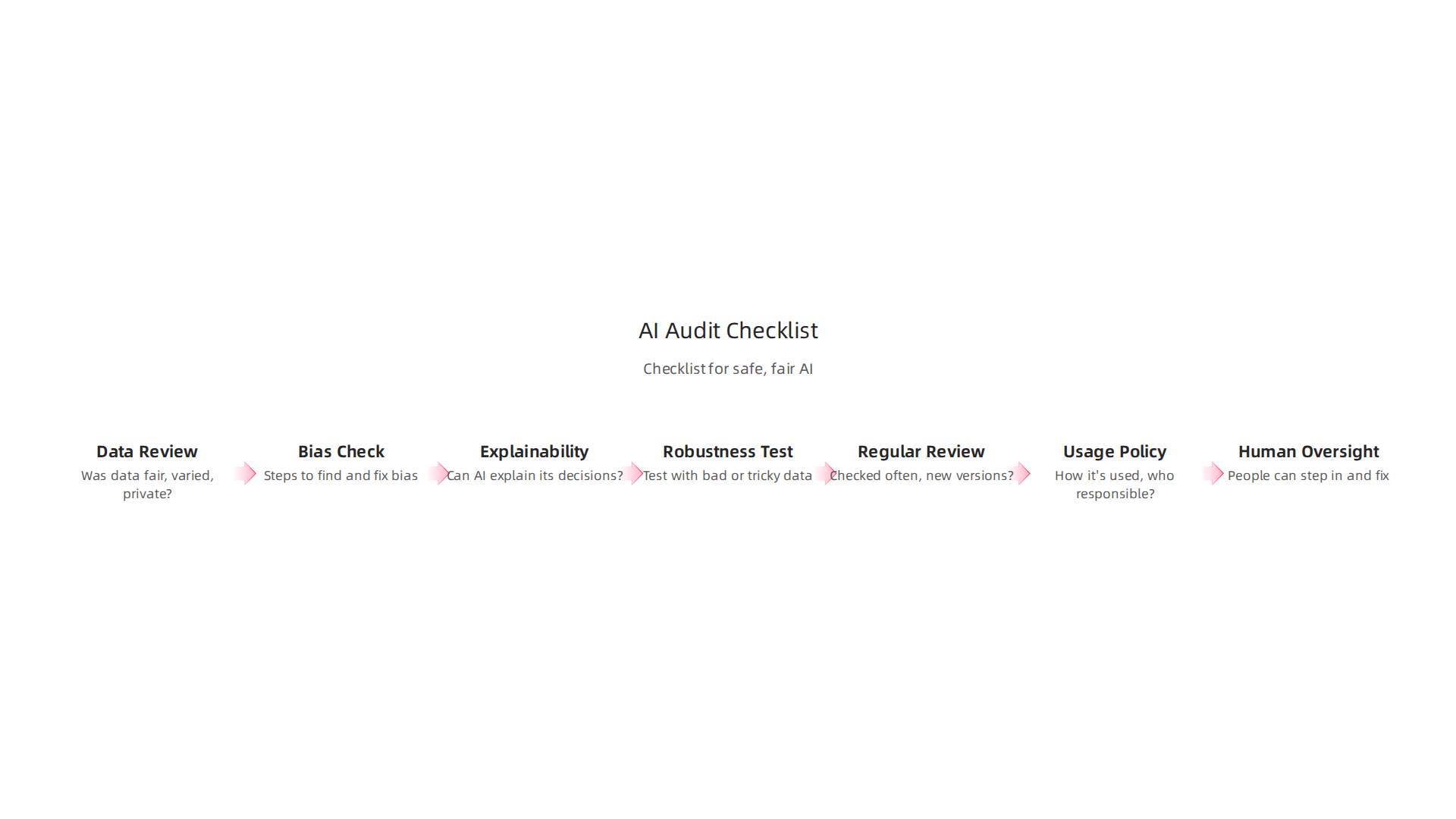
- Look at the Data: Was the data used to train the AI fair and varied? Does it protect private information?
- Check for Bias: Are there steps in place to find and fix any unfairness in the AI’s decisions?
- Understand the "Why": Can the AI explain how it made its most important decisions? If not, why?
- Test for Toughness (Robustness): Has the AI been tested with bad data or tricky situations to see if it stays reliable?
- Regular Reviews: Does the AI get checked often, especially when new versions come out? This is part of a Rigorous Artificial Intelligence Review for Policy Compliance.
- Clear Rules: Are there clear rules for how the AI should be used and who is responsible if something goes wrong?
- Human Oversight: Is there always a way for people to step in and fix things if the AI makes a mistake or acts unfairly?
By using these methods, we can better understand and control the different AI models being created. This helps us ensure that computer science for artificial intelligence is used for good, making our future with AI both smart and secure.
Summary
This article explains why neural network architectures matter for policy, technology, and business strategy in 2026. It introduces the basic building blocks—neurons, layers, activation functions—and shows how training with loss functions and weight updates makes models learn. The piece compares common architectures (MLPs, CNNs, RNNs, Transformers), highlights specialized models like GNNs and diffusion models, and explains which designs work best for generative versus agentic systems. It walks through key trade-offs—interpretability versus performance, robustness versus efficiency, and compute cost versus data needs—and why those trade-offs matter for governance and investment decisions. The article also covers scaling laws (model size, dataset size, compute) and the policy implications of concentrated compute and disclosure. Finally, it lays out safety, privacy, and fairness risks and provides a practical audit checklist so readers can evaluate architectures for compliance, trust, and real-world deployment.