

Why entrepreneurs must move from busyness to business thinking
It’s easy to get caught in a trap when you’re running your own company. You might feel like you’re always busy, working long hours, and doing many tasks. But here’s the thing: being busy doesn’t always mean you’re making real progress. This common problem, known as the difference between busyness vs business, can hold back even the most driven entrepreneurs.
Think about it this way: busyness is just being active. It’s checking emails, having lots of meetings, or doing small tasks that don’t really move the needle. Business, on the other hand, is about strategic progress.

It means focusing on tasks that create value, help your company grow, and get you closer to your main goals. It’s about how to value a business based on its true impact, not just the amount of work done.
This difference is super important for new companies, especially in 2026. Startups often have very little money and not enough people. Every choice and every hour worked needs to count. Also, the rules around technology and business are always changing, which adds another layer of challenge. Keeping up with these changes is key for any entrepreneur ventures aiming for success. This is why many professionals find it helpful to get daily updates on important topics like AI and technology policy. To stay ahead, consider getting The AI Newsletter Worth Reading.
To truly generate business ideas that lead to growth, you must switch your focus. You need to stop just doing things and start doing the right things. This means using smart ways to decide what’s most important. For example, many founders in 2026 use special guides like Startup Prioritization: 5 Frameworks Founders Actually Use (2026) to help them choose tasks wisely.
In the rest of this article, we’ll give you clear steps and tools to help you make this important shift. You’ll learn how to move from simply being busy to truly building a strong, valuable business. This way, you can achieve sustainable growth by learning to Adopt Digital Business Models: The SMB Guide to Sustainable Growth.
To truly stop just being busy and start making real progress, you need a clear plan. This plan comes from understanding three key things: your mission, your metrics, and your margin. Think of these as the strategic triad for any entrepreneur ventures aiming for growth.
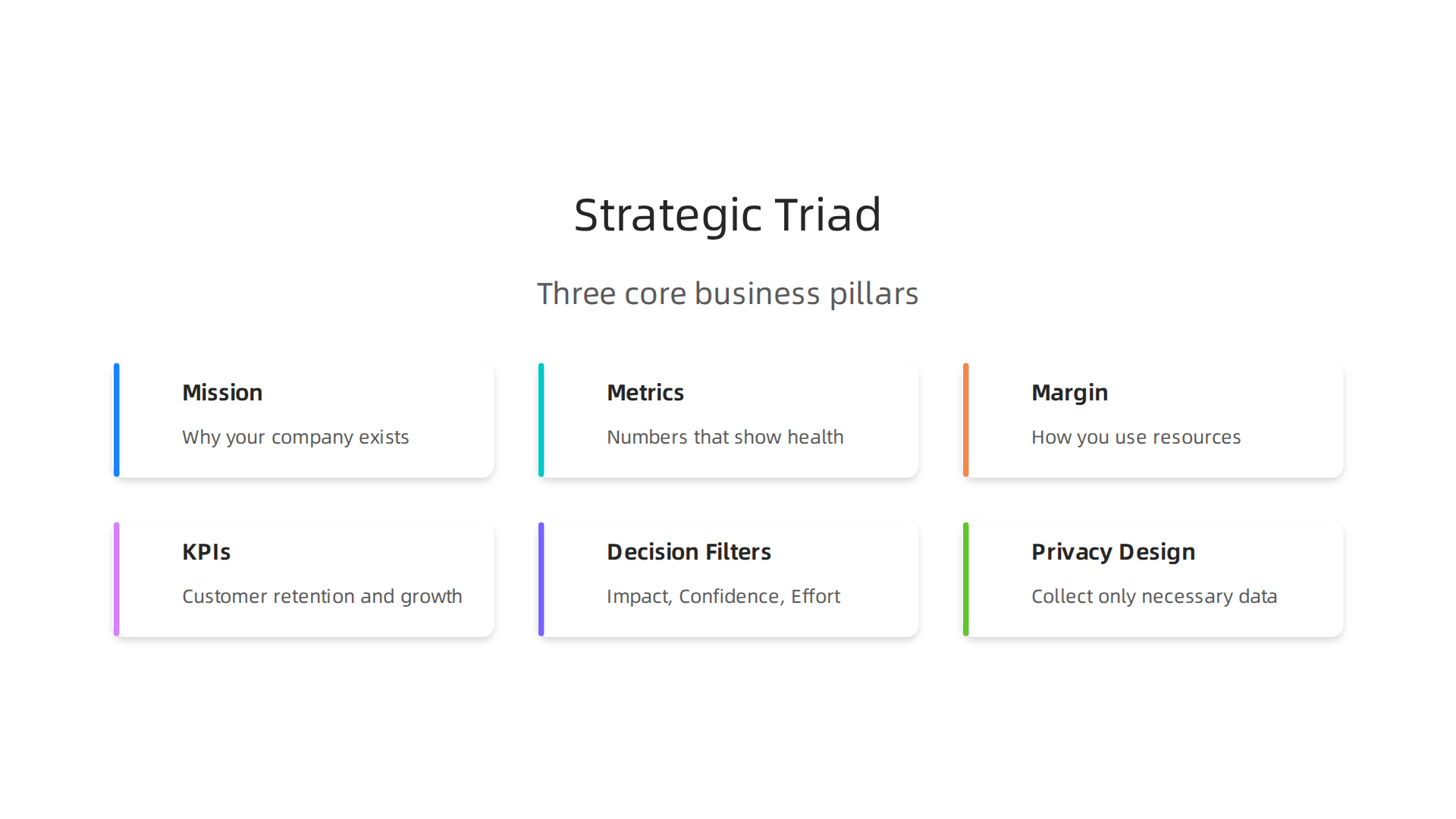

These three ideas help you move from simply being busy to truly building a strong company, avoiding the trap of busyness vs business.
Mission: Your Guiding Star
First, let’s talk about your mission. This is simply why your company exists. What problem do you solve? Who do you help? A clear mission acts like a compass. It tells you what’s important and what’s not, helping you make smart choices every day. When your mission is clear, it’s much easier to say "no" to tasks that don’t help you reach your main goal. This focus cuts down on busywork.
A strong mission helps you generate business ideas that really matter for your company. It keeps everyone on your team pointed in the same direction, making sure every effort adds to the big picture. It also helps you understand how policy creates powerful entrepreneur ideas for 2026 startups.
Metrics: Knowing What Matters
Next, we look at metrics. These are the numbers you track to see how well your business is doing. Here’s a secret: not all numbers are equal. Some numbers, called "vanity metrics," might look good, but they don’t really show if your business is healthy. For example, having many social media followers is nice, but if those followers never buy anything, it’s just busyness.
Instead, you need to focus on metrics that truly show how to value a business and help it grow. These are called Key Performance Indicators, or KPIs. In 2026, successful entrepreneurs look at things like:
- Customer Retention: How many customers keep coming back?
- Revenue Growth: Is your money coming in growing steadily?
- Customer Lifetime Value (CLTV): How much money does a customer bring in over their whole time with your business?
- Conversion Rates: How many people who see your product actually buy it?
These kinds of numbers help you understand what’s working and what’s not. They show you real progress, not just activity. Focusing on the right KPIs helps you choose tasks that have a big impact, moving you past the simple idea of business vs busyness towards real success. You can find more important metrics in guides like "Startup KPIs: Metrics Every Founder Must Master" which can help you track real growth in 2026.
Margin: Staying Alive and Growing
Finally, there’s margin. This word can mean a few things, but for new companies, it’s about how wisely you use your resources, especially money. It’s not just about how much profit you make on each sale. It’s also about your "runway."
Runway is simply how many months your company can keep running before you run out of cash, if nothing changes. It’s a very important number for startups. If your runway is short, you might have to make quick, tough choices. If it’s long, you have more time to learn, grow, and plan.
To manage your margin and runway well, you need to:
- Watch your spending: Every dollar needs to count.
- Increase your income: Find ways to bring in more money.
- Be efficient: Use your time and resources smartly to get the most done.
Keeping a close eye on your runway helps you make smart, strategic choices, ensuring your entrepreneur ventures have enough time to grow. For instance, knowing how to manage your cash is vital for early-stage companies to avoid running out of money too soon. If you’re looking for ways to extend your runway, learning how to Secure regional startup funding boost your local business growth can be a crucial step.
By clarifying your mission, focusing on the right metrics, and carefully managing your margin, you can move away from just being busy. You can start building a strong, valuable business that truly grows in 2026 and beyond. This strategic triad helps you make sure every action you take is a step forward, not just a way to fill your day.
Moving beyond just knowing your mission, metrics, and margin, the real challenge is making smart choices every day. This is where special tools, called prioritization frameworks, come in. They help you pick the most important tasks so you don’t get stuck doing busywork.

These tools are super helpful for small teams and new businesses that don’t have a lot of time or money. They help you move past the idea of busyness vs business by focusing on what truly matters.
Making Smart Choices with Decision Filters
Imagine you have a big list of things to do. How do you decide what to tackle first? You need simple rules to sort through them. Three key rules, or "decision filters," are:
- Impact: How much good will this task do for your business? Will it bring in more money, make customers happier, or solve a big problem? For example, a task with "massive impact" is much better than one with "minimal impact" (rated 3 vs. 0.25 on some scales) for your entrepreneur ventures SaaS Product Roadmap Prioritization: The Complete 2026 Guide to RICE, MoSCoW, and Kano Frameworks.
- Confidence: How sure are you that this task will actually work? Is it a wild guess, or do you have good reasons to believe it will succeed? Being confident helps you avoid wasting time on ideas that might fail.
- Effort: How much time and energy will this task take? Think about the people and resources needed. Tasks that take less effort but give big results are usually best.
Using these filters helps you quickly see which tasks are truly valuable and which are just filling up your day. Frameworks like ICE (Impact, Confidence, Ease) and RICE (Reach, Impact, Confidence, Effort) use these ideas to help businesses prioritize what to build next RICE Prioritization: Framework, Formula & Template (2026). The ICE method, for example, is great for startups because it’s quick and helps you focus on what will "move the needle" ICE Scoring: Prioritise by Impact, Confidence, Ease.
Building a Simple Plan That Stays Open
After you’ve scored your tasks using these filters, you can build a minimal roadmap. This isn’t a strict, unchangeable plan. Instead, it’s like a path that keeps your options open ("preserves optionality") while still moving you forward ("enabling momentum").
Here’s how:
- Focus on the Top Few: Pick the top 1 to 3 tasks that have the highest impact and confidence, and the lowest effort. These are your main goals for the next short period.
- Keep it Short: Don’t plan too far ahead. Things change fast, especially in 2026. A shorter plan means you can react quickly to new chances or problems.
- Learn and Adjust: As you work on your top tasks, you’ll learn new things. Use this new knowledge to update your roadmap. This keeps your plan fresh and relevant.
This approach helps you avoid getting bogged down in too much planning, which can be another form of busyness vs business. It lets you generate business ideas and put the best ones into action quickly, helping you truly how to value a business by seeing real results. Consider how adopting digital business models can help small businesses grow sustainably and make these decisions easier adopt digital business models.
Getting Rid of Low-Value Tasks
What about all those tasks that scored low on impact or high on effort? They often lead to a lot of busywork without much real gain. To beat the business vs busyness trap, you have to deal with them.
Here are some tactics:
- Delegate: If a task must be done but isn’t a top priority for you, can someone else do it? Maybe a team member, a freelancer, or even an automated tool.
- Eliminate: Sometimes, a task simply doesn’t need to be done at all. If it doesn’t help your mission, improve your metrics, or truly add value, get rid of it.
- Automate: For repeating tasks, look for ways to use technology. Many top AI tools in 2026 can handle routine work, freeing you up for more important things top AI tools 2026.
By actively cutting down on busywork through smart prioritization and eliminating unnecessary tasks, you make sure your time and effort are always focused on real growth and progress. This strategic mindset is what truly sets successful entrepreneur ventures apart.
Want to stay ahead on how AI can streamline your business and policy decisions? Discover why so many professionals trust this daily briefing. Get The AI Newsletter Worth Reading.
By actively cutting down on busywork through smart prioritization and eliminating unnecessary tasks, you make sure your time and effort are always focused on real growth and progress. This strategic mindset is what truly sets successful entrepreneur ventures apart. Now, let’s look at how you handle your most important resources: money, people, and the shortcuts you might take in your products.
Resource allocation: runway, talent, and technical debt
Even after you cut out busywork, you still have to decide where to put your valuable resources. This is about making smart choices with your money, your team, and even the quality of your product’s underlying tech. If you don’t manage these well, you can quickly fall back into the trap of busyness vs business.
Smart Money Choices: Balancing Growth and Stability
Every business has a "runway." This is how long you can keep operating with the cash you have before you run out of money. You can figure this out by dividing your cash by how much you spend each month, also known as your "burn rate" Startup Financial Metrics & Valuation Guide. In 2026, many startups aim for a runway of 18-24 months to stay safe Runway formulas and benchmark metrics Core formula.
The big question for entrepreneur ventures is how to split your limited money. Should you use it for new, exciting growth experiments that could bring in lots of customers but might also fail? Or should you use it to make your main product stronger and more stable, even if that doesn’t feel as exciting?
It’s a dance between trying new things and making sure your core business stays solid. Too much focus on risky growth without stability can lead to problems later. Too much stability without trying new things means you might miss out on big chances to grow. To truly understand how to value a business, you must find the right balance, using data to guide your capital allocation decisions. For strategies on securing the funds needed, check out how to secure startup funding in 2026 with platform verification and policy.
Building a Strong Team: Hiring and Contracting
Your team is your biggest asset, but it can also be your biggest cost. When you hire new people or bring in contractors, you want to make sure they add real value and don’t just create more busyness vs business.
Think about what tasks are essential but take up too much of your core team’s time. Can you hire someone specifically for those tasks, or use a freelancer for special projects? The goal is to increase "leverage," meaning each person’s work helps the whole business do more. For example, some companies are now using AI teammates to handle routine tasks and improve meeting efficiency, which allows human teams to focus on higher-value work. This helps to build your 2026 AI workforce strategy for policy compliance and avoid unnecessary hiring that could lead to more busywork.
Dealing with Technical Debt: A Strategic Choice
Technical debt is like taking a shortcut when building a product. Maybe you launched something quickly to get it to customers, but the code wasn’t as neat or well-built as it could have been. Over time, these shortcuts make it harder to add new features or fix bugs, slowing everything down. It creates business vs busyness because you spend time fixing old problems instead of building new value.
Instead of just reacting to technical debt when it causes problems, smart entrepreneur ventures manage it on purpose. You might decide to take on a little technical debt if it helps you launch a new feature quickly and get feedback. But you also plan to clean it up later. This means setting aside time and resources to improve your product’s foundation. It’s a strategic choice to balance speed now with ease of development later. Neglecting this can lead to big problems down the road, making it hard to generate business ideas or keep existing ones running smoothly. Understanding AI infrastructure 2026 navigating cost, security, and compliance is key for managing this debt wisely.
After you get a handle on your money, team, and product’s technical side, another big challenge for entrepreneur ventures is keeping up with all the rules and laws. In 2026, the world of business is full of new policies, especially for anything involving AI or user data. If you don’t pay attention to these, you can get caught up in endless fixing, which is a classic example of busyness vs business.
Keep an Eye on New Rules: Monitoring Policy Risks
It’s easy to get lost in the daily grind and forget about checking for new laws. But avoiding this can save you huge headaches later. Founders need ways to keep track of policies that might affect their products. For example, AI-powered tools can scan for new rules and give you advice tailored to your business, helping you stay ahead of laws like GDPR and CCPA Privasee – Funding: $500K+.
A smart approach is to think about what data your product collects and why. For AI products, you need to be very clear about how user data is used for AI training and if users can choose not to share their data. You should also label content that your AI creates Startup Compliance in the AI Era. This kind of careful planning helps you avoid problems and keeps your business running smoothly.
When to Ask for Help: Lawyers vs. Common Sense
Sometimes, you’ll need a lawyer or an expert to help you understand complex rules. This is especially true for big laws like the EU AI Act or new privacy acts. They can help you make sure your privacy policy is clear and written in plain language, explaining what data you collect and why Privacy Compliance Checklist for Startup Founders. For example, a complete GDPR checklist can guide first-time founders on necessary steps for compliance The Ultimate GDPR Checklist for First-Time Founders.
Other times, you can use common-sense rules, often called "pragmatic guardrails." This means collecting only the necessary information and making sure users know what’s happening with their data. You also need to have simple ways for users to agree to your terms, like a cookie consent banner that remembers their choices AI Startup Compliance Made Simple. Always make sure your privacy notice is easy to find on your website DPDP Act for Startups.
For more detailed strategies on navigating tricky regulations, take a look at a strategic guide to 2026 global tech policy.
Building with Rules in Mind: Integrating Compliance into Product Planning
The best way to handle policy and compliance is to build your product with these rules in mind from the very start. This idea is called "privacy-by-design." It means that for every feature you create, you think about:
- What data you need to collect (and only collect what’s necessary).
- Why you need it (like for training your AI or for reports).
- How you will keep it safe (using encryption and proper access).
- Who can see it.
- How long you will keep it.
This planning helps you avoid expensive changes later on. If you wait until your product is fully built to think about compliance, you might have to redo a lot of work, which is a waste of time and money, pushing you back into the cycle of busyness vs business. Building AI systems securely and compliantly requires a step-by-step blueprint that guides you through these early decisions How to Build AI Securely and Compliantly: A Step-by-Step Blueprint.
By planning for policy and compliance from day one, you build a stronger, more reliable business. This helps you focus on real value and growth rather than just reacting to problems.
Want to stay on top of daily AI updates and policy changes? Get clear daily AI updates from The AI Newsletter Worth Reading.
Building a strong entrepreneur venture means doing things that truly help your business grow, not just staying busy. After sorting out rules and laws, the next big step is making sure you talk to customers and sell in a way that truly helps you learn and make money. This means focusing on smart actions instead of getting stuck in the cycle of busyness vs business.
Talking to Customers to Really Learn
It’s easy to spend a lot of time talking to people without learning anything useful. To avoid this, you need to design your customer talks carefully. Think of these conversations as tests. You have ideas about who your customers are and what problems they have. These are called "hypotheses" or educated guesses. Your talks should help you see if these guesses are right or wrong, which is called "validation" or proving your ideas Customer Discovery.
When you talk to potential customers, focus on understanding their daily life, their goals, and what troubles them, instead of just telling them about your product. This is called "customer discovery," and it helps you find patterns in what customers truly need

Some Learnings on Customer Discovery at Early Stage Startups. For example, try to understand "a day in the life" of your customer to learn what really matters to them Validated learning about customers. This deep understanding helps you make a product that people actually want, cutting down on wasted effort.
Sales That Focus on Real Money, Not Just Being Busy
Sales are not just about making a lot of calls or having many meetings. Real sales mean getting customers who actually pay for your product and stay with you. This moves you from busyness vs business by tying sales actions directly to making money. For early businesses, it’s key to build a sales process that you can repeat over and over Customer Development stages.
You can use small experiments to test your sales process. For example, check if you are talking to the right customers. Also, see if you are selling in a way that makes sense for how customers like to buy How To Effectively Experiment with Your Early-Stage Sales Process. If your sales team is just doing a lot of activity without clear results, it’s time to rethink. An effective sales process helps you grow instead of just staying active. This also touches on how to secure regional startup funding by showing clear pathways to revenue.
Quick Experiments to Find What Customers Want
To make sure your product is a good fit for the market, you need to run quick and inexpensive tests, often called "discovery experiments." These tests give you early clues about your business ideas Quick and Cheap: Discovery Experiments Every Founder Should Know | M Accelerator.
Here’s how you can do it:
- List your ideas: Write down your guesses about your customer, their problem, and your product.
- Test the problem: Talk to customers to see if the problem you think they have is real.
- Create small tests: Turn your riskiest guesses into small experiments. These experiments should give you clear proof, not just opinions Lean Startup Methods and Rapid Business Experimentation.
For example, you could make a simple webpage to see if people are interested in your idea, or even test their willingness to pay before building the whole product MVP Testing: How to Validate Your Product (2026). This way, you learn fast and avoid wasting time and money on things people don’t want. This structured approach is key for any entrepreneur venture looking to genuinely generate business ideas and understand how to value a business based on real customer demand, pushing past mere busyness vs business.
Moving beyond just talking to customers and making sales, the next big step for any entrepreneur venture is to set up smart daily routines and use good tools. This helps you focus on what really matters instead of getting caught in the cycle of busyness vs business. It’s all about making your work count, not just doing a lot of it.
Daily Routines to Stay Focused
To make sure you’re always working on the most important things, it helps to have daily and weekly habits. These routines should help you find the big issues and push away tasks that just keep you busy.
Here’s how these habits can help:
- Start with big picture thinking: Spend a little time each day or week thinking about your main goals. What are the few things that will truly grow your business? This helps you see beyond the small tasks.
- Check your progress: Look at what you’ve done and ask if it moved your business forward. If not, figure out why.
- Plan your week wisely: Before the week starts, pick the most important tasks that match your big goals. This makes sure you don’t fill your days with busywork.
By doing this, you’ll naturally focus on important choices and actions, making sure your time is spent on things that actually help your business grow.
Smart Tools to Make Work Easier
In 2026, many new tools, especially those using AI, can help you avoid repetitive tasks. These tools can handle boring jobs, freeing you up to think about bigger ideas. For example, staying on top of all the rules and laws can be a lot of work. AI tools can help with this.
Some tools can scan data and keep an eye on new rules, like those for data privacy such as GDPR or CCPA Privasee – Funding: $500K+. They can give you advice on how to follow many different privacy laws at once Startup Compliance in the AI Era: EU AI Act, Data … – Udit Goenka. This means you don’t have to spend all your time reading every new law yourself. Such tools make sure you stay compliant from the very start, which is often called "privacy-by-design" Privacy-by-Design for AI MVPs – Compliance from Day One. They help you keep good records of what data you handle and why, which is key for rules like GDPR A Founder’s Guide to AI-Driven GDPR Compliance in the EU.
Using AI helps to improve how fast and how well you do many compliance tasks. It can even help with things like keeping track of your vendors and watching for any risks How to Ensure AI Systems Meet Enterprise Data Privacy Regulations. These smart tools remove busywork and let you make good decisions based on correct information. To learn more about how AI is changing businesses and policy, you might find The Biggest Information Technology Policy Shifts of 2026 helpful.
Picking the Right Tools and Processes
When you think about bringing in new tools or changing how you do things, always ask: Will this make my work simpler or more complicated? The best tools help you do more with less thinking. They should make your work easier, not add to your mental load.
Look for tools that make tasks like creating privacy policies simple and clear The Ultimate GDPR Checklist for First-Time Founders | AI Compliance Advisor Blog. Also, choose tools that help you collect only the necessary data and get clear consent from users AI Startup Compliance Made Simple – Key Rules and Frameworks.
By choosing tools and routines that really help you focus, you can make sure your entrepreneur venture grows strong. You’ll avoid wasting time on busywork and keep your attention on the important things that truly move your business forward.
Want to stay informed about the latest AI tools and policy changes? Get clear daily AI updates: The AI Newsletter Worth Reading.
Summary
This article explains why busy work often disguises a lack of strategic progress and shows founders how to shift from activity to impact. It lays out a practical three-part framework—mission, metrics, and margin—to help you decide what matters, measure it, and preserve the cash and time to execute. You’ll learn simple prioritization filters (impact, confidence, effort), how to build a short flexible roadmap, and ways to cut low-value tasks through delegation, automation, or elimination. The piece also covers resource allocation—runway calculations, hiring vs contracting, and managing technical debt—and why compliance and policy should be planned into your product from day one. Finally, it gives tactics for customer discovery, quick experiments that validate demand, and daily routines plus AI tools to reduce busywork so you can focus on scalable business outcomes.