The Intersection of AI and Visual Media Policy
Think about how fast this has happened. A few years ago, telling an AI to make a video was a gamble. You would type in a sentence and hope for the best. The results were often short, weird, and unpredictable. In 2026, that story has changed completely. Text to video artificial intelligence has matured into something much more useful. Top models can now create clips with consistent characters, proper lighting, and smooth motion. The latest state of AI video APIs in 2026 shows just how far this technology has come. It is a huge leap forward from where we were just a year ago. DataCamp’s review of the top models is a great place to start if you want to understand the tech behind it.
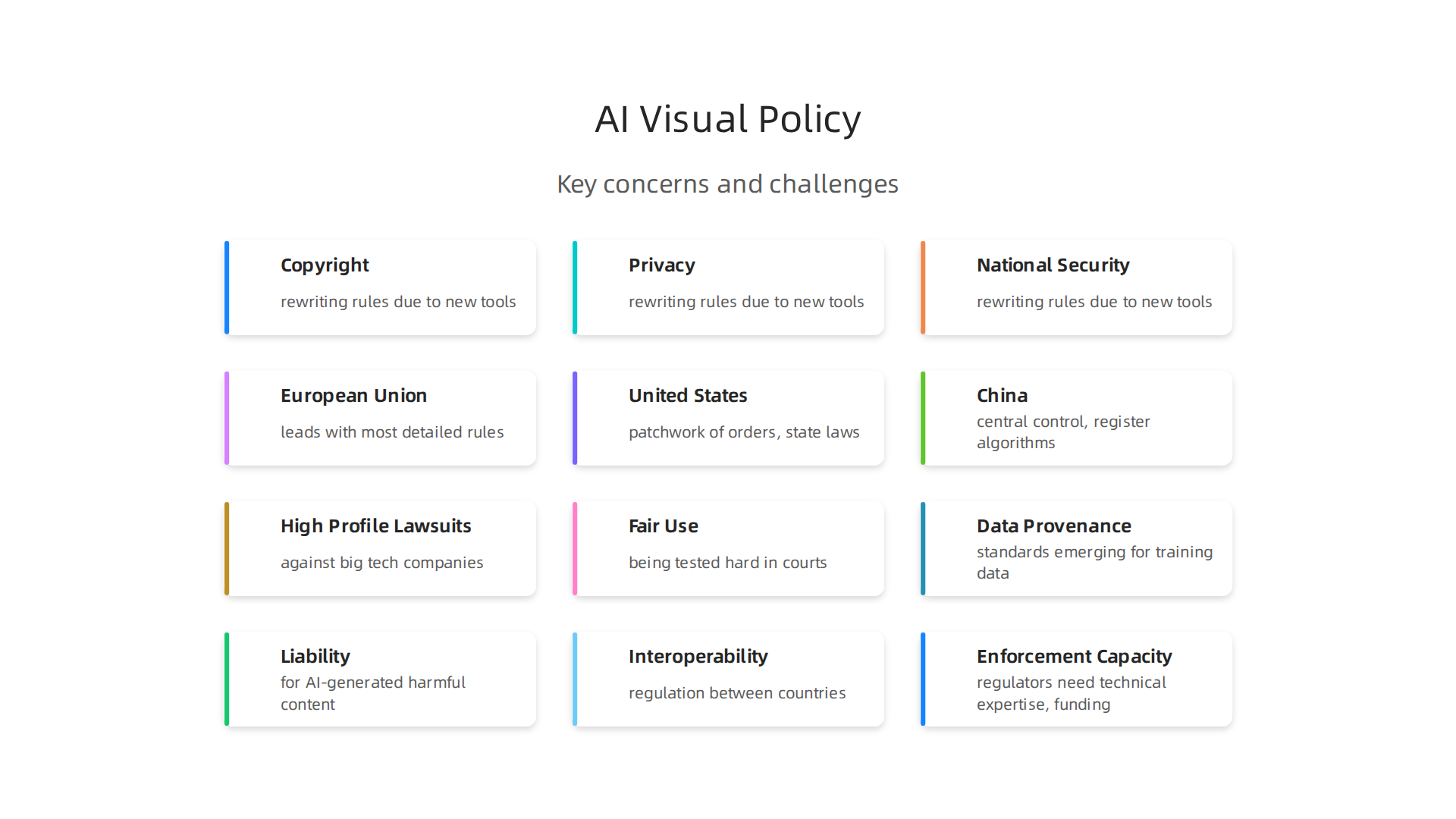
This speed creates a real problem for the rules we live by. The line between artificial intelligence with images and full video is disappearing quickly. Old concerns about pictures of artificial intelligence and deepfake photos are now much bigger with video. Artificial intelligence imaging tools are getting better every single month. Lawmakers and regulators are trying to catch up. They have to rewrite rules for copyright, privacy, and even national security because of these new tools.
We recently covered how image artificial intelligence is driving new policy in 2026, and the same forces are at play here, only stronger.
So, what does this mean for leaders and professionals who need to understand tech policy?

This article is your full policy primer. We will look at the core technology powering this shift. We will break down the biggest regulatory battles happening right now. And we will talk honestly about what comes next for copyright, deepfakes, security, and smart investment. If you are tracking AI governance in 2026, this is the starting point you need to get up to speed fast.
Key Players and Models in Text-to-Video AI
So who is building these tools? A handful of major players have completely changed the game in just the last 18 months. Let’s look at the names you need to know and why they matter for policy.
Google Veo 3.1 and OpenAI Sora 2 lead the pack right now. Frameo’s review of top models calls Veo 3.1 the best for realism and physics. Sora 2, on the other hand, excels at longer scenes with consistent characters. Both represent a huge jump from where we were in 2024. But they also raise big questions. Who controls these models? How transparent are they about safety testing? These are not small details. The competitive landscape directly shapes policy debates around market concentration. When just two or three companies hold the keys to the most powerful text to video artificial intelligence, regulators get nervous.
Other platforms are fighting for attention too. Invideo AI’s roundup of tested models highlights Seedance and WAN as strong options for motion control and editing. And DataCamp’s detailed comparison breaks down how each model handles artificial intelligence imaging differently. Some are better at realistic faces. Others shine at surreal animation. Each strength and weakness becomes a risk profile lawmakers have to understand.
Now here is where things get tricky for policy. Open-source versions of video generation models are spreading fast. Unlike big company models locked behind APIs, open-source tools can be downloaded and modified by anyone. That makes them harder to police. No central gatekeeper means no easy way to enforce safety rules or remove harmful content after release. This is a completely different governance challenge compared to proprietary systems. Think about how much harder it is to set standards when anyone can tweak the code.
This whole landscape reminds me of how image artificial intelligence is driving new policy in 2026. Only with video, the stakes are much higher. A fake video of a politician or a CEO can travel around the world in minutes. Regulators are starting to demand transparency reports from model makers. They want to know what data was used to train the AI. They want visible watermarks on generated clips. And they are asking tough questions about who gets access to the most advanced models.
Whether you work in government, a tech company, or an investment firm, you cannot ignore who builds these tools and how they operate. The choices these companies make today will define the rules you will live with tomorrow.
Adoption and Market Metrics for Generative Video
Numbers do not lie. The shift from curiosity to daily tool use for text to video artificial intelligence is happening faster than almost anyone predicted just two years ago. In 2025, the global AI video generator market was worth an estimated $788.5 million. By the end of 2026, that number is expected to hit $946.4 million, according to a detailed roundup of generative AI media statistics. Other analysis from Grand View Research confirms the same trend. And if you look ahead, projections from Fortune Business Insights say the market could reach $3.35 billion by 2034. That is serious growth.
But market size only tells part of the story. The real action is in how people are actually using these tools.

Enterprise adoption is the biggest driver right now. Marketing teams lead the charge. A recent survey found that 87% of marketers now use generative AI in at least one workflow in 2026, up from just 51% in 2024. That data comes from Digital Applied’s analysis of adoption trends. Even more telling, 79% of marketers plan to increase spending on generative AI creator content this year, as reported by eMarketer. This means the demand for artificial intelligence with images is spilling over into full video production.
Different sectors are moving at different speeds. Entertainment studios use these models for pre-visualization and storyboarding. Marketing agencies create ad variants in minutes instead of days. Educational institutions produce explainer videos for complex topics without hiring animators. Each sector has its own risk tolerance and policy needs. For a deeper look at how these differences play out in regulation, check out our article on how doctor AI regulation differs between healthcare and entertainment.
Geographically, adoption is concentrated in North America and parts of Europe, but Asia Pacific is catching up fast. Countries like Japan and South Korea are investing heavily in artificial intelligence imaging for manufacturing and training content. This global spread creates a patchwork of rules that policy leaders must track.
Here is the thing. When you see this much money and user growth in text to video artificial intelligence, you know regulators are watching. The very metrics that excite investors also worry lawmakers. Every new user means more generated content. More content means more potential for misinformation, copyright headaches, and privacy violations. That is why understanding pictures of artificial intelligence and their real-world use is so important for anyone in policy or compliance.
The market is still young. But the numbers make one thing clear. Generative video is not a niche experiment anymore. It is a mainstream production tool with real dollars flowing in. And that means the policies you build today will shape how this industry grows tomorrow.
Regulatory Frameworks for AI Visual Content
All that growth in text to video artificial intelligence means governments are paying close attention. Every country wants to encourage innovation and protect citizens. But they each have a different playbook. If you work in policy or compliance, you need to know what each major region is doing right now.
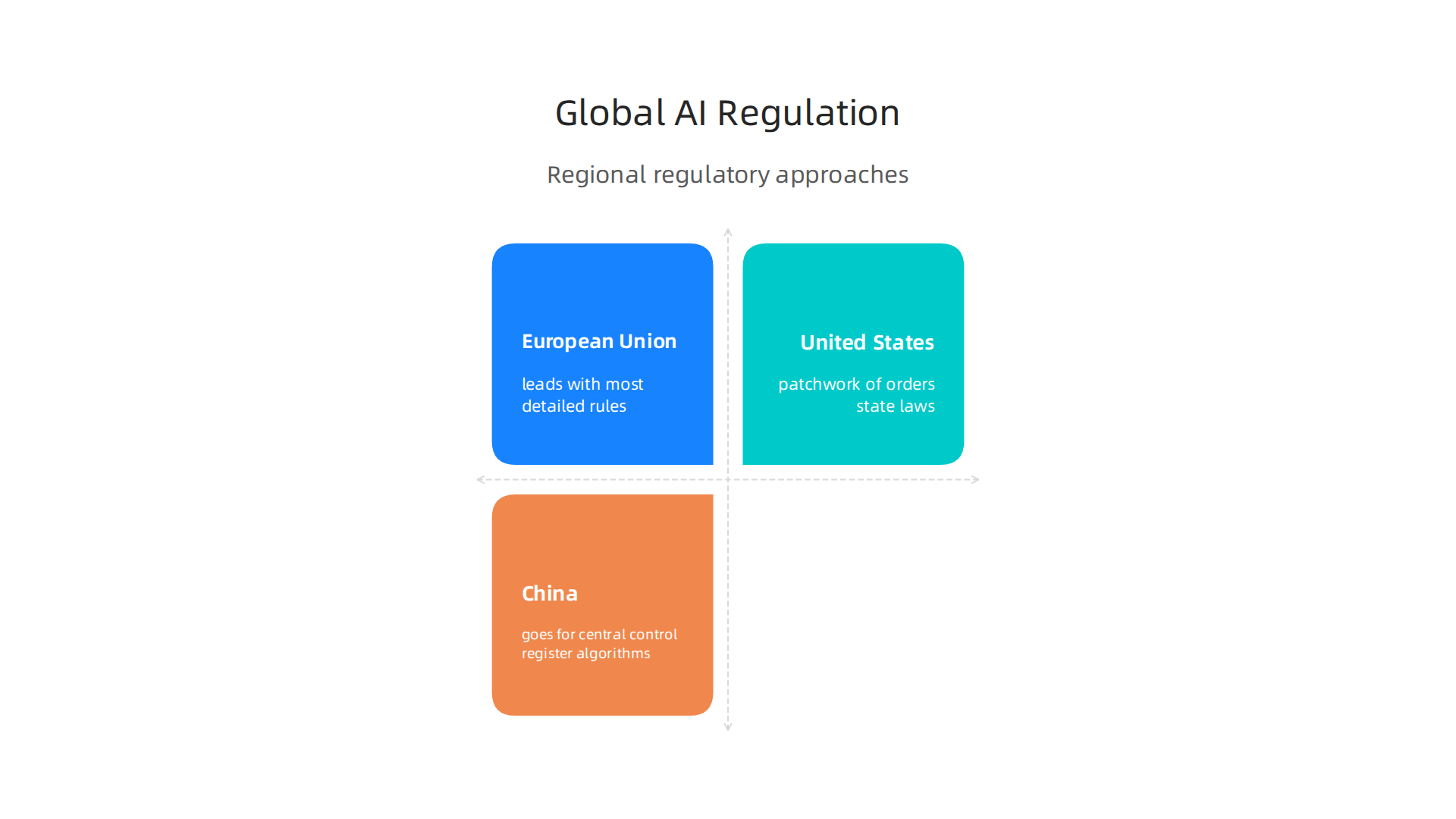
The European Union leads with the most detailed rules. The EU AI Act is the first big law that directly covers generative AI systems, including models that create artificial intelligence with images and video. Under this law, companies that build or use text to video artificial intelligence have specific duties. They must be transparent about how their models are trained. They have to label AI-generated content clearly. And they need to assess risks before launching new tools. The law sets different rules for different risk levels. High risk applications face the toughest requirements. This is the model that many other countries are watching closely.
The United States takes a different path. Here, there is no single federal AI law in 2026. Instead, you get a patchwork of executive orders from the White House, guidance from agencies like the Federal Trade Commission and the Department of Commerce, and a growing number of state laws. California, New York, and Colorado have already passed their own AI related bills. For a deeper look at how this split affects different industries, check out our article on how image artificial intelligence is driving new policy in 2026. The result is real confusion. A company using artificial intelligence imaging for marketing may have to follow one rule in California and a different one in Texas. That makes compliance expensive.
China goes for central control. The Chinese government requires companies to register their algorithms. They also review generative AI models before public release. Content that goes against state values is blocked or filtered. This approach affects everything from pictures of artificial intelligence to full video generation. And because Chinese tech companies are major players globally, their home country rules shape the tools the rest of the world uses.
So what does this mean for you? If you are a policy leader, you need to track all three approaches. The EU gives you a template for comprehensive regulation. The US shows what a fragmented system looks like. And China demonstrates how strict government oversight can work at scale. No matter where your organization operates, these frameworks will affect your decisions about text to video artificial intelligence and related tools.
Understanding the rules now can save you time, money, and legal headaches later. That is why we also explore how the picture on artificial intelligence matters more than ever for anyone building policy in this space.
Copyright, IP, and Training Data Disputes
Now that we have seen how different regions regulate text to video artificial intelligence, we have to talk about the biggest legal headache right now. Who owns the data used to train these models? And what happens when that data includes someone else’s work?
Imagine you are a photographer. You post your images online. Then a company uses them to train an AI model without asking you or paying you. That is exactly what is happening in courtrooms around the world right now.
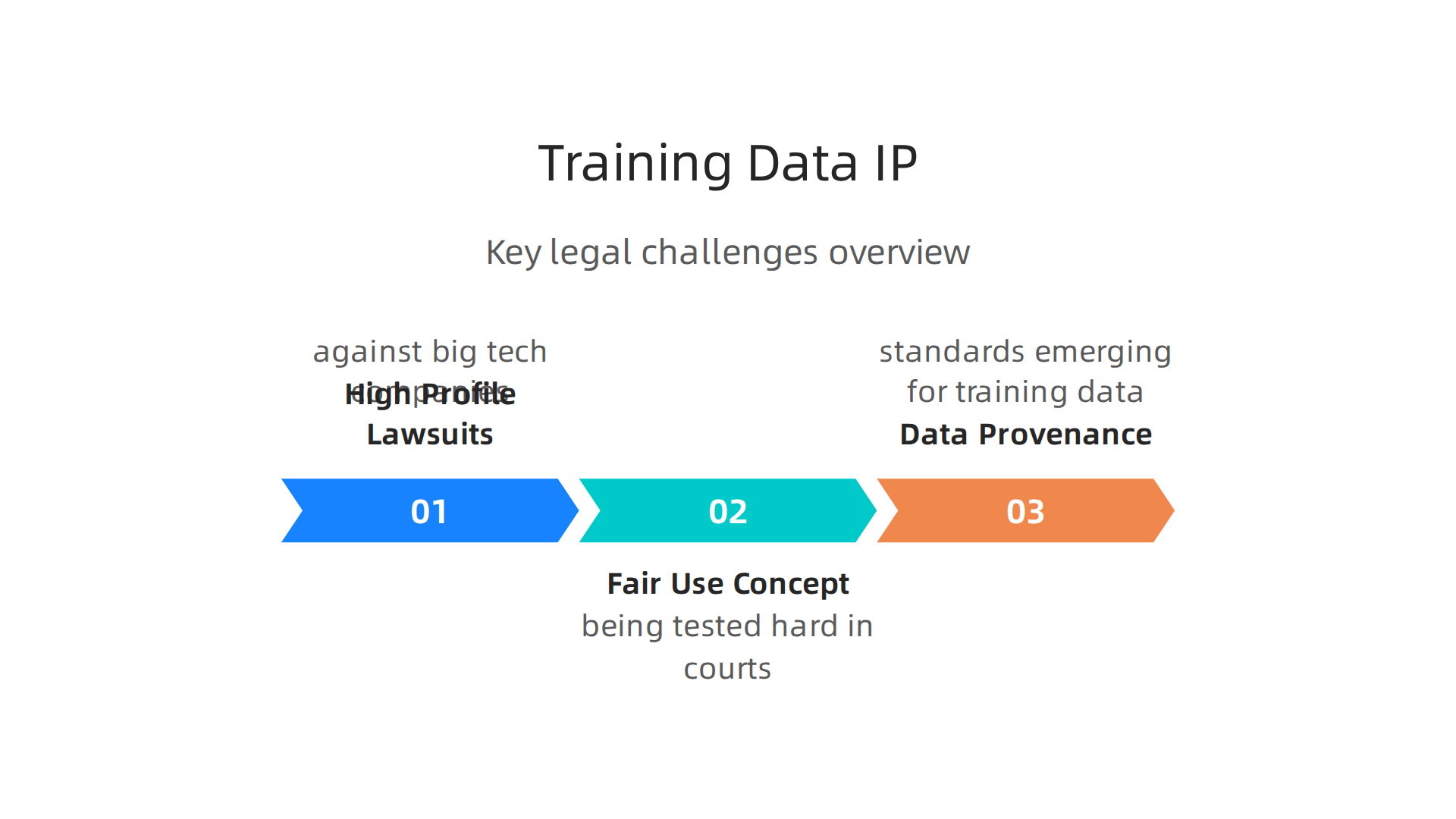
High profile lawsuits are everywhere. Getty Images sued an AI company for using its photos without permission. In late 2025, a UK court ruled that the AI company was not liable for copyright infringement when using images scraped from Getty’s websites in training models. But the fight is far from over. Visual artists have filed class action lawsuits against big tech companies like Google and Alphabet. They claim unauthorized use of their work as training data. Several cases are still moving through the courts. You can follow them using a generative AI intellectual property case tracker that updates regularly.
The legal concept of fair use is being tested hard. AI companies argue that training a model on publicly available images is a "transformative" use, which falls under fair use. But critics say that even intermediate copying of copyrighted work can be infringement. A detailed legal analysis from Ropes & Gray explains that the use of copyrighted content to train an AI model could indeed be infringement, even when the copying happens only as an intermediate step. Courts have not settled this yet. Every new ruling changes the landscape for companies building artificial intelligence with images and video.
What does this mean for your organization? It means you cannot just scrape any data you find. You need to know where your training data comes from. Data provenance standards are emerging. Some companies are moving toward licensing agreements with image libraries and artists. Others are building datasets using only public domain or explicitly licensed content. A recent legal analysis from Bochner Law advises that if you are training or fine-tuning AI models, you must ensure all training data is legally acquired and fully licensed. This is not optional anymore.
For anyone responsible for policy or compliance, these disputes will shape how you source data for years. The way we settle the question of fair use will affect everything from pictures of artificial intelligence to full video generation. To understand how these fights are already changing policy, check out our article on how image artificial intelligence is driving new policy in 2026.
The bottom line is simple. Text to video artificial intelligence and other artificial intelligence imaging tools are only as legitimate as the data they use. If you are building or using these tools, start auditing your data sources now. The courts are watching.
Deepfakes and the Misinformation Policy Landscape
The same text to video artificial intelligence that creates amazing content also makes it very easy to spread lies. Think about it. Anyone can now type a sentence and get a realistic video of a politician saying something they never said.

A CEO announcing a fake bankruptcy. A celebrity endorsing a product they hate. This is not a future problem. It is happening right now.
This technology combines artificial intelligence with images, audio, and video to produce synthetic media that looks real. The barrier to creating convincing fakes has dropped so low that almost anyone with internet access can do it. That scares governments, news organizations, and election officials.
Governments are fighting back with new laws. In 2026, a growing number of countries and states are passing laws that require clear labeling on AI-generated content. Political ads get the most attention. Some places now demand that any video used in a campaign must include a visible watermark or a spoken disclaimer saying it was made by AI. These rules apply to both pictures of artificial intelligence and full video clips.
What happens if a campaign ignores the rules? Fines, public warnings, and even criminal charges in some cases. The goal is to make voters know when they are watching something fake. But the laws vary a lot by location, which creates a headache for national campaigns and platforms.
Technical standards are trying to help. Groups like the C2PA (Coalition for Content Provenance and Authenticity) have created a standard that adds invisible digital watermarks to AI-generated media. These watermarks can be checked by software to confirm where the content came from. It sounds great. But here is the problem. Not all AI tools support this standard yet. And even when they do, bad actors can remove the watermarks or simply use a different tool.
Adoption is slow because it costs money and effort. Many smaller companies that build artificial intelligence imaging tools have not bothered to add C2PA support. That leaves a big gap.
What can you do about it? If you work in policy, communications, or security, start by knowing the rules in your area. Follow the court cases that are shaping this space. You can track current litigation using a generative AI intellectual property case tracker to see how disputes over synthetic media are evolving.
Also, teach your team to spot fakes. Every organization should have a plan for what to do if a deepfake targets them.
The battle against misinformation is moving fast. Laws and standards are improving, but they will never be perfect. Your best defense is awareness and preparation. For a deeper look at how these changes are reshaping regulations, check out our article on why the picture on artificial intelligence matters more than ever.
National Security and Export Control Implications
Now we move from misinformation to a bigger worry: national security. The same text to video artificial intelligence that can make a fun short film can also be used to create fake intelligence briefings, spread propaganda during a conflict, or impersonate military leaders. Governments now treat these advanced AI models as dual-use technologies. That means they have peaceful civilian uses and dangerous military or intelligence applications.
Think about it. A realistic video of a general giving false orders could cause chaos. A fake news report showing a staged attack could start a war. Because of this risk, countries are carefully controlling who gets access to the most powerful AI tools. And that leads straight to export controls.
The chip war directly affects video AI. The most advanced text to video artificial intelligence models require massive computing power. That power comes from high-end semiconductors. Starting in 2022, the United States put strict limits on exporting advanced AI chips to China and other countries. These controls grew stronger in 2023 and 2024. The goal is to slow down the development of cutting-edge AI in rival nations. According to the Law & Economics Center, these restrictions were "unprecedented" and keep expanding.
Here is the direct link to text to video artificial intelligence: without those chips, you cannot train or run top-tier video models. So export controls on semiconductors effectively limit who can build the next generation of synthetic video tools. Some experts argue this has actually boosted domestic innovation in China, as reported by Edge AI Vision. Others say the controls are necessary to protect national security.
The fight over open-source models. Another hot debate is whether companies should release the full model weights of powerful video AI systems. Open-source advocates say sharing models helps innovation and allows researchers to find safety flaws. But national security officials worry that open-source release lets anyone, including bad actors, download and use the tools without restrictions. They push for responsible disclosure: releasing only limited versions or requiring approval.
In 2026, this tension is stronger than ever. Some companies now build their own artificial intelligence imaging tools in secret. Others release them but with strict usage rules. The outcome of this debate will shape how text to video artificial intelligence evolves.
For leaders watching these developments, understanding the link between chips, models, and national security is critical. Our article on how image artificial intelligence is driving new policy goes deeper into how these rules affect the whole AI ecosystem.
In short, text to video artificial intelligence is no longer just a creative tool. It is a strategic asset that governments will fight to control. And the battle over chips and open-source models is just the beginning.
Economic and Investment Insights into Generative AI Video
The national security battle over chips and models we just covered is not happening in a vacuum. It sits right at the center of one of the biggest economic stories of 2026. Money is flowing fast into text to video artificial intelligence. But the rules are changing just as fast.
The investment boom comes with real risk. Venture capital firms have poured billions into generative AI video startups over the last three years. The chance to change advertising, movies, and education is huge. However, because advanced semiconductors are so tightly controlled by export laws, the cost to build a new AI company is incredibly high. This creates a unique risk for investors. A startup might have the best artificial intelligence imaging model. But if new export laws cut off their access to hardware, they cannot run their business. The regulatory whiplash around semiconductor exports directly shapes how this market plays out. Reports on the 2026 AI policy and semiconductor outlook show how this complex environment creates real uncertainty for those putting money into the space.
Big tech dominance raises antitrust flags. There is another economic worry too. A very small number of companies control the entire AI stack. They design the chips. They run the cloud servers that train the models. And they own the biggest video platforms. This makes it very hard for a small startup to compete. If you build a new text to video artificial intelligence tool, you might end up paying a competitor for the right to exist. That raises tough questions about market fairness. For a deeper look at how these market rules are evolving, check out our analysis on how image artificial intelligence is driving new policy in 2026.
The economic impact goes far beyond content creation. While the risks are real, the opportunities are massive. Text to video artificial intelligence is already shifting big sectors of the economy.
- Advertising: Brands now generate dozens of video variations in minutes. They test different scripts and visuals without expensive film crews or reshoots.
- Education: Teachers can make custom video lessons that match their exact lesson plan. Instead of searching for a perfect video online, they just create one that fits.
- Virtual Reality: Building virtual worlds used to take months of work by 3D artists. Now, describing a scene with artificial intelligence with images helps build the environment much faster.
This expansion means generative AI is not a passing trend. It is becoming core infrastructure for the digital economy. The link between pictures of artificial intelligence and new hardware keeps getting stronger. As the Silicon Catalyst network points out, we are at a major inflection point where generative AI and semiconductors will shape the economy for generations. For leaders watching this space, understanding both the investment trends and the antitrust debates is the only way to stay ahead.
Looking Forward: The Policy Agenda for 2027
So where does all this leave us? The economic shifts, the national security battles, and the rapid growth of text to video artificial intelligence are all pushing toward one big question. What happens next in the policy world? The answer is starting to take shape, and 2027 looks like a pivotal year.
International cooperation is likely to intensify. After the major elections in key jurisdictions during 2026, governments are beginning to find common ground on AI governance.

Countries realize that text to video artificial intelligence does not stop at borders. A model trained in one country can generate content that spreads everywhere. This reality is pushing leaders toward shared rules. The White House has already made AI and quantum technologies top R&D priorities for FY2027, as the OSTP budget memo makes clear. And the AI.Gov action plan outlines three pillars: accelerating innovation, building AI infrastructure, and leading international diplomacy and security. That last piece is key. Expect more multilateral talks on how to handle the global reach of generative video tools.
Industry self-regulation will fill some of the gaps. Let’s be honest. Legislation moves slowly. Technology does not. So in 2027, we will likely see tech companies step up with their own standards. Technical frameworks for watermarking AI-generated video and verifying content origins will become more common. Groups like the AI 2027 Scenario Initiative are already working to make complex AI futures more tangible for policymakers and the public. These voluntary efforts will not replace regulation. But they will set the floor while governments catch up.
Three big unresolved issues remain. Here is what keeps policy experts up at night.
- Liability for AI-generated content. If a text to video artificial intelligence tool creates something harmful, who is responsible? The company that built the model? The user who prompted it? The platform that hosted it? The courts will start answering this question in 2027.
- Interoperability of regulation. Different countries are writing different rules. If the EU says one thing and the US says another, how does a global company comply with both? The push for compatible frameworks will be a major theme.
- Enforcement capacity. Writing rules is one thing. Enforcing them is another. Regulators need technical expertise, funding, and tools to actually police AI systems. That is a huge gap right now.
These challenges do not have easy answers. But that is exactly why staying informed matters. The conversation around artificial intelligence with images and video is only getting louder. For a closer look at how these policy debates are playing out in different sectors, check out our analysis of how doctor AI regulation differs between healthcare and entertainment in 2026. The rules we set in 2027 will shape the future of generative AI for a long time to come.
Summary
This article is a policy primer on the rapid rise of text-to-video AI and why it matters for leaders in government, industry, and finance. It surveys the core technology, highlights major models and players, and explains how open-source tools change the governance equation. The piece reviews adoption and market metrics showing fast enterprise uptake across marketing, entertainment, education, and VR, and it compares how the EU, U.S., and China are approaching regulation. It then digs into the hottest legal fights—copyright and training-data disputes—alongside the practical and technical challenges of deepfakes and content provenance. National security issues, export controls on chips, and the economic implications for investment and competition are also covered. After reading, you’ll understand the policy levers, legal risks, and practical steps organizations should take to manage and influence AI video governance.