
Introduction
You have seen the headlines. Every morning, it feels like another round of tech layoffs news hits your feed. Oracle cuts 30,000 workers. Meta trims another 8,000. Amazon reduces its corporate staff by 16,000. The numbers are staggering, and they keep climbing.
If that makes your stomach drop, you are not alone.
So far in 2026, over 185,000 tech workers have lost their jobs across 267 separate layoff events. That works out to roughly 1,027 people per day. According to the 2026 Tech Layoffs Tracker, artificial intelligence now drives more than half of all layoff announcements. Companies are cutting staff to redirect billions of dollars toward AI chips, data centers, and automation tools. And this shift is not slowing down.
Here is the real problem. It is getting harder to tell the difference between a normal market correction and something deeper. Are these cuts temporary? Or are we watching a permanent restructuring of the tech workforce driven by regulation, AI substitution, and changing company priorities?
That uncertainty creates real anxiety for professionals across the ecosystem. Policy workers, tech executives, investors, and legal teams all need to know what comes next.

But the signals are mixed. One day a major company announces layoffs. The next day a startup announces a huge funding round. How do you make sense of it all?
That is exactly what this article is for.
We are going to walk through the data behind the 2026 layoffs and connect the dots between macroeconomics, new regulations, and workforce restructuring. You will learn which industries are hit hardest, why AI is the biggest driver, and how emerging technologies are reshaping the job market in real time. By the end, you will have a clearer picture of where the industry is heading and what it means for your own career or organization.
If you want to stay ahead of these changes, getting the right information is key. That is why we recommend The AI Newsletter Worth Reading. It delivers clear daily AI updates that help professionals like you make sense of the shifting landscape without the noise.
Let us start with the numbers. Because the scale of what is happening in 2026 demands attention.
The 2026 Tech Layoff Landscape: Key Statistics and Trends
Let us dig deeper into the numbers because the scale is hard to ignore. The first quarter of 2026 was brutal. Tech companies announced 81,747 job cuts in Q1 alone, making it the highest quarterly total since at least early 2024.
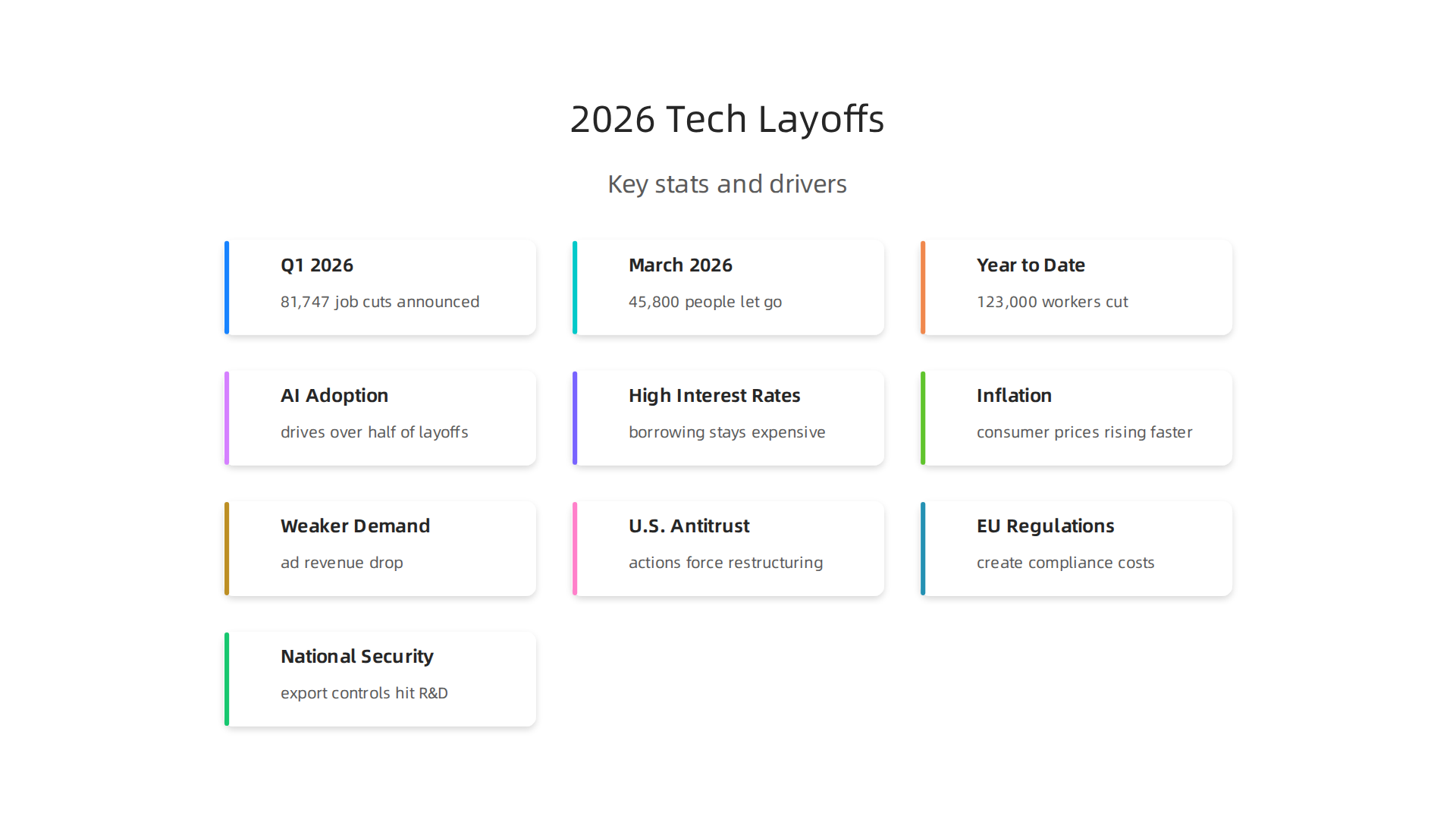
March was the worst single month in two years, with 45,800 people let go. These are the tech layoffs skyrocketing in Q1 2026 as tracked by the Kobeissi Letter.
If you zoom out to the full year so far, the trend accelerates. According to the 2026 Layoffs Tracker from WSJ, tech employers have cut more than 123,000 workers in 2026, a 66 percent jump over the same period in 2025. For context, Crunchbase reported around 95,667 tech layoffs in all of 2024 and about 127,000 in 2025. We are on pace to blow past last year’s total before the calendar flips to fall. That is not a normal cyclical dip.
So which parts of the industry are bleeding the most? Cloud infrastructure, fintech, and digital advertising are taking the heaviest hits. Oracle cut 30,000 people. Block laid off 40 percent of its workforce. Intuit trimmed 17 percent. Snap, Cloudflare, and Wix each announced reductions of 20 percent or more. AI is the common thread in nearly every announcement. A May 2026 layoffs analysis noted that over 148,000 tech workers had been cut by June, with California already scrambling to respond. Governor Gavin Newsom signed an executive order to explore ways to protect workers affected by AI-related job losses.
That geographic piece matters. The US West Coast remains the epicenter, but layoffs are spreading into the Midwest and Europe as regulatory climates shift. If you want a deeper look at how automation is reshaping the labor market, read our full breakdown of AI job displacement statistics and the policy roadmap that follows.
The bottom line: this is not a single bad quarter. The data shows a structural shift driven by AI investment and cost-cutting at scale. And it is accelerating month after month.
Economic Drivers: Interest Rates, Inflation, and Market Correction
High interest rates are not just a number on a screen. They directly change how tech companies operate. In 2026, the Federal Reserve has kept the federal funds rate stuck between 3.50 percent and 3.75 percent. The last cut was in December 2025, and major banks like Goldman Sachs expect no cuts for the rest of the year. Analysts at Goldman Sachs explain why the Fed is unlikely to cut rates this year. That means borrowing money stays expensive for tech companies.
When capital costs are high, company valuations shrink. Startups and big tech firms that relied on cheap debt to grow suddenly look less valuable. Investors stop rewarding rapid growth and start demanding real profits. This shift from "grow fast at any cost" to "show me the money" is a huge reason for layoffs. Overstaffed departments like marketing, recruiting, and experimental product teams become easy targets. Companies cut headcount to improve their bottom line.
Inflation adds another layer of pressure. Consumer prices are still rising faster than the Fed’s 2 percent target. The year-over-year inflation rate hit 4.2 percent in May 2026, according to the latest data from the United States Fed Funds Interest Rate page. When inflation stays high, people spend less on extras. Ad-supported tech companies like social media platforms and digital publishers see ad revenue drop. E-commerce companies watch shoppers tighten their wallets. Lower revenue forces even more job cuts.
Together, these economic conditions create a perfect storm. Expensive capital, a focus on profitability, and weaker consumer demand leave tech companies with few options but to shrink their workforces.
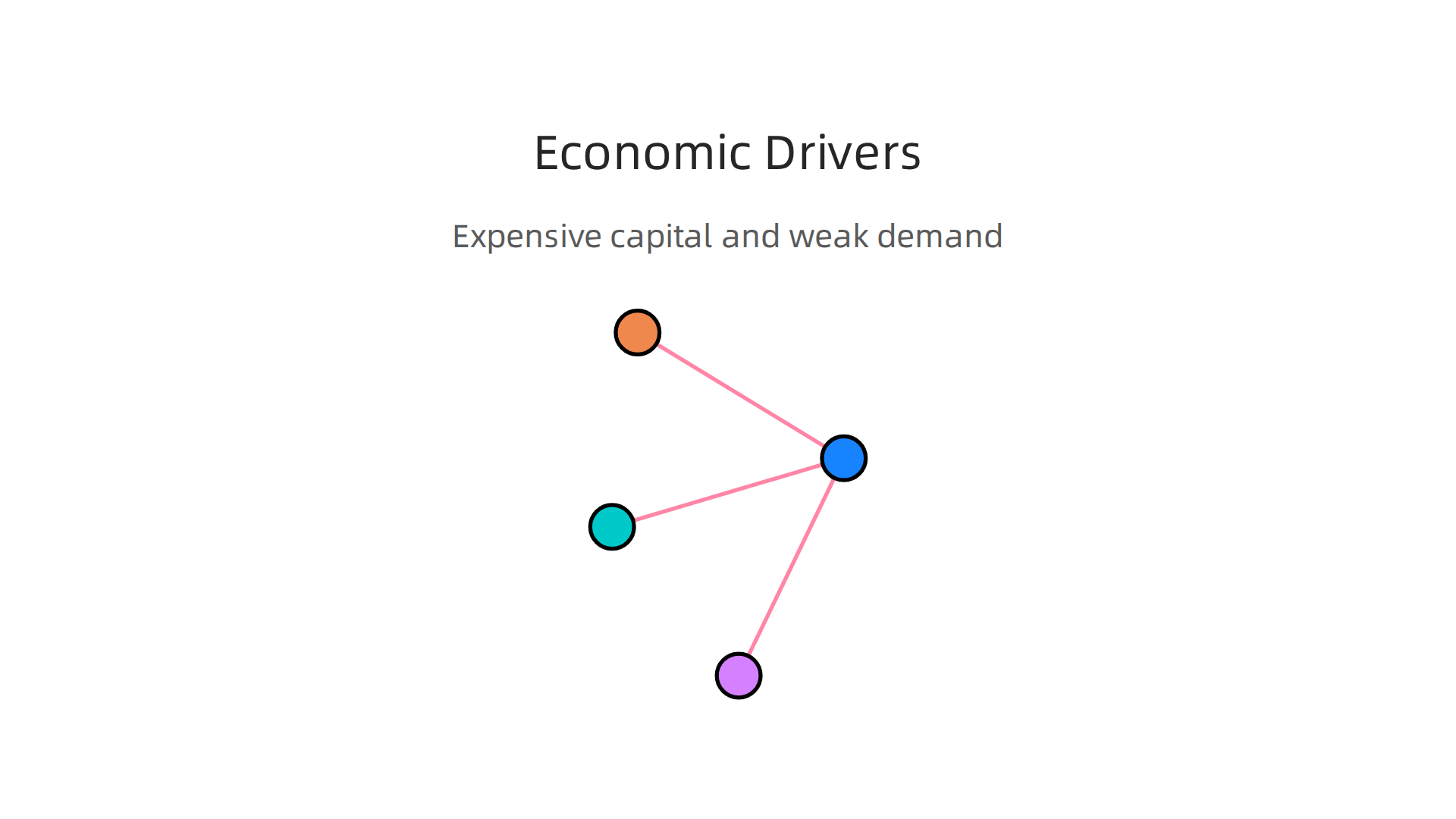
The market is correcting after years of overhiring and easy money. Understanding these drivers helps you make sense of why the layoffs keep happening. For a deeper look at how regulatory shifts interact with these market forces, check out our guide on how to navigate 2026 tech policy changes.
If you want to stay ahead of how these economic and policy changes affect your industry, get clear daily AI updates from The AI Newsletter Worth Reading.
Policy Shockwaves: How New Regulations Are Reshaping the Tech Workforce
Economic pressures are not the only force driving tech layoffs news in 2026. A wave of new regulations is also forcing companies to rethink their structures.
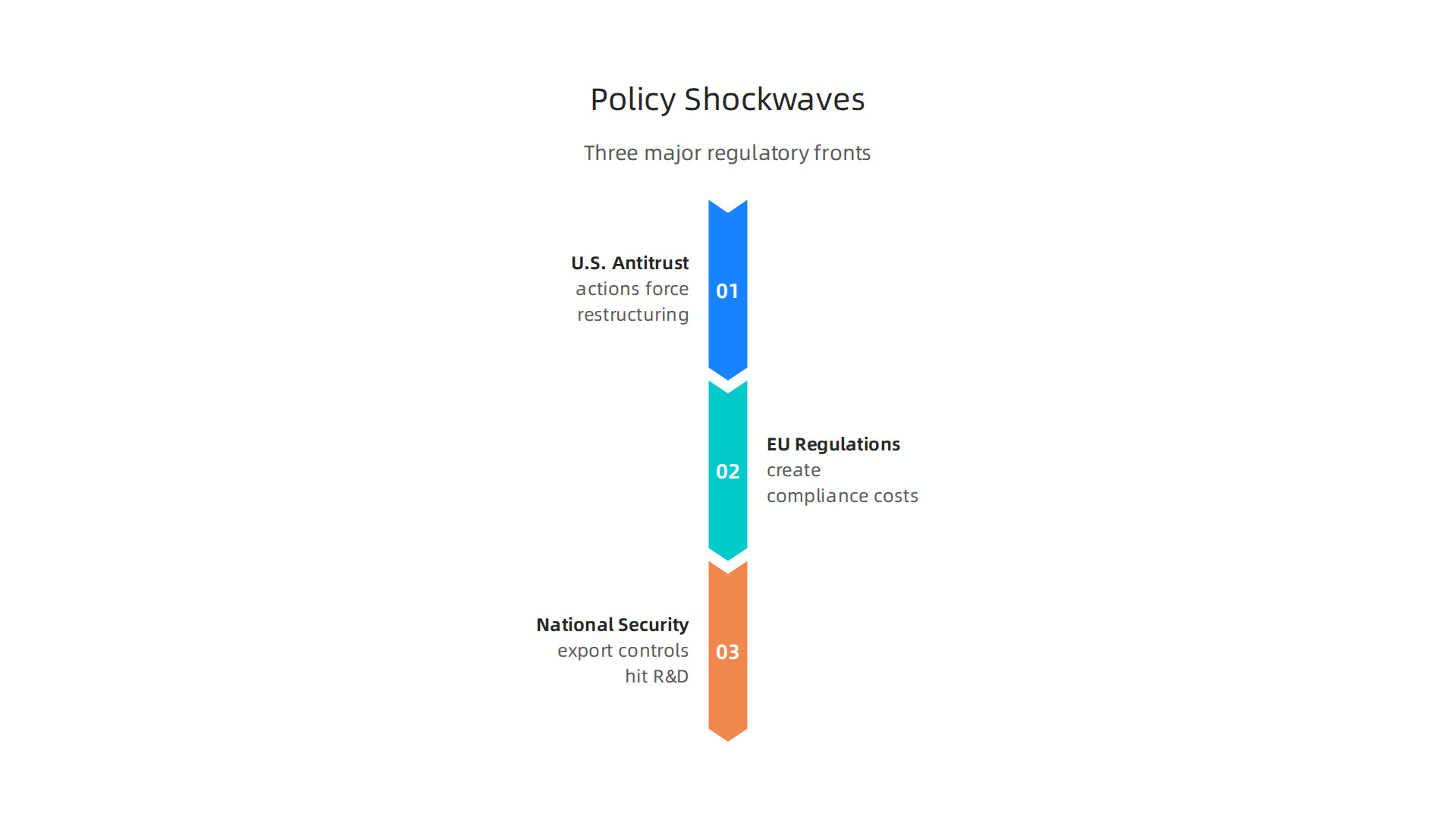
From U.S. antitrust crackdowns to European compliance rules and national security controls, policy changes are directly impacting headcounts across the industry.
U.S. Antitrust Actions Force Restructuring
The Federal Trade Commission and the Department of Justice have stepped up enforcement against the biggest tech companies. In 2026, agencies are aggressively pursuing cases for alleged monopolistic behavior in search, advertising, and cloud markets. The 2026 Antitrust Year in Preview for Big Tech notes that the current administration has carried forward litigation from the previous one, though with mixed results in court. As a result, some tech companies are being forced to divest parts of their business or restructure operations. Divestitures and spin-offs often lead to layoffs, as overlapping roles are eliminated and new organizational structures take hold. For a deeper look at how these antitrust moves fit into the larger regulatory picture, read our guide on software industry policy and major regulatory shifts for 2026.
EU Regulations Create Compliance Costs
The European Union’s Digital Markets Act and AI Act are also reshaping the tech workforce. Companies that operate in Europe must now comply with strict rules on platform fairness, data access, and AI risk management. Compliance teams have grown, but other departments have been cut to fund these legal and technical requirements. The Global Antitrust Enforcement Outlook 2026 highlights rising enforcement pressure on digital market dominance as a top global priority. Some business models are no longer viable under the new rules, leading to entire product shutdowns and the layoffs that follow.
National Security Export Controls Hit R&D
U.S. export controls on advanced AI chips are having a direct impact on tech employment. Companies that design or manufacture high-end semiconductors must limit sales to certain countries, reducing their revenue. At the same time, they are cutting staff in research and development divisions that rely on unrestricted chip access. These national security measures are meant to protect American technological leadership, but they also force companies to shrink their workforces. The shift of resources away from R&D and toward compliance and legal teams is another reason tech layoffs news remains a daily headline in 2026.
All three policy fronts — antitrust, EU regulation, and export controls — are creating a new landscape where tech companies must adapt quickly or face financial consequences. Understanding these policy shockwaves helps you predict where the next round of cuts might come from.
The Role of AI in Workforce Restructuring
Regulations are not the only story in tech layoffs news. Artificial intelligence is quietly reshaping the workforce from the inside out. In 2026, many tech companies are not just cutting jobs because of the economy. They are cutting jobs because AI can now do the work.
Customer support, content moderation, and even code generation are being handed over to AI tools.
Reports show that between January and June 2025, companies reported 77,999 tech job cuts directly connected to AI adoption, according to AI job replacement statistics for 2026. That is hundreds of people losing jobs every single day. And the trend has only accelerated in 2026.
The biggest targets are repetitive, rule-based roles. Chatbots handle first-line customer questions. AI moderation tools scan content faster than any human team. And code generation assistants like Copilot are writing large chunks of software, meaning teams need fewer junior engineers.
This has led to a rise in "AI-first" hiring strategies. Companies are no longer looking for generalist engineers. They want specialists who can build, tune, and oversee AI systems. So while some teams shrink, demand for AI talent is booming. For a deeper look at how job roles are shifting under this new model, check our breakdown of AI tech jobs in 2026 and how hiring is changing.
But the big question is what happens to the workers who are let go. That is where policy comes in. Lawmakers are debating AI job displacement taxes, where companies would pay a fee for each role replaced by automation. Others are pushing for mandatory retraining programs and expanded social safety nets. These ideas are still early, but they could reshape how companies handle layoffs in the future.
For anyone trying to make sense of these rapid changes, staying informed is critical. The landscape shifts every week. That is why we recommend The AI Newsletter Worth Reading from The Deep View. It delivers clear daily AI updates straight to your inbox, so you never miss a development that could affect your job or your business.
Sector-Specific Layoff Analysis: Big Tech vs. Startups
Not all tech companies are cutting jobs in the same way. If you follow tech layoffs news, you’ve probably seen headlines about both massive companies and tiny startups announcing cuts.

But the reasons behind those decisions look very different depending on the size of the business.
Big Tech: Restructuring, not just downsizing
Companies like Meta, Amazon, Google, and Microsoft are making what they call "efficiency cuts." They let go of workers in some departments while hiring aggressively in others, especially artificial intelligence. This is not pure downsizing. It is a restructuring. For example, Meta laid off about 1,500 people from its Reality Labs division but is redirecting investments toward AI research. Amazon cut 16,000 corporate roles but continues to build massive AI infrastructure. Overall, 2026 tech company layoffs show large firms using workforce reductions to free up capital for AI chips and data centers.
The result is a net shift in talent rather than a net loss of headcount.
Startups: A much harder hit
For smaller companies, the story is darker. Venture capital funding has dried up compared to a few years ago. Valuations are lower, and investors are more cautious. Startups cannot afford to "restructure" by moving people into AI roles. Many simply run out of money.
Regulatory burdens also hit small firms harder. A new compliance requirement that costs a startup $500,000 per year might be annoying for Google but crippling for a 50-person company. This is especially true in heavily regulated fields like fintech and healthtech. For a deeper look at how these regulatory shifts are affecting businesses of all sizes, read our guide on Software Industry Policy 2026: A Guide to the Major Regulatory Shifts.
Comparing by type: who gets cut more?
We can break it down a few ways. Bootstrapped startups lay off workers less often than venture-funded ones because they don’t answer to investors demanding growth at any cost. B2B companies have been more stable than B2C companies, since business customers bring recurring revenue. And regulated industries like fintech and healthtech have seen more layoffs than unregulated sectors because they face extra compliance costs on top of the economic pressure.
These differences matter. Understanding them helps you see past the headlines and figure out what tech layoffs news really means for your own job or investments.
Investor and Founder Perspectives on Policy Risk and Opportunities
Here is a shift you might not see in most tech layoffs news. Venture capitalists are now asking startups a new question before they write a check. It is not just about revenue or user growth anymore. They want to know about your regulatory strategy.

That is a big change. In the past, many VCs treated regulation as a problem to solve later. Now they see it as a risk that can kill a deal. According to the Venture Capital 2026 guide, a common misconception is that minority investments are free of regulatory risk. That is no longer true. Foreign investment screening and merger control rules now affect even small funding rounds. This makes compliance a central part of every pitch.
Compliance costs also shape which companies get funded. Startups in fintech, healthtech, and AI face higher regulatory hurdles that can eat up a big portion of a small budget. For founders, early planning around regulation can make or break a funding round. As one guide on regulatory strategy for AV startups explains, proactive regulatory strategy at the start can mean the difference between sustainable growth and costly setbacks.
For founders of AI companies, the picture is even more complex. Export controls on AI chips, shifting AI regulation timelines, and new data privacy rules create a maze to navigate. Founders who ignore these risks often find themselves stuck in later funding rounds.
But here is the upside. Regulation also creates demand. Startups that build compliance tools, offer legal services, or provide lobbying support are growing fast. These segments are actually hiring while other parts of tech are cutting. If you follow how AI tech jobs in 2026 are reshaping the workforce, you will see that policy expertise has become a valuable skill for founders and investors alike.
The bottom line is simple. Policy risk is now a factor in every funding conversation. Investors who understand it have an edge. Founders who plan for it build stronger companies. For daily insights on how AI and regulation are reshaping the tech landscape, get clear daily AI updates from The AI Newsletter Worth Reading. It helps you stay ahead of policy shifts without the noise.
Navigating Compliance and Risk Mitigation in a Shifting Regulatory Environment
So you know policy risk is a new factor in funding. But how do you actually handle it inside your company? The answer starts long before any layoff decision.

Here is a simple rule every leader should follow. Run a regulatory impact assessment before you restructure your team. Too many tech companies announce job cuts first and ask questions later. That can backfire fast.
Consider the numbers from 2026. Over 150,000 tech jobs were cut across more than 500 companies by mid-year, according to the latest tech layoffs tracker for 2026. Many of those cuts came from legacy enterprise companies trying to fund AI growth. But a surprising number also came from startups that missed compliance risks tied to workforce changes.
When you restructure, you might trigger new obligations under state or foreign laws. For example, if you operate in the EU and cut a set percentage of staff, you may need prior notification or severance rules you did not plan for. A quick regulatory check before the change can save you from fines and lawsuits.
That is where your public affairs and policy teams come in. These teams do not just handle government relations. They track regulatory signals months or years before they become rules. If your company has a strong policy function, it can flag upcoming privacy or AI rules that might affect your hiring or product plans. Then you can align your workforce planning with what is coming, not just react after it hits.
Think of them as your early warning system. They read the same signals that investors and regulators are watching.
Building a compliance framework that works across the US and EU is another big piece of the puzzle. The two regulatory systems are drifting apart. The US focuses more on national competitiveness and innovation, while the EU pushes strict rules on AI risk and data privacy. Your framework needs to handle both without becoming a mess of separate systems.
One smart move is to adopt a modular approach. Build a core compliance program that meets the highest standard between the two regions, then adjust for local differences. That keeps your costs down and your risk low.
For a deeper look at how major regulatory shifts are changing the game, read our guide on the software industry policy 2026 changes. It breaks down what you need to know for the year ahead.
What’s Next: Predictions and Strategies for 2027
Building that compliance framework puts you in a stronger position today. But what comes next? Let’s look ahead to 2027 and how you can prepare.
Many experts believe tech layoffs may finally plateau. Why? Companies are adapting to a new normal where AI handles more routine work and regulations are becoming clearer. The frantic cuts of 2025 and 2026 were driven by panic and cost-cutting to fund AI investments. By 2027, most large tech companies will have already reshaped their workforces. We will see fewer massive layoff rounds and more targeted rebalancing.
That does not mean stability is guaranteed. The US China tech war will keep creating uncertainty. New export controls, chip restrictions, and investment bans could force sudden pivots. Companies that monitor geopolitical signals will have an edge.
So what should you do right now?
First, invest in AI policy upskilling across your teams. Your product managers, legal teams, and public affairs staff need to understand how AI regulations in the US and EU will affect hiring, product launches, and data practices. This is not just a compliance exercise. It is a strategic advantage.
Second, build organizational flexibility. That means designing teams that can shift focus quickly as emerging technologies change the landscape. Use contractors and short-term project teams where possible. Keep core teams lean but skilled.
Third, get serious about policy intelligence. The companies that win in 2027 will be the ones that see regulatory shifts before they become headlines. This is especially true for startup funding rounds. Investors are already demanding proof that portfolio companies understand their regulatory risk exposure. As a recent analysis notes, regulatory pressures on asset managers are expanding and focusing on operational practices, which means your funders are watching how you handle risk just as closely as you are.
If you are wondering how to stay ahead, take a close look at the latest AI tech jobs and regulatory changes in 2026. Understanding where hiring and policy are headed will help you plan your own talent strategy.
Finally, make a habit of tracking daily developments. The landscape shifts fast, and what you do not know can hurt your next funding round. One simple way to stay informed is to subscribe to a daily briefing that cuts through the noise. The AI Newsletter Worth Reading delivers clear daily updates straight to your inbox, helping you and your team keep pace with the policy changes that matter most.
The bottom line? Layoffs are not gone forever, but the era of mass cuts is fading. Companies that invest in policy intelligence, organizational flexibility, and regulatory readiness will be the ones that attract top talent and earn market trust in 2027 and beyond.
Summary
This article analyzes the scale and causes of the 2026 tech layoffs, showing how economic pressures, new regulations, and accelerated AI adoption combine to restructure the industry. It reviews sharp quarter- and year-to-date job cuts, highlights the sectors and geographies most affected, and explains why companies are redirecting spending toward AI chips, data centers, and compliance. The piece breaks down how interest rates, inflation, antitrust action, EU rules, and export controls amplify cost pressures, and it describes how AI both replaces routine roles and creates demand for new specialist skills. Readers learn practical steps firms should take—like running regulatory impact assessments and building modular compliance frameworks—and what founders and investors now look for in funding rounds. The article also offers guidance for workers on reskilling into AI and policy roles and closes with a forward-looking view of how targeted rebalancing may replace mass rounds of layoffs by 2027. Overall, it equips professionals, leaders, and policymakers with a clearer framework to interpret headlines and prepare for the next phase of change.