
Introduction: Understanding the Rise of AI Agents
You have probably heard the term "AI agent" a lot lately. But what does it actually mean? Is it just another name for a chatbot? Not quite. Right now, AI is moving beyond simple question-and-answer tools into something much more capable: autonomous systems that can set goals, make decisions, and take action on their own.
That shift is exciting but also confusing. Many people use "AI agent" and "AI tool" as if they mean the same thing. They don’t. An AI tool waits for your command. An AI agent works toward a goal with minimal supervision. As one expert explains in Agentic AI, explained, these systems perceive their environment, reason about it, and act independently. That is a big leap from the chatbots we got used to.
This confusion leads to misaligned expectations. Businesses invest in "AI agents" thinking they are buying a smarter version of a chatbot. They end up disappointed because the technology works differently. Policy professionals struggle to regulate something they don’t fully understand.
That is why this article exists. We are going to give you a structured, clear breakdown of what AI agents are, how they work, and why they matter in 2026. You will learn the key traits that make an AI system an agent, the different types you need to know, and the real-world impact on industries and regulations.
If you want to stay ahead of these rapid changes, getting daily updates from trusted sources can make a big difference.

Check out The AI Newsletter Worth Reading for clear daily insights on AI developments.
For a deeper look at how advanced AI systems are reshaping the landscape, read our guide on the smartest AI in 2026. It covers the data and trends every policy leader should know.
Let’s get started.
Defining AI Agents: What Sets Them Apart from Traditional AI
So what exactly is an AI agent? The simplest way to think about it is this: an AI agent is a system that can perceive, reason, and act on its own to reach a goal. Traditional AI tools, like the chatbots you have used, just respond to your prompts. You type a question, they give an answer. They are reactive. AI agents, on the other hand, are proactive. They do not wait for you to tell them every step. They figure out the steps themselves.
This difference matters a lot. When you ask a generative AI tool to "write a report," it produces text based on patterns it learned. That is it. An AI agent, by contrast, would break that goal into smaller tasks. It would gather data from a database, check for accuracy, format the report, and even send it to the right person — all without you touching a button.
Understanding this distinction helps answer the question of what are AI agents. They are built around a continuous loop known as the perceive-reason-act cycle. The agent first perceives its environment through data streams or sensors. Then it reasons about what action makes sense next based on its goal. Finally, it acts by sending a command, updating a record, or calling another system. And then it learns from the result. One detailed explanation of the autonomous AI agent operating loop describes it as Perceive, Analyze, Act, and Learn, repeating over and over to improve performance.
This makes agentic AI fundamentally different from the generative AI you see in most tools today. Agentic AI is not just about creating content. It is about achieving outcomes.
If you want to see how this shift is changing the rules for businesses and governments, check out our analysis of the biggest information technology policy shifts of 2026. It connects the dots between agentic AI capabilities and the new regulations on the horizon.
The key takeaway? When someone asks what are ai agents, remember they are goal-driven, independent, and adaptive. They are not smarter chatbots. They are a new category of software that plans and acts. That is the real leap forward.
Core Characteristics: Autonomy, Goal-Orientation, and Adaptability
Now that you understand the perceive-reason-act loop, it helps to look at the three traits that make AI agents truly powerful. These traits are autonomy, goal-orientation, and adaptability.
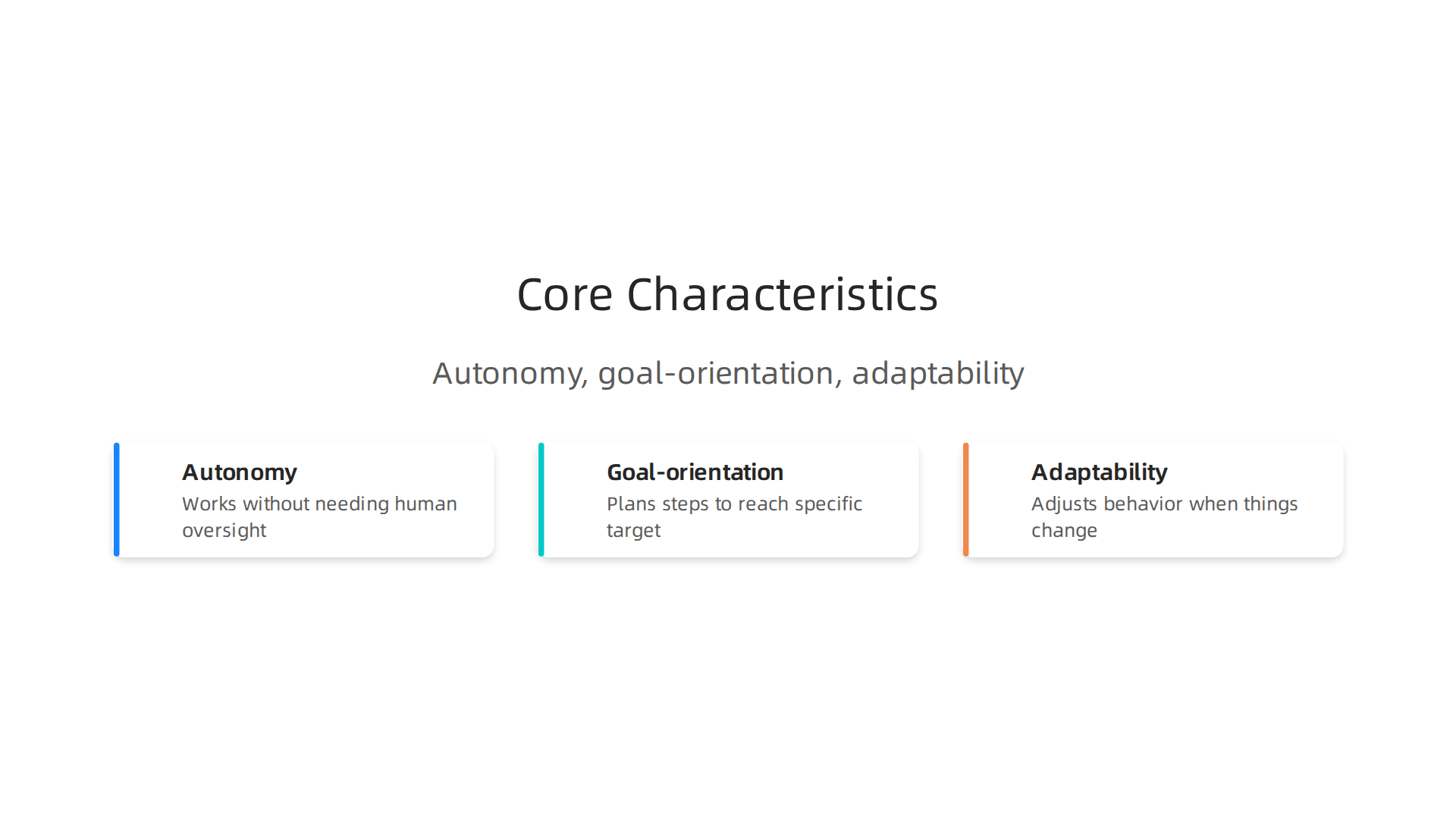
Autonomy means the agent works without needing you to hold its hand. It makes decisions and acts on its own. One guide to key characteristics of intelligent agents explains that autonomy allows these systems to operate independently without constant human oversight.
Goal-orientation is what makes an AI agent chase a real outcome instead of just answering a question.

The agent does not stop after one response. It plans a series of steps to reach a specific target. A discussion on using agentic AI for goal-oriented systems shows how agents think in terms of objectives rather than one-off outputs.
Adaptability lets the agent change its behavior when things do not go as planned. If a data source goes offline or a rule changes, the agent adjusts. It learns from each result and gets better over time.
These three characteristics work together to make agentic AI a leap beyond older tools. To understand how these autonomous capabilities are driving new regulations, check out our analysis of the artificial superintelligence policy shifts now underway.
For daily updates on how agentic AI is evolving and reshaping the regulatory landscape, subscribe to The AI Newsletter Worth Reading. It brings you clear, concise AI intelligence every day.
The Agent Loop: Perceive, Reason, Act
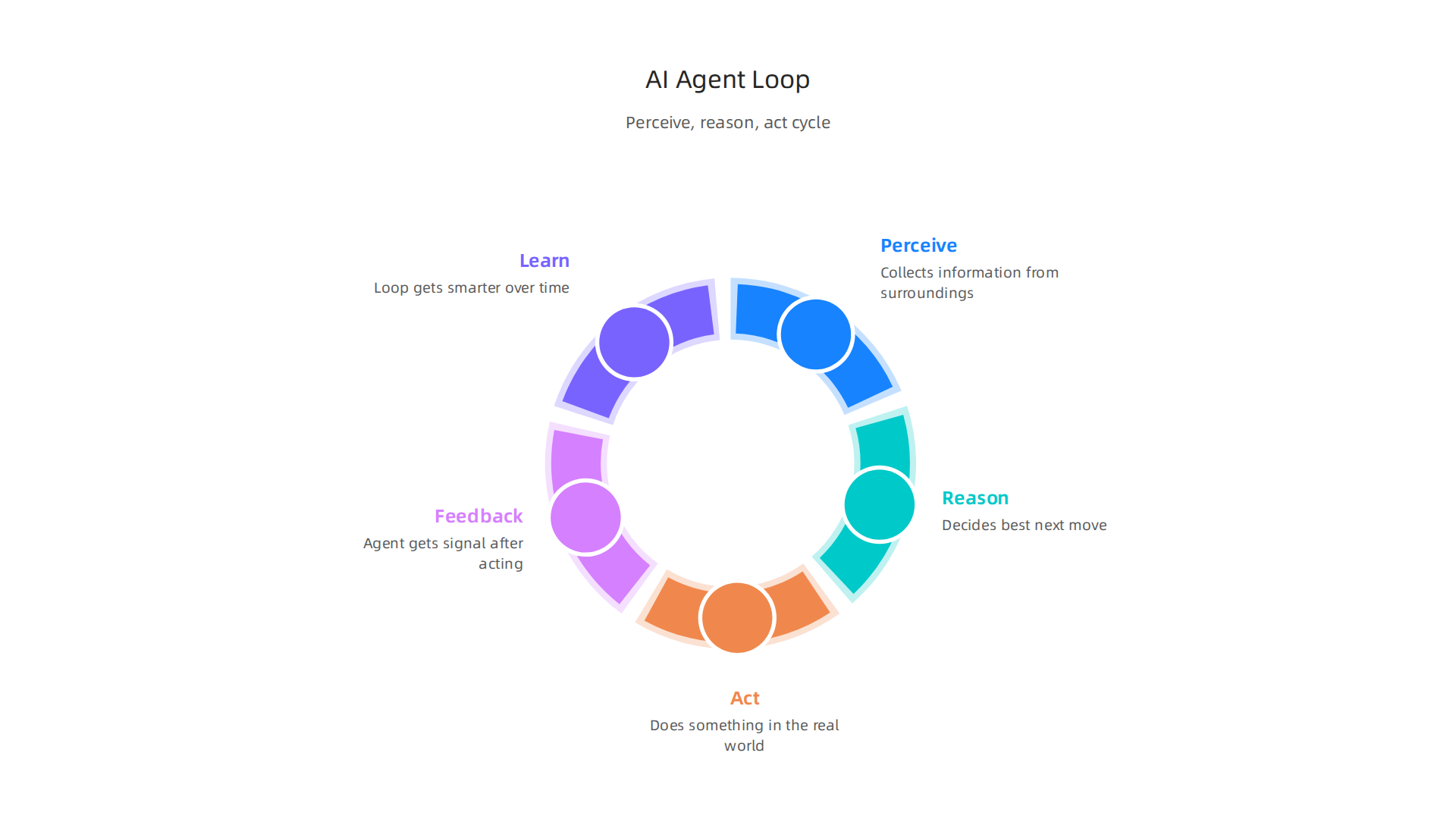
Now let’s get into how agents actually work step by step. Every AI agent runs on a simple three-stage loop: perceive, reason, and act.
Think of it like a continuous cycle that never stops.
Perceive means the agent collects information from its surroundings. It might pull data from a user prompt, an API, a sensor, or even a live database. This is the "eyes and ears" of the system.
Reason is the decision-making step. The agent takes what it perceived, checks it against its goals, and figures out the best next move. It may use a machine learning model, a set of rules, or both.
Act is where the agent does something in the real world. It could send an email, update a spreadsheet, call another app, or trigger a workflow.
But here’s the key: after acting, the agent gets feedback. That feedback feeds right back into the next perceive step. This makes the loop smarter over time. Advanced agents also use long-term memory and context. They remember past results and use that history to make better choices in future cycles. One detailed guide to autonomous AI agents breaks down this loop as Perceive, Analyze, Act, and Learn.
If you want to understand how these loops are built and how you can design your own agentic workflows, check out our complete roadmap on how to learn AI in 2026. It covers both the technical and policy sides of building smart agents.
The Architectural Blueprint of Modern AI Agents
Now that you understand the basic loop, let’s look under the hood at the parts that make it all work. Every AI agent relies on a clear set of building blocks. Most modern architectures break down into three main modules: perception, reasoning, and action. But the best designs add two critical sub-systems: memory and communication.
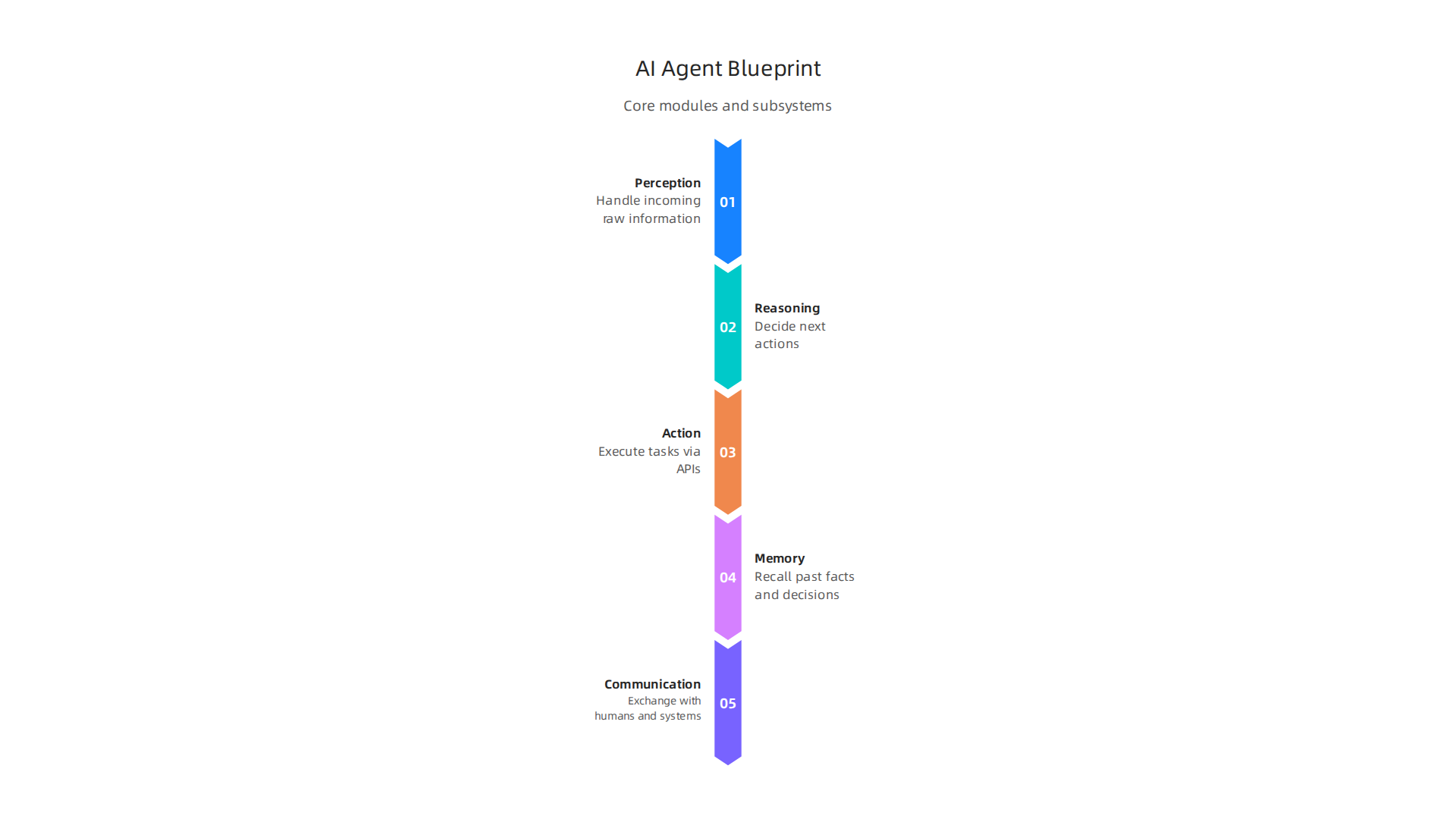
Perception modules handle incoming information. They take text, data from APIs, sensor readings, or user commands and turn them into something the agent can use. This is the agent’s sensory system.
Reasoning and planning engines are the brain. They take the perceived information, check it against goals, and decide what to do next. Strong reasoning engines can break big goals into smaller steps and pick the right tools for each step.
Action mechanisms do the actual work. They call APIs, run code, send messages, or update databases.
The 7 core components of an AI agent architecture include goal definition, perception, memory, reasoning, tools, orchestration, and feedback. These parts work together to make agents smart and reliable.
Memory is where the magic happens. Agents need short-term memory to remember what just happened in a conversation. They also need long-term memory to recall facts, past decisions, and learned patterns. Without memory, an agent starts fresh every time and makes the same mistakes.
Communication sub-systems let agents talk to other agents, external systems, and humans. They handle coordination, error handling, and data exchange.
A modular design is key. By separating these components, you can swap out the reasoning engine for a more powerful one without rewriting the whole system. You can add new tools, improve memory, or change perception inputs independently. This is what allows agents to scale from simple chatbots to complex automation systems that manage entire business processes.
If you are building or evaluating an agent system, understanding this blueprint helps you ask the right questions. What kind of memory does it use? How does it reason? How does it communicate?
For a deeper look at where AI is heading and how to stay ahead, check out the smartest AI in 2026 roadmap for leaders. It covers the latest trends in agent architecture and policy.
And if you want to keep up with daily breakthroughs in AI agents and policy, consider The AI Newsletter Worth Reading. It delivers clear, unbiased updates straight to your inbox.
Sensor / Perception Module and Data Ingestion
Let’s zoom in on the first part of the loop: perception. Think of the perception module as the agent’s eyes, ears, and hands. It takes in all the raw information from the outside world.
This information can take many forms. It might be plain text from a user’s question. It could be data from an API call, like the latest sales numbers from a database. It might even be an image or a video feed. The perception module’s job is to grab all of that and turn it into something the agent can work with.
For example, a customer support agent might receive an email full of messy text and attachments. The perception module cleans that up, extracts the key details, and passes a neat summary to the reasoning engine.
Modern agents go even further. Multimodal agents can blend information from different sources at once. An agent helping a doctor, for instance, might look at both a patient’s lab results (text) and an X-ray image (vision) together. This fusion creates a much richer understanding of the problem.
But here is the catch: perception only works well if the data it receives is high quality and timely. Dirty data, missing fields, or slow feeds will ruin the agent’s output. That is why smart teams invest heavily in data pipelines and validation checks right at this stage.
If you want to dive deeper into how data handling affects compliance and security, check out this tech policy 2026 guide. It covers the rules every leader should know when building agent systems that process sensitive information.
Beyond text and images, perception modules also handle structured data from internal tools like CRMs or spreadsheets. They normalize everything into a common format so the reasoning engine can make sense of it. For a full breakdown of how perception fits into the larger agentic architecture, the IBM team explains it clearly.
Data quality and latency are the two biggest risks here. Even the smartest reasoning engine will fail if it sees stale or messy inputs. So the perception module isn’t just a simple input channel. It’s a critical filter that decides what the agent sees and how fast it sees it.
Reasoning and Planning Engines
Once the agent has clean, high-quality data from the perception module, it needs to figure out what to do next. That is the job of the reasoning and planning engine.
Think of this engine as the brain of the agent. It takes the cleaned input and decides on a sequence of actions to reach a goal. For example, if the goal is "book a flight," the engine will plan steps like searching for flights, comparing prices, and confirming the booking. It often uses search or optimization methods to pick the best path. The core components of an AI agent architecture explained by Glean describe this engine as the part that turns abstract tasks into structured solutions.
Large language models, or LLMs, are now the most common reasoning backbone for agents. They analyze the context, recall rules, and generate the next logical action. This is what gives modern agents their flexibility. Instead of hardcoded rules, the LLM decides what to do each step of the way.
For complex goals, hierarchical planning helps. The agent breaks a big task into smaller subtasks. Each subtask gets its own plan. This makes even huge challenges manageable. If you want to see how LLM reasoning connects to real-world policy, read this guide on how GPT-3 architecture drives AI policy.
The reasoning engine is where the agent becomes truly intelligent. It turns raw data into smart decisions. And if you want to stay ahead of these fast-moving changes, The AI Newsletter Worth Reading delivers clear daily updates on AI and tech policy.
Action Execution and Feedback Loops
Once the reasoning engine decides on a plan, the agent has to carry it out. That is the job of the action execution layer. This layer actually does things in the real world. The actions an agent can take fall into a few types.
Some agents control physical machines. Think of a warehouse robot that moves boxes. Others make software calls. They send API requests to update a database or send an email. And some agents generate content. They write summaries, code, or images. The AI Agent Architecture article from GeeksforGeeks breaks down these tool actions into API calls, code execution, and external system interactions.
But action is not the end of the story. The agent needs feedback. After it acts, the environment sends back a signal. Did the API call succeed? Did the robot bump into something? That signal is critical. The agent uses it to adapt. If it failed, the agent might try a different approach. If it succeeded, it moves to the next step.
Safety also matters here. Many agents have hard rules about what they are allowed to do. You do not want a financial agent to delete accounts. These safety constraints are built into the execution layer. They limit actions based on permissions or risk scores. This is where policy and compliance come in. To understand how to keep agents safe, check out this guide on new human-AI interaction guidelines for policy professionals.
So the action execution layer turns plans into results, and the feedback loop turns results into better future plans. That closed loop is what makes agents truly autonomous.
Design Principles for Emerging AI Agents
Building a powerful AI agent is one thing. Building one you can trust is another. As agents get smarter and take on bigger tasks, a few design principles become non-negotiable.
First up is explainability and transparency. People need to understand why an agent made a certain decision. If a financial agent rejects a loan, you need to know the reason. Regulators expect this too. The IBM guide on agentic architecture explains that self-reflectiveness and self-awareness are core to building trustworthy agents. When an agent can explain its own reasoning, it builds confidence and helps with compliance.
Second is safety and alignment with human values. This has to be built in from day one. You cannot bolt on safety after an agent is already running. The agent needs clear rules about what it can and cannot do. It should know when to stop and ask for help. Alignment means the agent’s goals match your goals. If you ask a customer service agent to solve a problem, it should not delete accounts or change prices to make the customer happy. Safe design keeps the agent inside a guardrail.
Third is getting the balance right between human-in-the-loop and full autonomy. This depends on risk. For low-risk tasks like sorting emails, full autonomy is fine. For high-risk tasks like medical diagnosis or approving financial transactions, a human needs to stay in the loop. The agent suggests, the human decides. For medium-risk tasks, you might use a timeout rule. If the agent is unsure, it escalates to a person. This is where understanding the context matters most.
These principles are not just nice ideas. They are becoming requirements. Governments and regulators are paying close attention. To stay ahead, policy professionals need to track how these rules evolve. The AI newsletter worth reading delivers daily updates on AI governance and regulatory shifts, keeping you informed without the noise.
When you design an agent with transparency, safety, and the right human oversight, you get a system that is both powerful and responsible.

That is the real goal of agents that are emerging today.
Explainability and Transparency
So what does explainability look like in practice? It is not just a nice idea. Developers are now building explainable AI (XAI) techniques directly into agents. Methods like attention visualization and decision trees help you see exactly how the agent reached a conclusion. For example, if an agent denies a permit, you can scroll through a visual map of its reasoning steps. This kind of traceability is becoming a must-have. The AI agent architecture and governance patterns from Galileo show that observability and control planes are now core to production systems. Without them, you cannot audit decisions or catch mistakes.
Transparency also means being honest about what an agent can and cannot do. A good agent tells you its limits upfront. It knows when it lacks data and asks for help. This builds real trust with users. People feel safer using a tool that says "I am not sure about this" than one that quietly makes a wrong guess.
Regulators are pushing hard on this front. The EU AI Act requires high-risk applications to be explainable. That means any agent used in healthcare, hiring, or banking must show its work. Policy teams need to stay current with these rules. Our human-AI interaction guidelines for policy professionals offer practical steps to keep your agent compliant and transparent. When you design for explainability from the start, you avoid costly fixes later.
Safety, Alignment, and Human-in-the-Loop
Safety is another critical layer. Even if an agent is transparent, it can still cause harm if its goals are misaligned. When asking what are AI agents in practice, alignment means making sure the agent’s objectives match what you truly want. Without it, you risk unintended consequences.
Developers use several safety measures to reduce risk. Constrained action spaces limit what an agent can do. For example, it might read data but never delete files. Adversarial testing tries to break the agent on purpose to find flaws before real deployment. These techniques are vital for production systems, as explained in the AI agent architecture components and types from PuppyGraph.
Human-in-the-loop (HITL) design gives people control over agent decisions. The level of control can vary. Some agents need full approval for every step. Others only ask for human input when something unexpected happens, like a high-risk exception. This range from full approval to exception handling lets teams balance speed and oversight. For a deeper look at how to structure these reviews, see the rigorous AI review for policy compliance at Tech Policy News Today.
Keeping up with evolving safety best practices is essential. The AI Newsletter Worth Reading delivers clear daily insights to help you stay ahead.
Functionality in Action: Transforming Industries
So you understand what AI agents are in theory. But where are they actually making a difference? The short answer is everywhere. In 2026, AI agents are no longer just a tech demo. They are actively reshaping how whole industries operate.
Healthcare is one of the most exciting areas. Think about the repetitive, time-consuming tasks that burn out doctors and nurses.

AI agents now handle many of them. For example, an agent can listen to a patient visit and draft the clinical note automatically. It fills in the right codes, orders follow-up tests, and even submits insurance paperwork. This frees up clinicians to focus on patients, not paperwork. A great collection of real-world AI agent examples in healthcare shows just how far this has come, from prior authorization to patient triage.
These agents need to work inside strict rules, especially around privacy. That is one reason healthcare requires a unique design approach. You cannot just plug in an AI and hope it works. The best deployments connect directly to electronic health records and operate inside HIPAA-compliant environments. For a deeper look at how these regulatory demands shape design, check out the overview of doctor AI regulation differences across sectors.
Finance is another industry that relies on AI agents heavily. Banks use them to detect fraud in real time, automate loan approvals, and handle customer support inquiries. An agent can check account balances, answer policy questions, and escalate complex issues to a human. This cuts wait times and lowers costs.
Customer service has also been transformed. You have probably already talked to an AI agent without knowing it. These agents handle common requests, reset passwords, and schedule appointments. They learn from each interaction and get better over time.
Every industry has its own challenges. But the core lesson is the same. AI agents work best when they are integrated into existing systems, trained on real data, and supervised by people. That is what makes the difference between a helpful assistant and a frustrating bot.
Healthcare: Clinical Decision Support Agents
To truly understand what are AI agents in medicine, it helps to see them in action. One of the most important roles they play today is clinical decision support. These agents help doctors make better decisions. They do not replace the doctor. Instead, they act as a powerful assistant that never gets tired. The agent constantly monitors patient data from many sources, including electronic health records, lab results, medical imaging, and vital signs. It synthesizes all this information in seconds. When it spots a pattern that suggests a specific diagnosis or a dangerous drug interaction, it alerts the care team.
For a deep dive into the technical architecture behind these tools, you can explore how multi-AI agents can improve clinical decision support in real hospital settings.
One of the most common examples is medical imaging. Radiologists read hundreds of scans per day. An AI agent can analyze these scans immediately. It flags anomalies like a small nodule or a potential stroke, and it can prioritize urgent cases so the radiologist sees them first. This speeds up treatment and saves lives.
But deploying these agents comes with serious challenges. The healthcare industry is heavily regulated. Before an autonomous agent can make treatment recommendations without direct human oversight, it needs approval from bodies like the FDA. Navigating these rules requires a clear understanding of the legal landscape. You can learn more about the specific hurdles in this overview of doctor AI regulation differences across sectors.
As AI agents take on more clinical responsibility, staying informed becomes essential. The AI Newsletter Worth Reading delivers daily updates on how AI is reshaping healthcare and policy, helping professionals stay ahead of the curve.
Finance: Automated Trading and Risk Management
Finance moves fast. AI agents move even faster. In high-frequency trading, these agents operate in milliseconds. They continuously scan market data, detect price patterns, and execute trades before a human can even blink. This raw speed gives hedge funds, banks, and trading firms a real competitive edge. But it also demands ultra-low latency architecture to work reliably at scale.
Risk management agents take a different approach. Instead of chasing speed, they watch the big picture. These agents monitor portfolio exposure around the clock. When risk levels climb beyond safe thresholds, the agent automatically executes hedge strategies to protect against losses. It does all of this without waiting for a human to review the situation.
These systems are powerful. But they introduce serious regulatory questions. Regulators worry about systemic risk. If many agentic AI trading systems all react the same way at once, they could trigger a flash crash. Market manipulation is another major concern. Financial firms must stay on top of these evolving rules. You can explore the major regulatory shifts in the software industry policy guide for 2026 to better understand the compliance landscape.
Regulatory and Ethical Implications for AI Agents
So AI agents can trade stocks and manage risk on their own. That sounds exciting and a little scary at the same time. The truth is, the more freedom we give these systems, the harder it gets to keep them safe and fair. That is why regulators around the world are scrambling to put rules in place.
In 2026, the biggest regulatory framework is the European Union’s AI Act. It took effect in August 2024 but most of its rules become fully applicable on August 2, 2026. AI agents are not treated as a separate category under the Act. Instead, they fall under the existing definitions for AI systems and general-purpose AI models. That means the same rules apply. For example, if your AI agent interacts with people or creates content, you must tell users they are talking to a machine. The Act also bans harmful practices like manipulation and social scoring. Fines can go up to 7% of a company’s annual worldwide turnover. You can read more about how AI agents are governed under the EU AI Act for the full details.
The United States has taken a different path with the Executive Order on AI, which focuses on safety testing and responsible development. The UK’s AI Safety Institute also pushes for early testing of advanced models. Each approach tries to handle the same problem: agents that act on their own can cause real harm if no one watches them.
Ethical worries are just as big. AI agents can make bias worse because they learn from data that already contains unfair patterns. If nobody audits the agent, it keeps repeating those biases at scale. There is also an accountability vacuum. When an agent makes a wrong decision, who is responsible? The developer? The company that deployed it? The agent itself? And then there is job displacement. As agents take over more tasks, many workers will need to learn new skills. You can dive into the latest AI job displacement statistics to see how big this shift might be.
Keeping up with all these rules and ethical questions is a lot to handle. That is where staying informed every day helps. If you want a clear, daily update on AI policy and governance, check out The Deep View Newsletter. It cuts through the noise so you know what actually matters.
Current Regulatory Frameworks (EU AI Act, US Executive Orders)
Beyond those general rules, the specific way regulators treat AI agents depends on where you operate. The EU leads with a risk based system. Under the EU AI Act, every AI system including an agent gets sorted into one of four risk levels: unacceptable, high, limited, or minimal. Unacceptable risk is banned outright. High risk systems, which many autonomous agents fall into, must pass a conformity assessment before they can be sold or used. Providers have to put a risk management system in place, keep technical documentation, and ensure their training data is clean and fair. The 2026 EU AI Act compliance requirements lay out exactly what companies must do by the August deadline.
The United States takes a different approach. The Executive Order on Safe, Secure, and Trustworthy Artificial Intelligence does not create new laws. Instead, it tells agencies like the Department of Commerce and the National Institute of Standards and Technology to update their guidelines for agentic systems. That includes testing rules, reporting standards, and safety protocols. Agencies have to report back on how they are handling autonomous decision making.
Other countries are moving too. The UK’s AI Safety Institute focuses on early testing of advanced models. Japan is working on non binding guidelines that promote innovation while addressing risk. Canada has proposed the Artificial Intelligence and Data Act, which would require companies to assess and report on high impact AI systems. Each framework tries to answer the same question: how do you let agents act freely without letting them cause harm? If you are building or deploying AI agents, keeping track of all these rules is essential. Staying current with the AI policy shifts in the public sector can help you stay ahead of compliance deadlines.
Ethical Challenges: Bias, Accountability, and Job Displacement
Rules help guide AI agents, but they cannot fix every problem on their own. Three big ethical challenges keep coming up: bias, accountability, and job displacement.
Bias can sneak in at any stage. The data used to train an agent might be unfair. The model itself might favor certain groups. Even how the agent is deployed can create new bias. The EU AI Act requires providers to use bias detection and correction methods. You can read more about these requirements in the official AI Act Service Desk FAQs.
Accountability gets messy fast. When an AI agent makes a harmful decision on its own, who is responsible? The developer? The company that deployed it? The user? Current laws are still catching up, and courts are just starting to see these cases. This is why clear rules around transparency and human oversight are so important.
Job displacement is a real concern for many people. While AI agents can take over repetitive tasks, they also threaten roles that involve routine decision making. This includes jobs in customer service, data entry, and even some legal work. Understanding the AI job displacement statistics in 2026 can help policy leaders prepare for the shift.
These ethical challenges are not going away. Staying informed about how they evolve is part of responsible AI governance. If you want clear daily updates on AI and policy, you can subscribe to The AI Newsletter Worth Reading.
The Future of AI Agents: Trends to Watch
These ethical challenges are real, but the technology keeps moving forward. In 2026, AI agents are becoming smarter, more connected, and more independent. If you are wondering what are ai agents and where they are headed, these three trends will shape the next few years.
Multi-Agent Systems Take Center Stage
The biggest shift in 2026 is the move from single agents to teams of agents working together. One agent trying to do everything is slow and error prone. Instead, businesses are building multi-agent systems where each agent handles one specific task. Think of it like a pit crew in Formula 1. Each person has one job, and together they change four tires in seconds. According to the article agentic AI trends in 2026 from Druid, these systems can automate end-to-end workflows with containment rates between 80% and 99.5%. This is the real agentic ai definition in action: AI that acts, not just answers.
Specialized agents mean better accuracy and fewer mistakes. Instead of one giant AI brain, you get a group of focused experts. This also makes it easier to keep humans in the loop as supervisors. Policy professionals should watch this trend because multi-agent systems will soon handle tasks like regulatory compliance monitoring and risk assessment. You can learn more about the policy implications in this smartest AI in 2026 roadmap.
AI Agents Move Into the Physical World
The second big trend is AI agents connecting with Internet of Things (IoT) devices and edge computing. Instead of living only in the cloud, agents will run on factory floors, in delivery vehicles, and inside smart buildings. They can sense the environment, make split-second decisions, and act without waiting for instructions.
For example, a warehouse agent could see that a shelf is low on stock, communicate with a robot to restock it, and update the inventory system automatically. This kind of ai automation agency is already being tested in logistics and manufacturing. It brings new policy questions about safety standards, liability, and data privacy. Agents that move in the real world need strong guardrails.
Agents That Learn and Remember Over Time
In the past, most AI agents had no memory beyond a single conversation. That is changing fast. In 2026, agents are being built with long-term memory. They can remember past interactions, learn from outcomes, and adapt their behavior over weeks or months.
This makes them much more useful and personal. A customer service agent that remembers your past orders can solve problems faster. A policy research agent that remembers your past searches can find better information. Continuous learning means the agent gets better the more you use it. But it also raises new questions about data retention and user control.
These trends show that AI agents are evolving from simple tools into true partners. Whether you work in policy, tech, or business, understanding what are ai agents today will help you prepare for the systems running tomorrow.
Multi-Agent Systems and Cooperation
Teams of AI agents sound great on paper, but they need a way to work together without stepping on each other’s toes. That is where cooperation mechanisms come in. Instead of one big command center telling every agent what to do, agents now use shared communication protocols to negotiate tasks, swap information, and divide work on the fly. This is a big part of the agentic ai definition: AI that coordinates with other AI to achieve a shared goal.
Two protocols are making this possible. The Agent-to-Agent (A2A) protocol allows agents to talk directly to each other without a central boss. The Model Context Protocol (MCP) standardizes how agents pull in tools and external data. According to a Solace analysis on agent communication protocols like A2A and MCP, these standards are the foundation for multi-agent systems that can handle real-world complexity.
Why does this matter for you? Because specialized agents that cooperate can tackle problems no single AI can solve alone. Think of a disaster response scenario where one agent monitors satellite images, another coordinates drone routes, and a third manages supply deliveries. They negotiate who does what in real time. The same idea applies to supply chain optimization and distributed robotics.
Policy professionals need to pay attention because these cooperative systems raise new questions about accountability and oversight. For a broader look at how these technologies fit into the current regulatory landscape, check out this tech policy 2026 guide. And to stay on top of the latest developments in multi-agent AI and other breakthroughs, The AI Newsletter Worth Reading delivers clear daily updates straight to your inbox.
Integration with IoT and Edge Computing
Beyond cooperation, AI agents are also moving out of the cloud and into the physical world. Edge computing and IoT sensors give agents a body and real-time awareness. Instead of sending all data to a central server, agents run directly on devices like cameras, drones, and factory robots. This is a practical application of the agentic ai definition: AI that takes action autonomously, even on small hardware with limited resources.
Running agents on edge devices cuts latency dramatically. A decision that once took a second now happens in milliseconds because the data never leaves the device. That speed matters for things like autonomous safety systems or real-time quality checks on a production line. It also protects privacy. Sensitive information stays local instead of traveling to a cloud server, which reduces exposure to breaches.
IoT sensors feed these edge agents with constant streams of environmental data. A warehouse agent reads temperature and humidity sensors to adjust climate controls. A traffic management agent processes camera feeds and road sensors to optimize light timing. The combination of edge compute and IoT creates closed-loop systems that react instantly to changing conditions.
However, edge deployment comes with real challenges. Small devices have limited processing power and battery life. Running complex AI models on a microcontroller requires careful optimization. Engineers use model compression and lightweight architectures to make it work. According to a 2026 analysis of how multiagent systems transform business operations, enterprises are investing heavily in edge-ready agent frameworks. These frameworks balance intelligence against hardware constraints by prioritizing which decisions happen on device and which get sent to the cloud.
For policy professionals, the privacy gains of edge AI are a double-edged sword. Local processing reduces surveillance risks, but it also makes oversight harder. As edge agents handle more critical decisions, regulators will need frameworks that ensure accountability without sacrificing the speed that makes edge computing valuable. These developments are part of the broader major information technology policy shifts of 2026 that are reshaping data governance and compliance standards.
Conclusion: Navigating the Agentic Future
So what does all of this mean for you? By now, you have a clear answer to what are ai agents. They are autonomous systems that perceive, decide, and act. They come in many architectures, from simple reflex agents to complex multi-agent teams. And they are already reshaping industries, governments, and daily life.
The agentic ai definition goes beyond chatbots. These systems act on your behalf, coordinate with other agents, and handle end-to-end workflows. As 2026 progresses, multi-agent systems are becoming the standard. According to a detailed overview of agentic AI trends in 2026, enterprises are redesigning operations around coordinated AI agents that automate complex processes while keeping humans in oversight roles. The same report shows containment rates between 80 and 99.5 percent across sectors like finance, healthcare, and education.
For policy professionals and executives, understanding this shift is not optional. These systems create new regulatory questions around accountability, transparency, and data governance. The decisions you make today will shape how AI is deployed responsibly tomorrow.
What can you do right now? First, subscribe to a trusted policy monitoring service. The AI Newsletter Worth Reading delivers clear daily updates so you never miss a critical regulatory development. Second, engage with standards bodies that define how agents communicate. The adoption of protocols like MCP and A2A is accelerating, and your input matters. You can also explore the software industry policy guide for 2026 to understand the regulatory landscape ahead.
The agentic future is here. The question is not whether AI agents will transform your world, but how you will navigate that transformation.
Summary
This article explains what AI agents are, how they differ from traditional AI tools, and why that difference matters for businesses, regulators, and policy professionals in 2026. It walks through the agentic operating loop—perceive, reason, act—and the architectural modules (perception, reasoning, memory, action, communication) that make autonomous behavior possible. The piece highlights core design principles such as explainability, safety, and the right human‑in‑the‑loop balance, then shows concrete applications in healthcare, finance, and customer service. It outlines major regulatory frameworks—most notably the EU AI Act and U.S. executive guidance—and flags ethical challenges like bias, accountability, and workforce impacts. The article also surveys near‑term trends, including multi‑agent systems, edge/IoT integration, and long‑term memory, and gives practical pointers for leaders to monitor standards, compliance, and governance as agentic AI scales.