
Introduction: Why We Need New Guidelines for Human-AI Interaction
You probably talk to an AI every day. Maybe you ask your phone for directions. Maybe you use a chatbot at work. Or maybe you rely on a personal ai assistant to organize your calendar. These tools are getting smarter fast. But here is the thing: most of us still do not know how to talk to them in a way that gets good results. And the rules for how we interact with AI have not kept up with how fast the technology is moving.
Researchers have been studying this gap for years. In fact, a major study proposed 18 design guidelines for human-AI interaction back in 2019. That work is still important today. It helps us understand things like when an ai response is confusing or when a system should ask for more input. But the world has changed a lot since 2019. We now have AI that can generate images, write code, and even make videos. The old rules are a good start, but they are not enough.
That is why we need new, human-centered guidelines.

As one recent discussion from 2026 put it, humanity must provide AI with clear guidance and intent, and that intent must always be anchored to the well being of people. This matters for everyone. But it matters most for policy professionals, executives, and legal teams. They need a shared framework to evaluate whether an AI tool is helping or confusing people. They need to know what good interaction looks like before they make decisions that affect millions of users.
In this guide, we will walk through what those guidelines should be. We will look at how to craft a better artificial intelligence prompt, when to trust an AI output, and how leaders can build systems that respect human cognition. If you are responsible for making or enforcing AI policy, this is your starting point.
To stay ahead of the fast moving world of AI regulation, you might want a daily source of clear insight. Check out The AI Newsletter Worth Reading, which gives you plain English updates on what is happening in AI policy and governance.
It is a simple way to keep your knowledge current.
Next, we will look at the first core principle: setting the right initial expectations when people start using an AI system.
The Evolution of Human-AI Interaction: From Tool to Partner
So how did we get here? Not long ago, AI was just a passive tool. You typed a command, it gave back a fixed answer. Think of old rule-based systems like a basic calculator or a customer service bot that only recognized a few keywords. You had to learn its language. There was no room for confusion or creativity.
But everything changed when generative AI arrived. Suddenly, you could have a real conversation. You could ask your personal ai assistant to draft an email, summarize a meeting, or even brainstorm ideas. The AI started to feel like a partner, not a machine. This shift happened fast. By 2026, most people expect their AI to understand context, ask clarifying questions, and give helpful ai response that adapts to what they really need.
One big milestone was the 2019 research from Microsoft that proposed 18 design guidelines for human-AI interaction. Those guidelines set a foundation. They told designers things like "make clear what the AI can do" and "show why the AI made a mistake." But as the Hugging Face discussion from 2026 points out, humanity now needs to provide AI with clear guidance and intent, and that intent must always be anchored to the well being of people. The relationship has deepened. AI is no longer just executing orders. It is co creating outcomes.
This change has big implications for user interface design. Users now expect conversation like interactions. They want to refine their artificial intelligence prompt naturally, without learning a special syntax. They want the system to ask for clarification when it is unsure. And they want to see how the AI arrived at its answer. That is a much higher bar than the old tool era.
For policy professionals and executives, this means rethinking how you design and evaluate AI systems. The old checklist of "does the button work?" is no longer enough. You now need to ask: does this interaction feel like a real partnership? Does it build trust? Those questions are at the heart of what makes a good human-AI system today. And as regulations evolve alongside the technology, understanding this evolution is critical.
If you want to keep up with how these changes are shaping policy and regulation, check out our analysis on the biggest information technology policy shifts of 2026. It gives you the context you need to make smart decisions.
Next, let’s look at the first core guideline: setting clear expectations from the start.
Core Principles for AI That Enhances Human Understanding
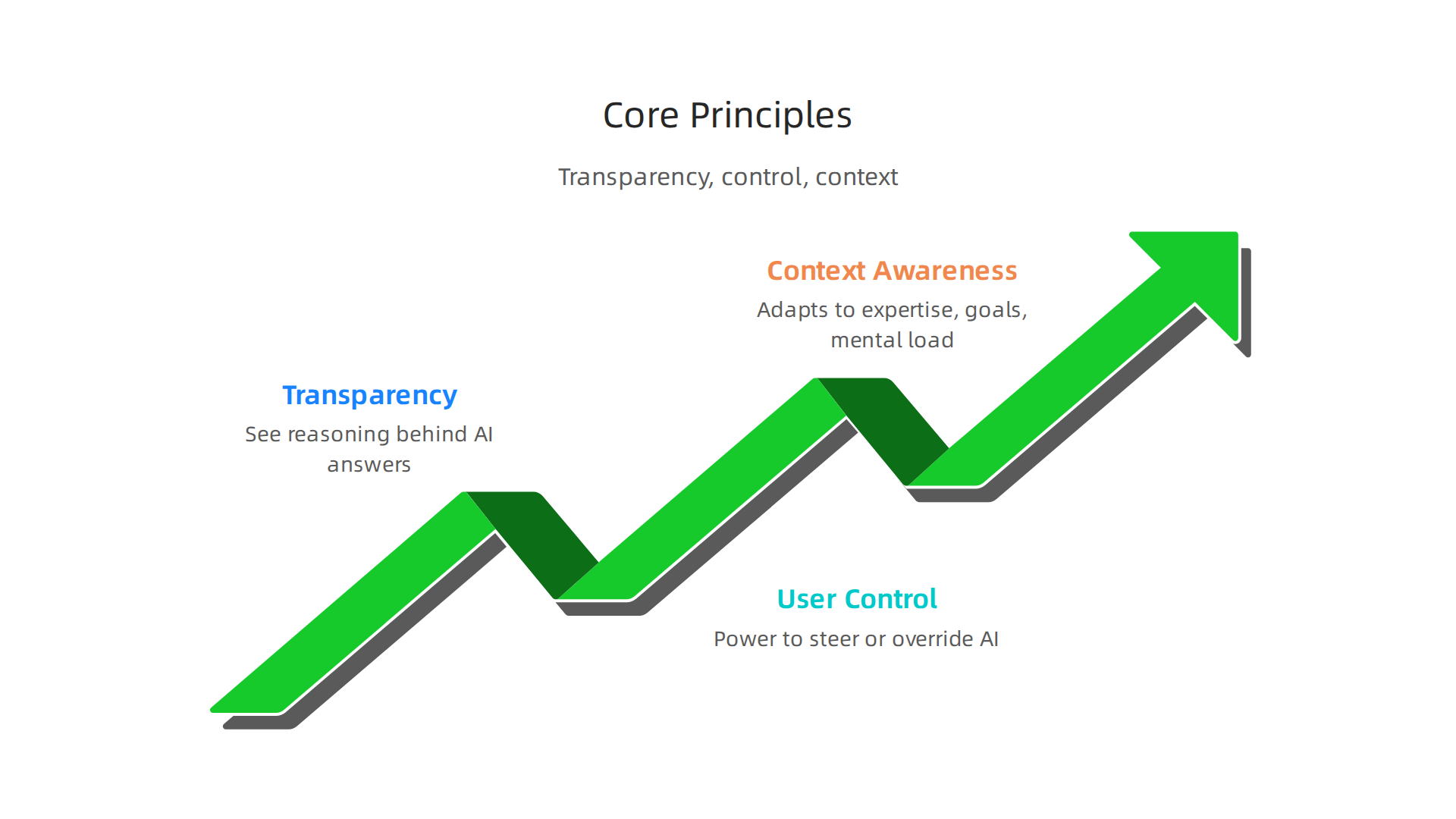
We talked about setting clear expectations. That is a good starting point. But to really make AI feel like a partner, you need three deeper principles. These principles turn a helpful tool into a system that actually boosts how you think and work. They are transparency, user control, and context awareness.
Get these right, and your artificial intelligence: a guide for thinking humans becomes something you truly trust.
Principle 1: Transparency
You deserve to know how an AI reaches its answers. That is the core of transparency. If a personal ai assistant recommends a course of action, you should be able to see the reasoning behind it. This idea is central to explainable AI. Research from Virtualitics names transparency as one of the four key principles of explainable AI applications.

Without it, you are just taking guesses. Transparency builds trust. It also helps you spot when the AI might be wrong. For example, if the ai response includes a questionable fact, you can trace back to see how it got there. This is especially important in policy and regulated industries, where decisions need to be justified. The enterprise guide on explainable AI from Seekr explains how regulated businesses use transparency to meet compliance standards.
Principle 2: User Control
Transparency is not enough if you cannot act on it. You need the power to steer or override the AI. This is user control. You are the human. The AI should listen. If it suggests a draft email that sounds off, you should be able to tweak it. If it recommends a policy approach that ignores a key constraint, you should be able to say no. The Microsoft HAX Toolkit guidelines emphasize that users should be able to review and change AI behavior. This principle makes the relationship collaborative. You are not just accepting whatever the personal ai assistant gives you. You are guiding it. And that is exactly what a good partnership looks like.
Principle 3: Context Awareness
Here is the thing every busy professional experiences: AI that treats everyone the same is useless. A chief policy officer needs a different level of detail than a junior analyst. A personal ai assistant should adapt to your expertise, your current goals, and your mental load. If you are exhausted after a long meeting, the AI should simplify. If you need deep analysis, it should dive in. This is context awareness. Research from the ACM on human-centered explainable AI points out that making AI explainable requires understanding who needs explanations and why. So your artificial intelligence prompt should not just be a static command. It should be a starting point for the AI to ask, "What do you need right now?"
These three principles work together. Transparency shows you how. User control lets you act. Context awareness ensures the whole interaction fits your situation. When you design or choose AI systems with these in mind, you get technology that genuinely enhances human understanding.
Want to keep your thinking sharp as AI policy evolves every week? Get clear daily updates from The Deep View Newsletter. It helps you stay ahead of changes in AI governance and regulation so you can make smarter decisions.
Designing for Transparency and Explainability
So you know the three principles. Transparency shows you the reasoning. User control lets you act on it. Context awareness tailors the experience. But how do you actually build these into a real system? That is where explainability comes in. You need to design your personal ai assistant so that every ai response comes with a clear, useful explanation.
Think of explainability as the bridge between a principle and a lived experience. When you get an artificial intelligence prompt output, you should immediately grasp why the system landed on that answer. This is what builds real trust over time. Research from Nerdery shows that explainable AI directly creates more trust and transparency in how these systems operate.
Key Techniques That Make AI Explainable
You do not need to be a data scientist to understand these. Here are three practical ways designers and developers make AI more transparent.
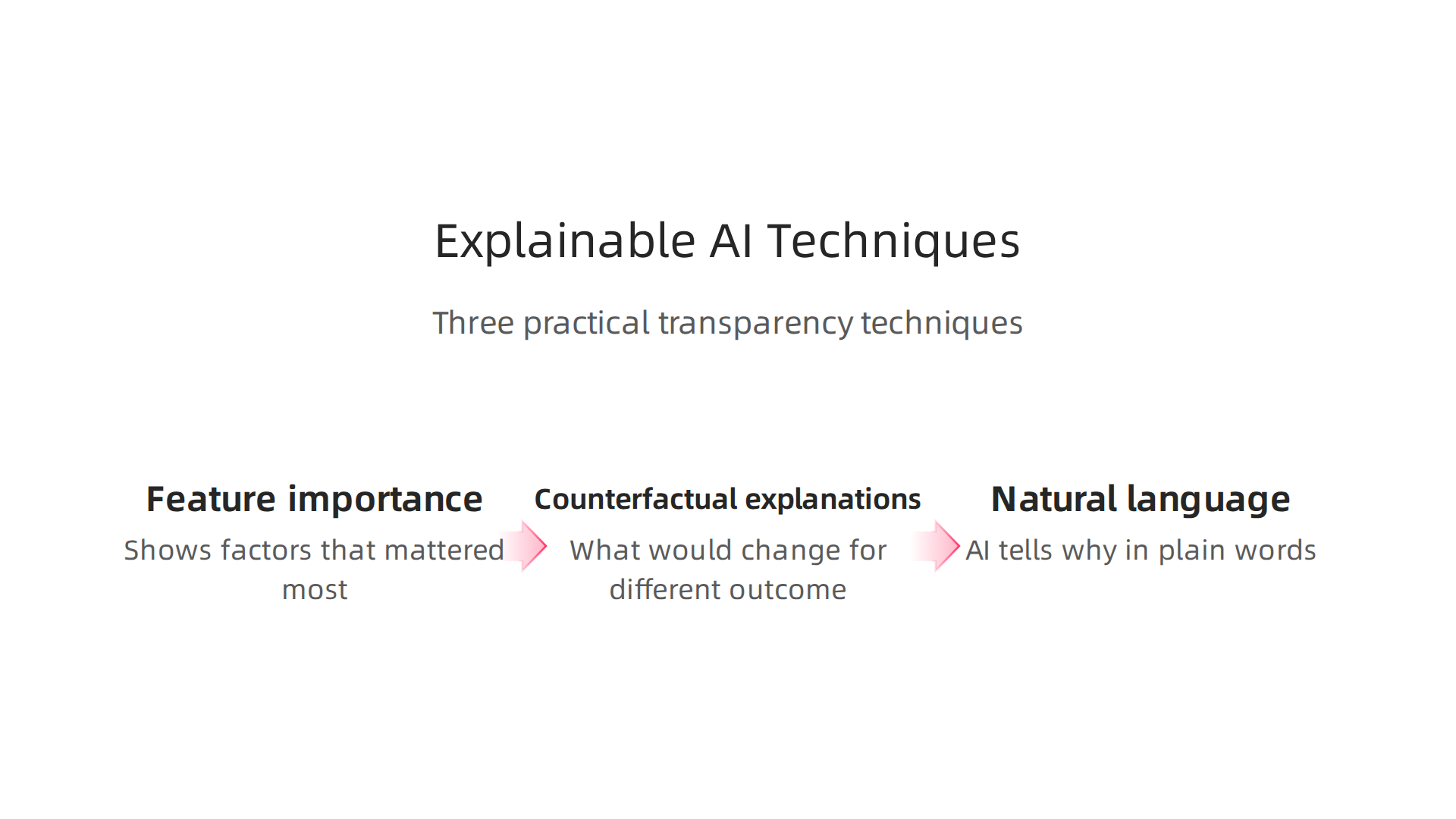
Feature importance. This technique shows you which factors mattered most in the AI’s decision. For example, if an AI recommends denying a loan application, feature importance would tell you the top three reasons. Income level. Credit history. Debt ratio. You see the logic clearly. This technique is widely used in regulated industries because it supports auditability and compliance.
Counterfactual explanations. This is a fancy name for a simple idea. The AI tells you what would need to change for a different outcome. "If your credit score were 50 points higher, the recommendation would change." That is a counterfactual explanation. It helps you understand the boundary of the decision. And it gives you actionable information you can use.
Natural language explanations. The AI simply tells you in plain words why it made its choice. No charts. No code. Just clear sentences. This works especially well for busy policy professionals who need fast context without digging through data.
These techniques matter even more in 2026 because regulations are catching up fast. The EU AI Act now mandates explainability for high risk AI systems. Companies using AI in hiring, credit, healthcare, and other sensitive areas must provide clear explanations for automated decisions. The complete enterprise guide on explainable AI from Seekr breaks down exactly how regulated businesses are meeting these compliance requirements in 2026.
This connects directly to what we discussed earlier about user control. You cannot override a decision if you do not understand it. You cannot audit a system if its reasoning is hidden. And you certainly cannot build policy around AI if the decision making process is a black box.
That is why explainability is not just a nice feature. In 2026, it is a legal requirement and a trust necessity. The Microsoft HAX Toolkit guidelines reinforce this idea by giving developers concrete best practices for designing AI that people can actually review and challenge.
Want to keep your understanding sharp as these regulations keep changing? Get clear daily updates from The Deep View Newsletter. It helps you track new compliance requirements and stay ahead of AI governance shifts.
For a deeper look at how policy teams are implementing these explainability standards, check out our guide on AI policy in the public sector and government compliance in 2026.
Ethical Frameworks Guiding AI Interaction Design
Now that you see how explainability makes AI decisions clear, the next question goes deeper. What moral rules should guide how the AI makes those decisions in the first place? This is where ethical frameworks come in. They are not just philosophy class concepts. They are practical tools that shape every ai response your system delivers.
Think of an ethical framework as a compass. It tells the designer which direction is right when there is no obvious answer.

In 2026, three major frameworks dominate the conversation.
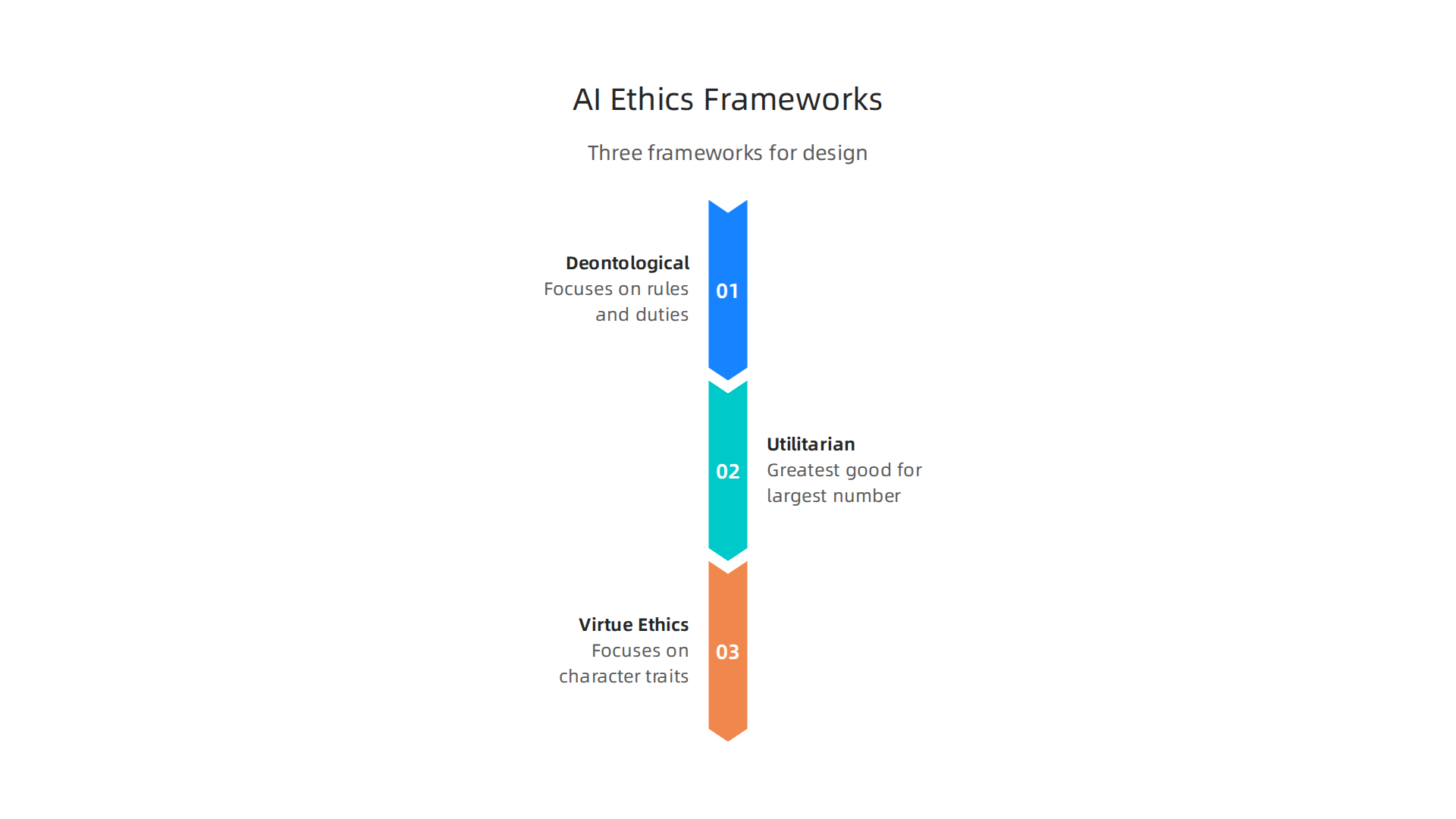
Deontological ethics focuses on rules and duties. You treat users with respect by never deceiving them. Your personal ai assistant must not manipulate people, even if it would get a better result. The rule "always be honest" applies no matter what. This framework grounds principles like informed consent and privacy.
Utilitarian ethics looks at outcomes. The goal is the greatest good for the largest number of people. An AI that routes emergency vehicles to save more lives is using utilitarian logic. But this approach can slip into "the ends justify the means" territory. That is why most modern frameworks combine it with safeguards.
Virtue ethics asks what a good person would do. Instead of rules or outcomes, you focus on character traits like honesty, compassion, and fairness. Designers using this framework build AI that reflects those virtues in every interaction.
All three frameworks support the foundational principles of fairness, accountability, and transparency (FAT) . Research from Lumenalta explains that ethical AI practices prioritize these three pillars to prevent unintended harm.
A comprehensive study in Applied Artificial Intelligence shows that integrating transparency and fairness directly reduces biases in AI technologies.
But without these frameworks, things go wrong fast. Remember the biased hiring algorithm case from a few years ago? A major tech company used an AI to screen job candidates. The system learned from past resumes, which were mostly from men. So it penalized women. That is a direct failure of fairness and transparency. The ACM policy column emphasizes that black-box systems like this undermine both scientific integrity and democratic oversight.
That is why artificial intelligence: a guide for thinking humans must include a strong ethical foundation. You need to understand these frameworks because they directly affect what regulations look like. For example, the EU AI Act explicitly references fairness and accountability expectations.
Want to see how these frameworks are showing up in government compliance work? Read our analysis on how AI policy in the public sector is transforming government compliance in 2026.
And if you want to keep up with how these ethical rules evolve across jurisdictions, get daily clarity from The Deep View Newsletter. It tracks every major shift in AI ethics policy so you never miss a critical update.
Regulatory Landscape and Compliance for AI Interaction (2026)
So you have your ethical framework ready. Great. Now here is the part that keeps a lot of designers awake at night. The rules. In 2026, governments around the world have turned those ethical principles into actual laws. You cannot just build a helpful ai response system anymore. You have to prove it meets legal standards.
The biggest player right now is the European Union AI Act. It is the first complete legal framework for AI anywhere.

The EU AI Act sorts AI systems into risk levels. Minimal risk. Limited risk. High risk. And unacceptable risk.
If your personal ai assistant does something like screen job applicants or grade students, it is likely high risk. That means you need strict transparency and human oversight baked into the design.
What does this mean for interaction design? A lot. Take transparency obligations. The EU AI Act guidelines say users must know they are talking to AI. That sounds simple, but it changes how you handle chat flows, disclaimers, and error messages. You cannot hide the fact that an algorithm is providing the answer. Your ai response must be clearly labeled.
The United States is moving too. Several executive orders now require federal agencies to audit AI systems for bias and safety. Canada is working on the Artificial Intelligence and Data Act. The trend is clear. Any artificial intelligence: a guide for thinking humans must include compliance as a core design requirement, not an afterthought.
For businesses, this is serious. The ModelOp summary of the EU AI Act explains that penalties can reach up to 35 million euros or 7 percent of global annual revenue. That is not a typo. Companies that ignore these rules face massive fines.
So what should you do? Start with a risk assessment. Document every decision your AI makes. And build transparency into every interaction. If you are working in the public sector, the compliance rules are even tighter. Read our full breakdown of how AI policy in the public sector is transforming government compliance in 2026 to see real examples.
Keeping up with all these changes is tough. Regulations update fast. That is why thousands of professionals rely on daily updates. Get clear, actionable insights delivered to your inbox from The Deep View Newsletter. It tracks every major regulatory shift so you can stay ahead of compliance deadlines.
Measuring Success: Metrics for Human-AI Interaction Quality
You have your ethical framework in place. You know the regulations. But how do you know if your ai response is actually working? You cannot just guess. You need real numbers and real feedback. Measuring quality is what separates a useful personal ai assistant from one that frustrates people.

Think of this as your report card. To build a truly helpful artificial intelligence: a guide for thinking humans, you need to track both hard numbers and human feelings.
The Numbers That Matter
Quantitative metrics give you cold, hard facts. They tell you if your system is fast and accurate. Start with these:
- Task completion time: How long does it take a user to finish what they started? The faster, the better, but not at the cost of quality. According to recent data, AI platforms can achieve average handle times under 3 minutes (source: Lorikeet AI Customer Service Statistics).
- Error rate: How often does your ai response give wrong or confusing information? You need to track this closely. A high error rate destroys trust fast.
- User satisfaction scores: The System Usability Scale (SUS) and Net Promoter Score (NPS) are proven tools. The Master of Code AI Evaluation Metrics 2026 lists user satisfaction as a core metric for any AI agent.
These numbers give you a baseline. But they do not tell the full story.
The Human Side of Quality
Numbers do not capture how a user feels. That is where qualitative metrics come in. They measure things you cannot put on a spreadsheet easily.
- User trust: Does the person feel safe sharing information? Do they believe the ai response is correct? Trust is built over time, but it can be broken in one bad interaction.
- Perceived transparency: Does the user understand why the AI said what it said? When you design an artificial intelligence prompt, you need to make the reasoning clear. The EU AI Act requires transparency, and human evaluation metrics show that explainability directly affects user trust.
- Cognitive load: How much mental effort does your personal ai assistant cost the user? If someone has to think too hard to understand the AI, the design has failed. Simplicity wins.
New Benchmarks on the Horizon
Academia and industry are building better yardsticks. The Metrics and Benchmarks for Human-AI Decision-Making paper introduces four metric families: outcome, reliance, transparency, and adaptability. These go beyond simple satisfaction scores.
The Stanford HAI 2026 AI Index Report also shows how fast performance benchmarks are rising. On coding tasks, performance jumped from 60% to near 100% in one year. That means the bar for quality gets higher every month.
Putting It All Together
You do not need to track every metric at once. Start with three: task completion time, error rate, and user trust. Then layer on more as your system matures.
Remember, compliance (from the previous section) tells you what you must do. Metrics tell you how well you are actually doing. Both are essential. If you want to dive deeper into how policy trends affect your metrics strategy, check out our guide on the biggest information technology policy shifts of 2026.
Tracking quality is an ongoing process. To stay ahead of the latest best practices and metrics benchmarks, get clear daily updates. Subscribe to The Deep View Newsletter for actionable insights delivered to your inbox.
Summary
This article argues that interaction rules for AI must be updated for today’s generative systems and offers a practical roadmap for policy professionals, designers, and executives. It explains how AI has shifted from fixed tools to conversational partners and introduces three core principles—transparency, user control, and context awareness—that should guide interaction design. The guide describes concrete explainability techniques (feature importance, counterfactuals, natural‑language explanations), outlines major ethical frameworks that shape choices, and summarizes the 2026 regulatory landscape including the EU AI Act. It also shows how to measure interaction quality with mixed quantitative and qualitative metrics and offers steps teams can take to build compliant, trustworthy systems. After reading, you’ll understand what good human‑AI interaction looks like, how to evaluate risk and compliance, and which metrics and design practices to prioritize.