

Why combining ethics and performance evaluation matters for policy
In 2026, artificial intelligence (AI) is changing our world very fast. This makes it hard for people who make rules to keep up. When deciding about AI, policymakers need two main things: to know if the AI works well and to make sure it is fair and safe.

It is not enough to just ask "what is the best ai" based only on how fast or smart it seems. We also need to think about how it impacts people’s lives.
If we only look at how well an AI works without thinking about its ethics, we might miss big problems. For example, an AI might be very good at its job, but it could be unfair to certain groups of people. Or it might not be a robust AI if things change even a little bit. That’s why keeping ethics and performance separate can lead to bad decisions. Policy needs to bring these two parts together. We need to make sure AI systems are not only effective but also AI Literacy for Policy Professionals and explainable.
Governments all over the world are working on rules for AI. For instance, the European Union has the AI Act | Shaping Europe’s digital future, which will be fully in place by August 2026 for many high-risk AI systems. This shows a strong focus on risk-tiered frameworks and compliance requirements. The United States is also working on a National Policy Framework Artificial Intelligence to guide its approach. These efforts show that knowing how to evaluate AI properly is more important than ever. This guide will give you a clear plan to check AI systems. This plan is useful for making rules, buying AI tools, or watching over how AI is used.
To keep up with all the new AI rules and important policy changes every day, it helps to have reliable updates. Get clear daily AI updates from The AI Newsletter Worth Reading.
To truly understand what makes AI "good," we must first be clear about what we are trying to measure. It is not enough to simply ask what is the best AI based on how fast it runs or how many tasks it completes. We need to clearly define both our ethical goals and the actual working traits of the AI system. This way, everyone understands what success looks like, which helps avoid confusion and ensures good policy decisions. Having clear definitions is key to Mastering definitions and corporate forms for any tech policy.
When we talk about AI, people often worry about fairness, privacy, and safety. These are important ethical concerns. But how do we check if an AI meets these ethical standards? We need to turn these big ideas into things we can actually measure.
Here are some common ethical worries and how they can be measured:
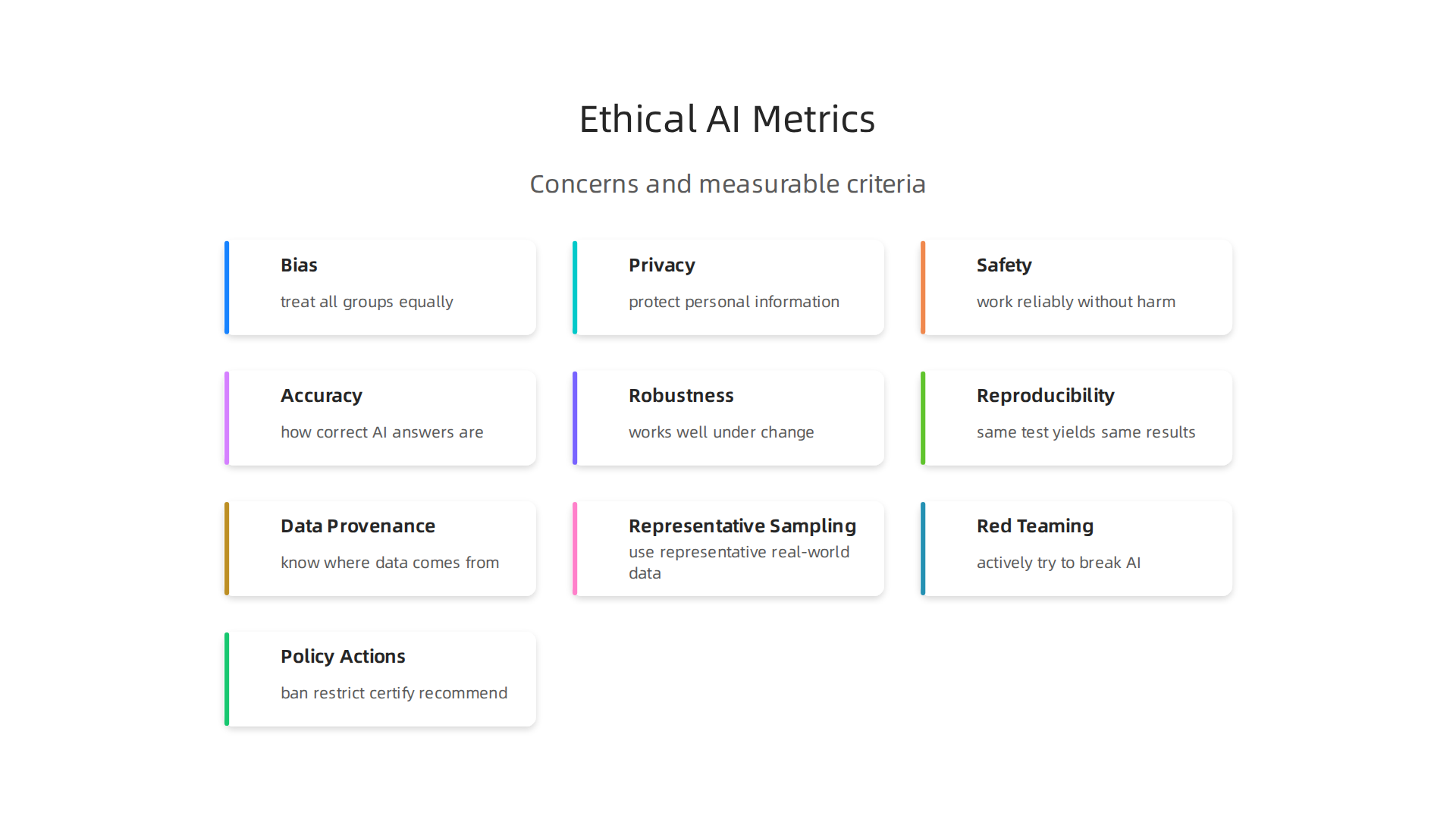
- Bias and Fairness: Does the AI treat all groups of people the same way? For example, does a hiring AI suggest good candidates from all backgrounds, or does it favor one? We can measure this by testing the AI with data from different groups and seeing if its success rates are similar for everyone. Many places, like the UNESCO, have put out rules about AI ethics that touch on this.
- Privacy: Does the AI protect people’s personal information? This can be measured by how little personal data the AI needs to do its job, or how well it keeps that data safe and secret.
- Safety: Does the AI work reliably and without causing harm? This means making sure the AI is a robust AI that does not break down or act in unexpected, harmful ways. We can measure safety by testing the AI in many different situations, especially tricky ones, to see how it performs. Experts agree that Ethical AI principles are vital in 2026.
Sometimes, making an AI better in one way can make it worse in another. This is called a trade-off. For instance, an AI that is super accurate might be very complicated. This complexity can make it hard to understand why the AI made a certain decision. This is where the idea of explainable AI comes in handy. Policy professionals need to be able to explain how AI works. If an AI is not explainable, it is harder to trust, even if it is very accurate.
Another example is privacy. An AI that is designed to protect privacy very strictly might not be able to use all the data it needs to be super accurate or helpful. So, when deciding what is the best AI, policymakers must balance these different needs. It is about finding the right mix of performance and ethical safeguards that works best for the people it serves.
Key metrics and benchmarks: what to measure and why
We just talked about how a "good" AI needs to be fair, private, and safe. Now, let’s look at how we actually measure these qualities. To understand what is the best AI for a certain job, we need clear ways to check its performance and behavior. This helps everyone, from policymakers to regular users, know what to expect.
Here are the main things we measure to see if an AI is working well and safely:
- Accuracy: This is about how correct the AI’s answers or actions are. For example, if an AI is supposed to find cats in pictures, accuracy measures how often it correctly spots a cat. This is often the first thing people look at.
- Robustness: A robust AI can keep working well even if things change a little. Imagine a self-driving car AI. It needs to work in bright sun, heavy rain, or even when a road sign is slightly damaged. Measuring robustness means testing the AI in many different, difficult situations to make sure it handles unexpected inputs without failing or doing something risky.
- Fairness: As we said, this means the AI should treat everyone fairly, no matter their background. We measure fairness by seeing if the AI’s results are similar for different groups. For example, a loan approval AI should not approve loans for one group more often than another if all other factors are equal.
- Privacy Impact: This metric checks how well the AI protects private information. Does it use the least amount of personal data needed? Does it keep that data safe from being seen by the wrong people? We measure this by looking at how data is collected, stored, and used.
- Operational Reliability: This is about how consistently and dependably the AI works over time. Does it crash often? Does it give strange results sometimes? Reliable AI is essential, especially in critical systems like healthcare or transportation.
Using benchmarks and datasets
To compare different AI models, we use special tests called benchmarks. These are like standardized exams for AI. They often come with specific datasets, which are large collections of information used to test the AI. For instance, there are benchmarks to test how well AI models understand language or perform coding tasks. In 2026, many of the leading AI models are showing big improvements on such benchmarks. For example, performance on a key coding benchmark rose significantly in just one year, showing how fast AI is developing technically The 2026 AI Index Report | Stanford HAI.
Groups like Stanford HAI collect a lot of data on AI capabilities and benchmarking to help everyone understand how different AIs stack up. Other reports also look at real-world benchmarks of AI models in 2026, checking things like speed and cost, not just raw accuracy.
However, benchmarks have limits. They are often run in controlled lab settings, which might not show how an AI acts in the real world. Also, many benchmarks focus on technical performance, but not enough on responsible AI qualities like fairness or safety Responsible AI | The 2026 AI Index Report – Stanford HAI. Policy professionals need to think about these real-world uses and ethical concerns, not just the highest scores.
Choosing what matters most
When you decide what is the best AI, you need to pick your main goals first. For some policy objectives, accuracy might be the most important thing. For others, like an AI used in a public service, fairness and explainable AI might be more important. These are your "primary" metrics. Other metrics become "secondary," still important, but not the top priority.
For example, if the AI helps doctors make important choices, we want it to be super accurate and also very explainable so doctors can trust its advice. But if it’s an AI that just sorts emails, high accuracy is good, but explainability might not be as critical. The key is to match the metrics you measure to the actual goal of the AI and its possible impact on people.
Staying up-to-date on AI’s rapid changes and how to measure them is a big job. Get clear daily AI updates from The AI Newsletter Worth Reading.
Now that we know how to measure an AI’s performance, the next step is to make sure it acts in ways that align with our values. This is called "ethical alignment." It’s about taking big ideas like fairness and privacy and turning them into real-world checks for AI systems. We want to make sure an AI is not just good at its job, but also does it in a responsible way that benefits everyone.
Leading ethics frameworks and practical checks
Across the world, many groups have created guides, known as ethics frameworks, to help make sure AI is used responsibly. In 2026, some of the most important ones include the EU AI Act, the NIST AI Risk Management Framework (RMF) from the United States, and the international ISO/IEC 42001 standard. These frameworks give us a roadmap for designing, building, and using AI in a way that respects people and society Ethical AI: Principles, Frameworks and Why It Matters in 2026.
For instance, the EU AI Act focuses on how risky an AI system is, putting strict rules on AI used in sensitive areas like healthcare or law enforcement. The NIST AI RMF is more about managing risks and building trust, helping organizations understand and handle the problems that AI might create AI Ethics Framework in 2026: Principles, Governance, and Implementation Guide for Enterprises. These different frameworks show us that there’s no single answer to "what is the best AI" for all situations. Instead, it depends on what we want the AI to do and the rules it needs to follow.
To turn these high-level ideas into practical steps, we use tools like "model cards" and "datasheets."
- Model cards are like nutrition labels for AI models. They explain what an AI model is meant for, how it was built, what data it used, and how well it performs in different situations. This helps people understand the AI’s strengths and weaknesses.
- Datasheets for datasets do something similar for the data used to train AI. They describe where the data came from, what’s in it, and any possible biases it might have. These tools help create more explainable AI by making its inner workings easier to see.
Converting principles into audit questions
It’s one thing to have principles, but another to make sure they are actually followed. This is where audit questions and acceptance criteria come in. We need to ask clear questions to check if an AI system lives up to its ethical promises.
For example, if a framework says an AI must be "fair," audit questions might be:
- Does this AI treat all user groups the same way?
- Have we tested it for bias against different ages, genders, or backgrounds?
- Can we show how we fixed any unfairness we found?
If a framework says an AI must be "transparent," we might ask:
- Can we easily understand why the AI made a certain decision?
- Are its model cards and datasheets clear and complete?
These questions help us create a clear checklist. When an AI system can answer "yes" to these questions, it meets the acceptance criteria for ethical use. This is a core part of building AI systems securely and compliantly, making sure they are not only smart but also safe and responsible. For more on building reliable systems, explore a step-by-step blueprint for building AI securely and compliantly.
The role of people and openness
Making sure AI is ethically aligned isn’t just a technical task. It also needs human input.

This means involving different groups of people, known as stakeholders, who might be affected by the AI. They can include users, experts, community leaders, and even those who might be disadvantaged by the technology. By listening to their concerns and ideas, we can make the AI better and fairer.
Openness, or transparency, is also key. Being open about how AI works, its limits, and how ethical checks are done builds trust. When people understand that an AI system has been reviewed for fairness, privacy, and safety, they are more likely to accept and trust it. This helps ensure that the AI we build serves society in the best possible way.
Even with clear ethical rules and audit questions, it’s really important to see how AI acts in the real world. That’s why we use special tests that go beyond simple checks. These tests help us find problems that might not show up during normal use.
Stress Tests and Red-Teaming for Real-World AI
Imagine you have a new car. You wouldn’t just drive it on a perfect, empty road, right? You’d want to see how it handles bumpy roads, heavy rain, or sudden stops. It’s the same idea for AI. We need to put AI systems through "stress tests" to push them to their limits. This means giving them very unusual or difficult tasks to see if they break down or make bad decisions. These tests are key to building robust AI.
Another powerful testing method is called "red-teaming." This is like having a team of experts try to intentionally find flaws in the AI, much like a cybersecurity team tries to hack a system. They look for ways the AI could be tricked, misused, or lead to unfair results. By actively trying to "break" the AI, red-teaming helps uncover hidden weaknesses that might not be visible in regular tests.

This helps make sure the AI is safe and reliable when faced with unexpected situations. Standard benchmarks show great performance on common tasks, with some AI models reaching nearly 100% on coding benchmarks like SWE-bench Verified in 2026 [The 2026 AI Index Report | Stanford HAI]. But red-teaming helps us look deeper to see where models might still struggle.
How to Design Good AI Tests
To truly understand an AI’s performance and determine what is the best AI for a specific job, we need to design tests carefully. This involves a few key ideas:
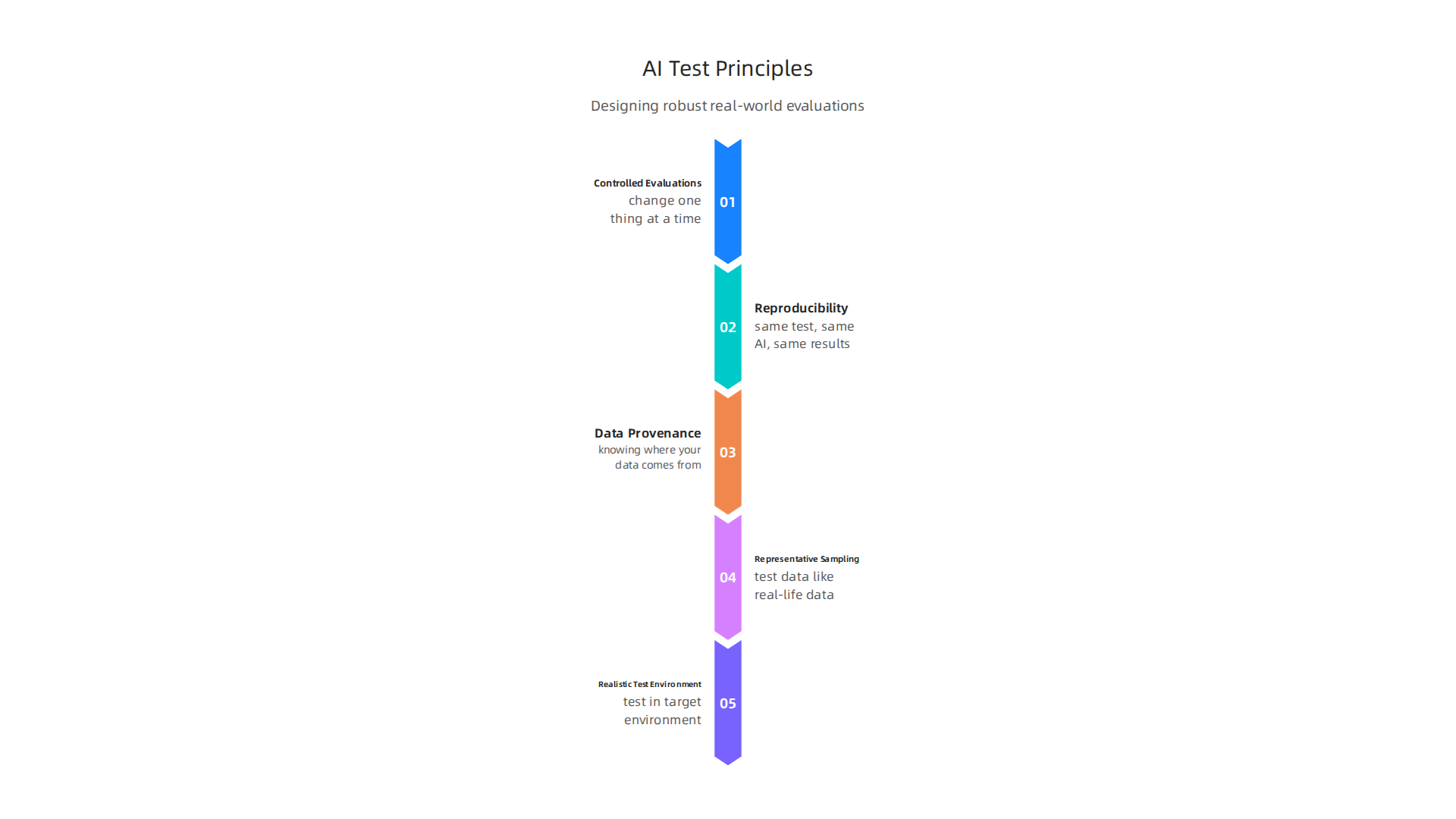
- Controlled Evaluations: This means setting up tests where we change only one thing at a time. For example, if we’re testing an AI that writes summaries, we might change the length of the original text but keep the topic the same. This way, we can clearly see what affects the AI’s performance.
- Reproducibility: It’s vital that if someone else runs the exact same test with the same AI and data, they get the same results. This builds trust and lets others check the findings. Without reproducibility, it’s hard to be sure an AI’s performance is truly what it seems. In fact, many organizations now publish detailed AI Model Benchmarks and Pricing Dataset 2026 to help with comparisons.
Making Tests Realistic
For tests to be truly helpful, they need to reflect the real world.
- Data Provenance: This big phrase just means knowing where your data comes from. Is the data used to test the AI from reliable sources? Is it up-to-date? Knowing the origin of your data helps ensure your tests are fair and relevant.
- Representative Sampling: The data used for testing should look like the data the AI will see in real life. If an AI is meant to help people all over the world, its test data shouldn’t just come from one small group of people. It needs to represent many different backgrounds and situations to avoid biases.
- Realistic Test Environment: Finally, the place where you test the AI should be as close as possible to where it will actually be used. Testing an AI that drives a car on a closed track is good, but it also needs to be tested on real roads with real traffic to truly prove its capabilities.
By using stress tests, red-teaming, and thoughtful evaluation design, we can go beyond basic benchmarks. This allows us to find out how an AI really performs and ensure it is safe and reliable for everyone. To learn more about how experts break down complicated AI information, you might enjoy unpacking tech data: a policy professional’s guide for 2026.
Want to stay informed on the latest AI developments and their real-world impact?
The AI Newsletter Worth Reading
After we put AI systems through tough tests, the next big step is to use what we learn to make rules and guide how these tools are bought and used. This is where evaluation results truly shape real-world policies.
Policy case studies: how evaluations affected regulations, procurement, and oversight
Seeing how AI acts in real-world situations, especially through stress tests and red-teaming, gives us important information. This information helps leaders make smart choices about AI. It’s not just about finding out what is the best AI, but also about making sure AI is used safely and fairly for everyone.
For instance, the European Union’s AI Act, which is becoming fully applicable in 2026, shows how evaluation can lead to big rules AI Act | Shaping Europe’s digital future – European Union. The goal was to create trust in AI. This law has different rules for AI depending on how risky it is. These risk levels were decided after many evaluations and discussions about how AI systems could impact people.
Another example comes from government use of AI. A federal agency worked to use AI responsibly by setting up its own AI rules and better ways to check AI tools. This helped them meet goals while staying safe and accountable Driving mission impact through AI governance. Such efforts show how evaluating AI helps governments decide what AI to buy and how to watch over its use. This type of thoughtful governance is key to making sure that public sector AI serves everyone well.
What helps and hurts turning AI findings into policy
Making technical reports into clear policy rules can be tricky. Here’s what works and what doesn’t:
Success Factors:
- Clear Results: When AI evaluations show very clear and easy-to-understand results, it’s easier for policymakers to act. If a test clearly shows an AI is unfair, it’s simpler to make a rule to fix it.
- Good Communication: Sharing findings in a way that non-experts can understand is super important.

This often means using simple language and showing real-life examples, not just numbers. Understanding things like explainable AI can help here, as it focuses on making AI’s decisions clear.
- Teamwork: When people from different groups like technical experts, lawmakers, and community leaders work together, policies are stronger. This way, different concerns are heard and addressed.
Pitfalls (What Makes it Hard):
- Too Complex: Sometimes, AI test results are very technical and hard for policymakers to understand. This can slow down or stop new rules from being made.
- Lack of Trust: If policymakers don’t trust how an AI was evaluated, they might not use the findings. This is why things like rigorous artificial intelligence review for policy compliance are so important.
- Not Enough Disclosure: If companies or developers don’t share enough about how their AI works or how it was tested, it’s hard for policymakers to make good rules.
Lessons for the future
To make sure AI evaluations truly help shape good policy in 2026 and beyond, we need to remember a few key things:
- Reproducibility: Always make sure that if someone runs the same AI test, they get the same results. This builds trust in the findings.
- Clear Disclosure: Be open about how AI systems work, what data they use, and how they are tested. This helps everyone understand the risks and benefits.
- Talk to Everyone: Make sure all groups who will be affected by AI policies have a say. This includes experts, businesses, and regular people.
By following these lessons, we can make sure that our efforts to evaluate AI lead to smart, fair, and helpful policies for its use across all parts of life.
Turning big ideas about AI policy into real-world actions for buying and using AI tools is the next important step. This means taking what we learn from evaluating AI and putting it into clear rules for companies and government groups. It helps ensure that when someone asks, "what is the best AI" for a job, the answer includes not just performance but also safety and fairness.
Making AI Rules Real: Contracts and Checks
When an agency or company decides to use an AI system, the results from careful evaluations become very important. These results help them write clear rules in contracts with AI vendors. For example, a contract might state that an AI system must meet specific safety standards or pass certain acceptance tests before it can be used. These tests check if the AI works as promised and follows all the rules. A good way to handle this is by using an AI Procurement Checklist (2026), which helps buyers look at important technical, ethical, and legal points. This ensures that the chosen AI is not only effective but also aligns with policy goals.
For large organizations, managing these requirements is complex. A strong set of rules, often called a Procurement AI Governance, Risk & Compliance Framework 2026, helps guide how AI is bought and used. It makes sure that every step, from choosing a vendor to actually using the AI, follows the established policies. This helps keep AI systems robust and reliable over time.
Keeping an Eye on AI: Ongoing Monitoring and Audits
It’s not enough to just check an AI system once. We need to watch it constantly to make sure it keeps working well and follows all the rules after it’s been deployed. This is called continuous monitoring. Imagine an AI that helps make important decisions; we need to be sure it doesn’t start making unfair choices over time. Tools like an AI Audit Checklist: Prove Compliance + Free Template (2026) can help agencies perform regular checks. This is especially important for high-risk AI systems, which should be reviewed often, sometimes every six months, due to how quickly AI rules are changing in 2026.
Regular audits also help make sure AI systems stay compliant. An audit is like a thorough inspection. These checks can look at everything from how the AI was built to how it’s currently performing. They help organizations find any problems early and fix them. For more on building secure and compliant AI systems, you can read about a How to Build AI Securely and Compliantly.
The Role of Outside Helpers and Public Trust
To really make sure AI is used responsibly, we often bring in outside experts. Third-party auditors are independent groups who check AI systems and their use. They can give an unbiased opinion on whether an AI system is fair, safe, and works as it should. Their checks can help confirm if the AI meets certain standards, a process sometimes called certification. This adds another layer of trust.
Public reporting is also key for accountability. When organizations share information about how their AI systems work, what data they use, and how they perform, it builds trust with the public. Transparency helps people understand the benefits and risks of AI, leading to better discussions and stronger policies. For instance, in government, AI in audits helps track public spending and ensure fairness, moving from small trials to widespread use for better public service. If you want to dive deeper into how AI is being used in procurement and what it takes for these systems to pass an audit, there’s a good article on How to Use AI in Procurement That Survives An Audit.
Staying on top of these fast-moving changes in AI policy and technology is crucial. To get clear, daily updates and in-depth analysis on AI and tech policy, consider subscribing.
The AI Newsletter Worth Reading
When we finish checking an AI system, the next big step is to decide how we want to use it. This means moving from simply evaluating an AI to making clear rules about it. Should we ban it, limit its use, give it a seal of approval, or just suggest it? These choices depend on how well the AI performed in our checks and how much risk we are willing to take.
Making Big Decisions for AI Use
To make smart choices about AI, we need a simple way to decide. Think of it like a set of guidelines that links what we found during our checks to specific actions. This helps answer the question, "what is the best AI" for a certain job, not just based on how powerful it is, but also how safe and fair it is.
Here are some ways we decide what to do with AI:
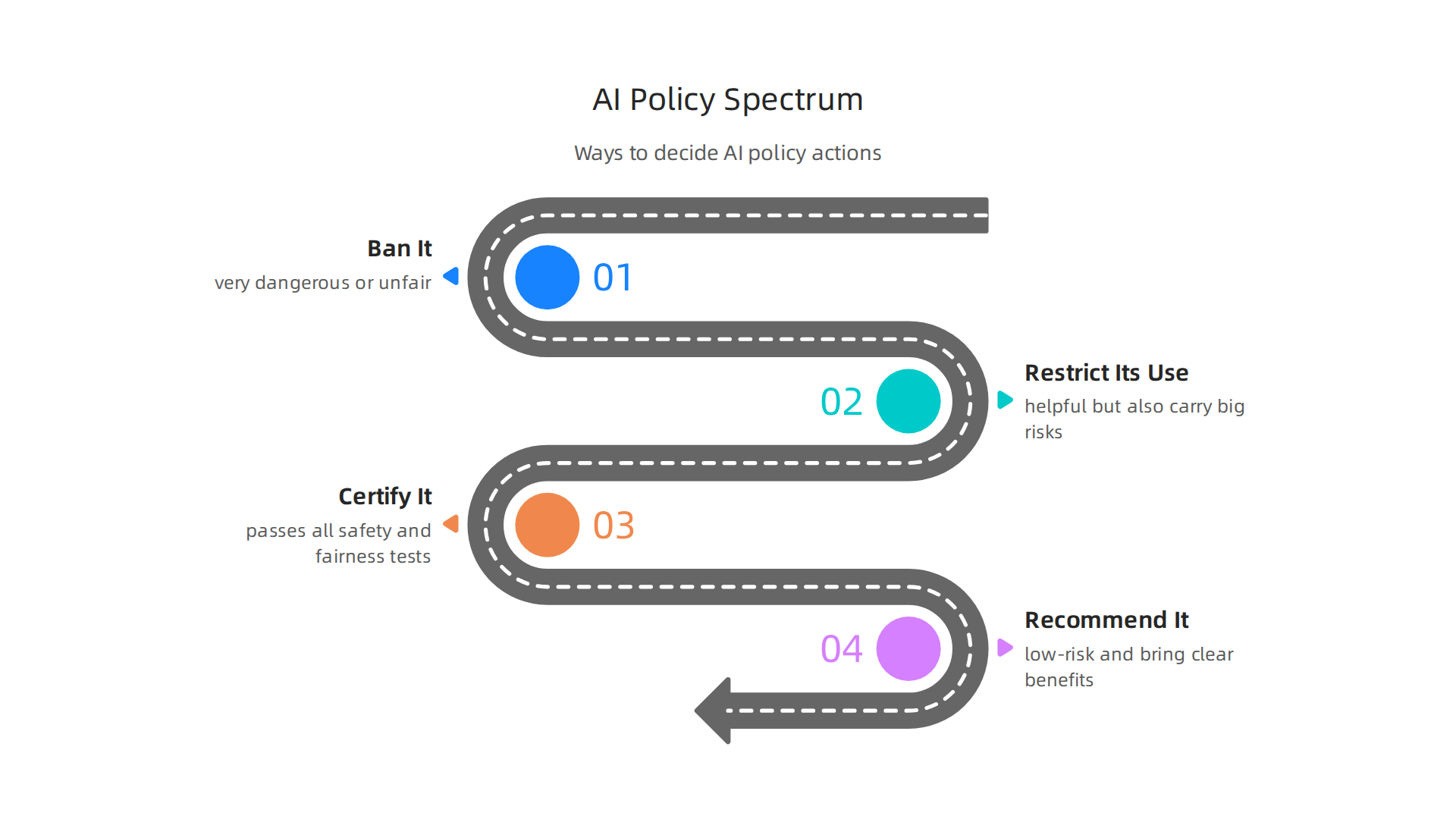
- Ban It: If an AI system is found to be very dangerous or unfair, it might be banned completely. For example, some AI uses that create "unacceptable risk" are outright forbidden under the AI Act in Europe. This law has different levels of risk for AI systems, and some high-risk uses also face strict rules, with full rules for these systems coming into play by August 2026.
- Restrict Its Use: Some AI systems are helpful but also carry big risks. For these, we might put strong limits on how they can be used. This could mean they need constant checks, special training for users, or extra safety features. Many countries, including those following the EU AI Act and others around the world, use a risk-based approach to decide which rules apply to which AI systems, as highlighted in a 2026 guide to global AI regulations.
- Certify It: If an AI system passes all its safety and fairness tests, it might get a special certification. This is like a "seal of approval" that tells everyone it meets high standards. This helps build trust in the AI.
- Recommend It: For AI systems that are low-risk and bring clear benefits, we can recommend them for wider use. This encourages people to use helpful AI without too many worries.
Balancing Risks and Rewards
Deciding on these policies isn’t always easy. Leaders have to think about many things, like how much risk society is comfortable with (this is called "risk tolerance") and what good the AI can do versus its possible downsides. These decisions often involve tough choices and even political trade-offs. What one country sees as too risky, another might see as an acceptable tool for progress. This is why having robust AI systems that work well and safely is so important.
Sometimes, it’s hard to tell how an AI makes its decisions. This is where "explainable AI" comes in handy. It helps us understand why an AI gave a certain answer, making it easier to trust and regulate. You can learn more about this by reading how Lucid AI is Reshaping Business and Work by Making AI Explainable.
Talking Tech to Everyone Else
One of the biggest challenges is explaining complex AI evaluation results to people who don’t work with technology every day. Policy makers, politicians, and the public need to understand the facts to make good decisions. This means:
- Using simple language: Avoid confusing technical words.
- Giving clear examples: Show how the AI works in real life.
- Focusing on the main points: Highlight the most important findings about safety, fairness, and performance.
Being able to clearly share what we learn from AI evaluations is key. It helps everyone understand the impact of AI and supports better policy choices for our future. To help you understand these complex topics, check out this guide on AI Literacy for Policy Professionals: A Guide to Machine Learning and Regulation in 2026. This way, more people can contribute to the important discussion about what is the best AI for society.
Summary
This article explains why policymakers must combine ethical checks with technical performance when evaluating AI systems, arguing that accuracy alone is not enough to judge whether an AI is suitable for real-world use. It outlines the key metrics to measure—accuracy, robustness, fairness, privacy impact and operational reliability—and shows how benchmarks, datasets and controlled tests fit into an evaluation strategy while also noting their limits. The piece describes practical methods like model cards, datasheets, stress tests and red‑teaming to surface hidden risks, and explains how evaluation results should feed into procurement, contracts, audits and policy choices such as bans, restrictions or certifications. It highlights leading ethics frameworks and the need for reproducibility, stakeholder input and clear disclosure to build trust. Readers will learn how to design realistic tests, translate findings into acceptance criteria, and set up ongoing monitoring so AI systems remain safe, fair and compliant in deployment.