
Why ‘AI scientist’ needs policy fluency now
Working as an AI scientist in 2026 is exciting, but it also comes with new challenges. One of the biggest changes is how quickly rules and laws about artificial intelligence are growing.

These new rules are reshaping everything, from how we develop AI tools to how companies can use them and even how research gets funded. It’s not just about making the smartest AI anymore; it’s also about making sure it follows the rules.
Governments all over the world are creating new policies to guide AI. For example, by the middle of 2026, 47 countries had put specific AI laws in place, and more are on the way AI Regulation by Country 2026. This fast pace means that what was allowed last year might not be allowed today. An AI scientist needs to understand these changes so their work stays useful and legal. If we ignore these rules, we might create something that can’t be used, or worse, something that causes problems because it doesn’t fit with current societal expectations. Some people even worry that certain types of artificial intelligence could be bad if not guided properly.
This article is here to help. It’s a clear, step-by-step guide for every AI scientist and technology expert dealing with policy. We will give you a practical playbook to keep an eye on new AI policies, figure out what they mean, and act on the chances and risks they bring. Learning about these policies can also help you understand how to approach different types of artificial intelligence in a responsible way. This way, you can make sure your AI projects are not just smart, but also safe and beneficial for everyone. If you’re an AI scientist looking to grow your career, understanding policy is now a key part of your job, helping you master AI research roles for policy, industry, and public interest.
Staying informed about these rapid changes is critical.
The world of AI policy moves fast, and staying on top of it can feel like a full-time job. For clear, daily updates and deep analysis on AI and technology policy, consider subscribing.
The AI Newsletter Worth Reading
Staying informed about these rapid changes is critical. But what does it really mean to be an "AI scientist" when policy is so important? It means more than just being good at science.
Defining the role: what being an ‘AI scientist’ in policy means
In 2026, the job of an AI scientist has grown. It’s no longer just about doing technical research in a lab or writing code. Now, an AI scientist also needs to understand how their work fits into the world of rules and laws. This means balancing deep technical duties with important policy responsibilities.
On one hand, an AI scientist still does the core work of creating, testing, and improving different types of artificial intelligence. They build the smart systems that can learn and solve problems. This is the part of the job that needs strong science and math skills. They make sure the AI works well and does what it’s supposed to do.
On the other hand, the role now also includes policy-facing duties. This means the AI scientist helps shape the rules for how AI should be used. For example, they might:
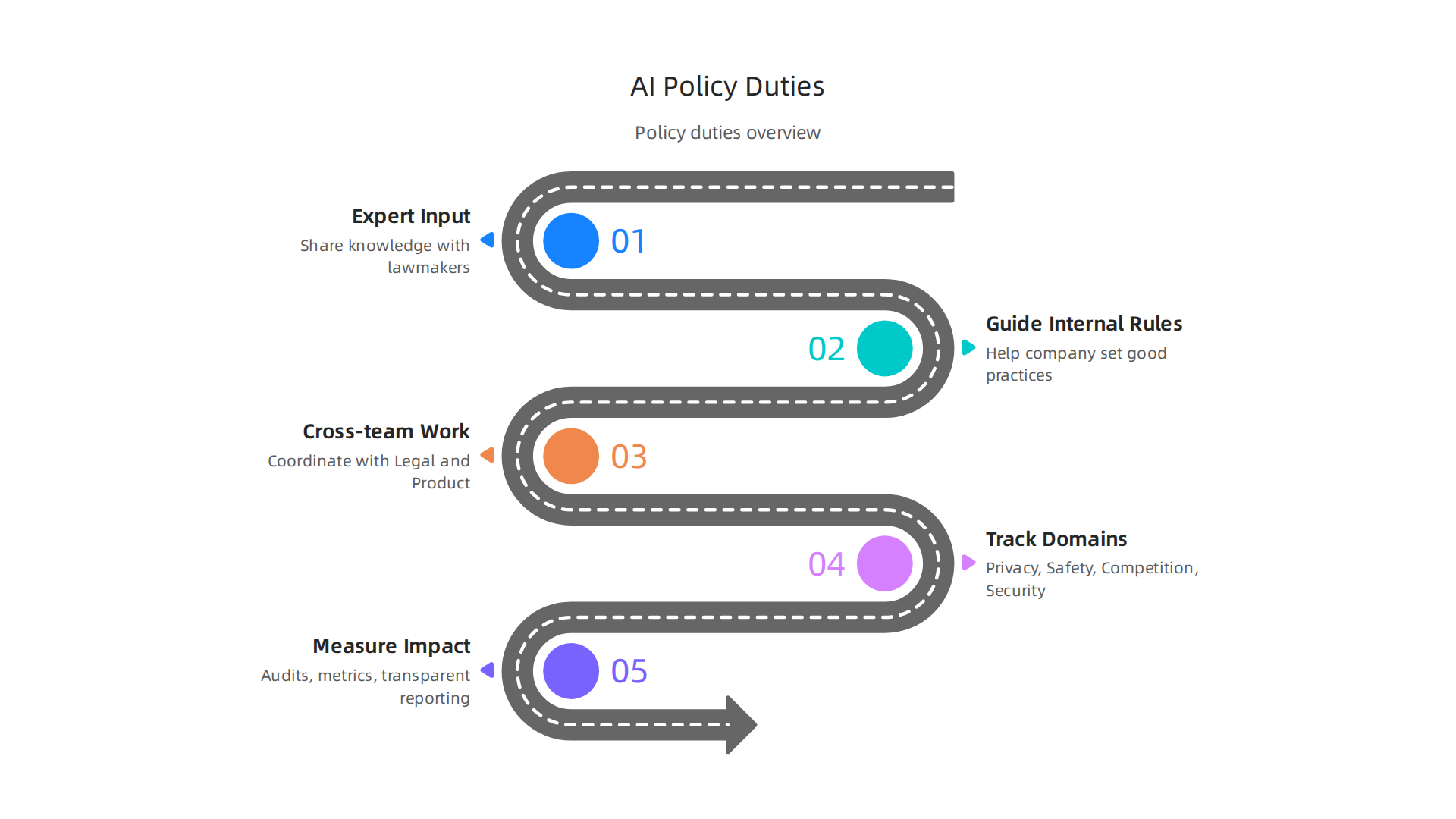
- Provide expert input: Share their knowledge with lawmakers or company leaders about how new AI policies will actually work. This helps create fair and practical rules. The global landscape of AI regulation is complex, with many different approaches The Artificial Intelligence (AI) global regulatory landscape.
- Guide internal rules: Help their company set up good practices for using AI safely and ethically. This is like creating a guide for everyone inside the company. It’s about making sure their own AI projects meet high standards for rigorous artificial intelligence review for policy compliance.
- Spot problems early: Look for ways that AI might cause issues if not carefully managed. They understand why some people worry that certain uses of AI are bad and can help prevent those problems.
The technical skills of an AI scientist are very important for these policy talks. Because they truly understand how AI is built and how it works, their ideas about policy are strong and trustworthy. They can explain what’s possible, what’s risky, and how new rules might affect the actual technology. This helps make sure that the policies we create for AI are not just hopeful, but also realistic and effective.
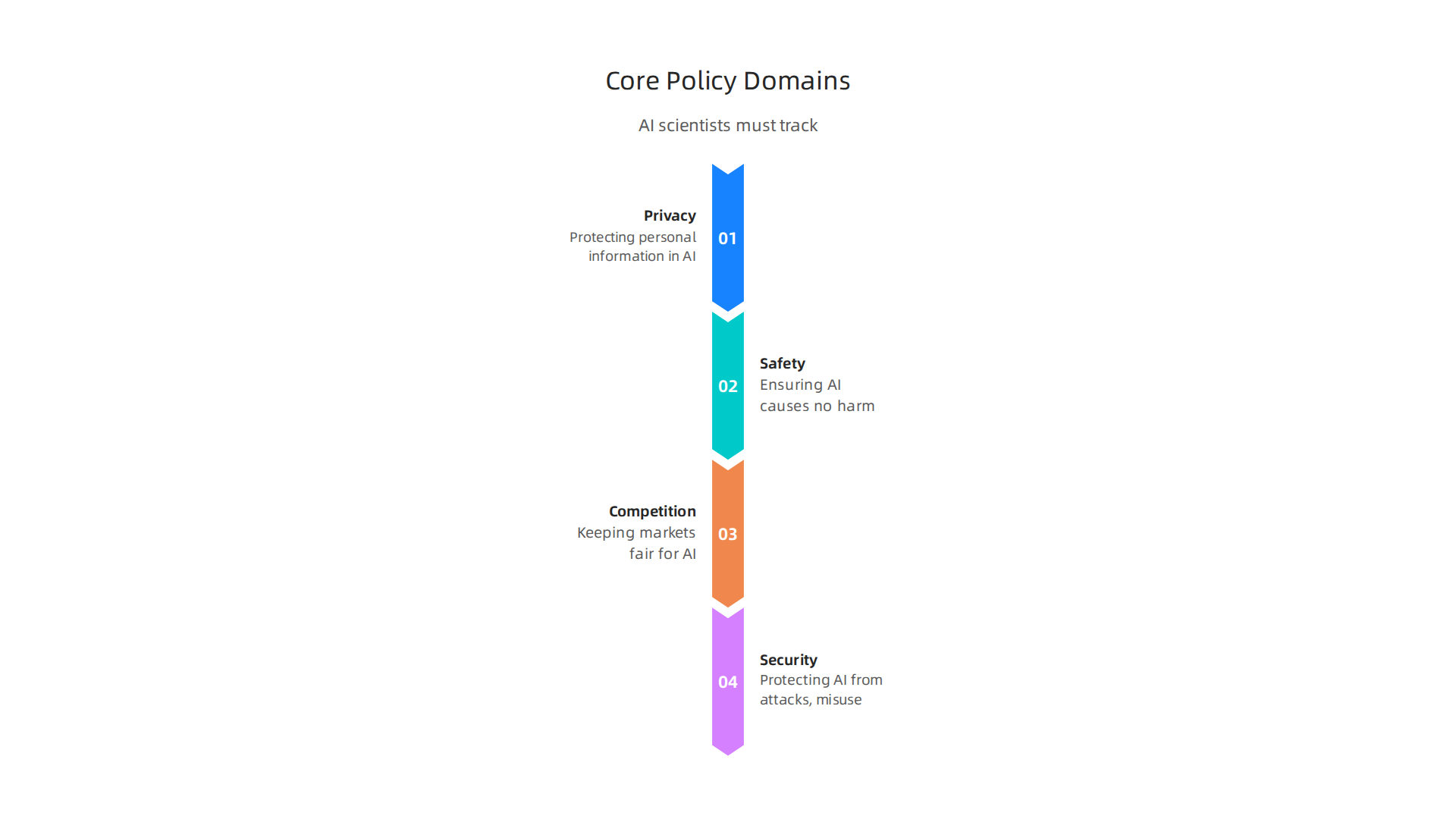
The role of an AI scientist goes beyond just building smart systems. In 2026, understanding how these systems fit into the wider world means keeping a close eye on key policy areas. These areas directly affect how AI models are made, how data is handled, and how AI tools are used. For an AI scientist, being aware of these rules helps make sure their work is not just clever, but also responsible and fair.
Let’s look at the main policy domains every AI scientist must track:
Privacy
Privacy is about protecting personal information. When AI systems collect and use data, there are strict rules about what can be gathered, how it’s stored, and who can see it. An AI scientist needs to know these rules because they work with the data. If an AI system uses personal information without permission, or if that data gets leaked, it can cause big problems. For example, a learning model might be trained on private health records. An AI scientist must ensure this is done in a way that respects people’s privacy and follows the law. This helps prevent situations where people might feel that AI is bad or harmful because their data isn’t safe. Understanding these risks is part of making sure AI systems are built right, as detailed in reports like Privacy in the Age of AI: A Taxonomy of Data Risks.
Safety
AI safety means making sure AI systems do not cause harm to people or society. This includes everything from making sure a self-driving car doesn’t crash to ensuring an AI used in hiring doesn’t show bias. An AI scientist plays a big part in safety by:
- Testing for unexpected behavior: They look for ways the AI might act strangely or incorrectly.
- Preventing bias: They check that the data used to train the AI is fair and doesn’t lead to unfair decisions.
- Ensuring control: They build ways to stop or correct the AI if it starts to do something wrong.
Thinking about safety helps guide which types of artificial intelligence are developed and how they are deployed. The International AI Safety Report 2026 highlights that risks often fall into categories like malicious use or malfunctions, which AI scientists must consider.
Competition
Competition rules aim to keep markets fair and prevent big companies from having too much power. When an AI scientist builds a new tool or platform, they need to think about how it might affect competition. For instance, if an AI makes it super easy for one company to offer much lower prices, it could make it hard for smaller businesses to compete. Policy makers want to ensure that AI helps many businesses grow, not just a few. An AI scientist might help design AI systems that share benefits widely or contribute to open standards, promoting a healthy market for innovation.
Security
AI security focuses on protecting AI systems from attacks and misuse. Just like computers can get viruses, AI models can be tricked or hacked. An AI scientist must think about:
- Data security: Protecting the vast amounts of data AI uses.
- Model integrity: Making sure the AI model itself isn’t changed in a bad way.
- System resilience: Building AI that can keep working even when under attack.
Knowing about security policy helps an AI scientist build more robust systems. It also means understanding what kind of dangers AI can create if it falls into the wrong hands. For professionals navigating this landscape, it’s vital to stay current with legislative and policy developments around the globe, as mapped by resources like the Global AI Law and Policy Tracker. To gain timely and accurate insights into the latest developments in technology policy and AI governance, we encourage you to:
Stay Informed with the Latest AI Policy News
Get clear daily AI updates from The AI Newsletter Worth Reading.
As an AI scientist, understanding how AI policies work in one place is already a big task. But what happens when your AI project or product will be used in many different countries? The rules can change a lot from one place to another.

This means an AI scientist needs to know how to compare these rules and decide which ones matter most for their work.
Let’s look at a simple way to think about the rules in different big areas: the U.S., Europe (EU), the United Kingdom (U.K.), and parts of Asia (APAC markets).
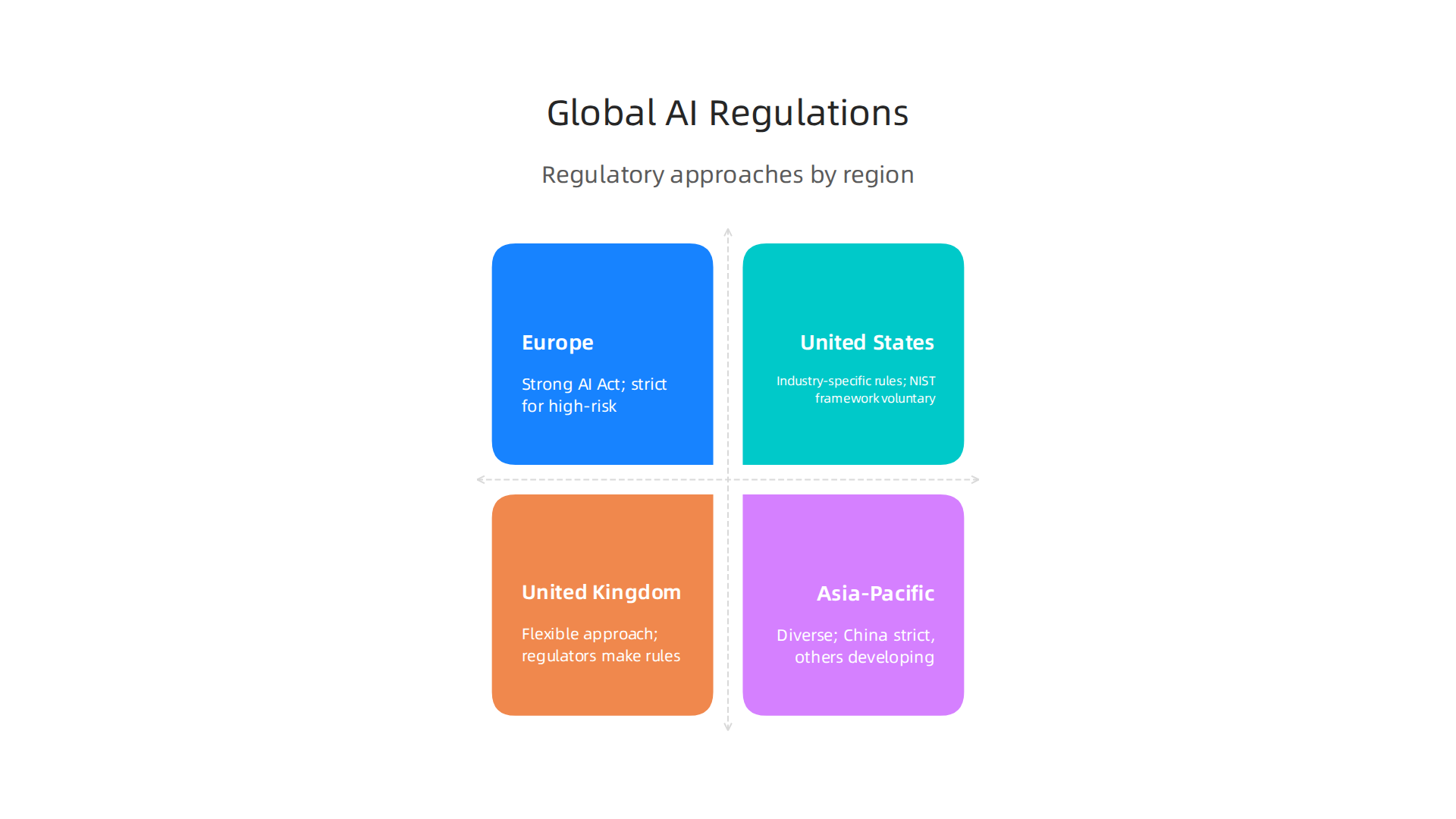
Each has its own way of thinking about AI governance.
- Europe (EU): The EU has a strong law called the AI Act. It puts AI systems into different risk groups. High-risk AI, like systems used for hiring or managing critical infrastructure, faces very strict rules. If your AI fits into one of these high-risk groups and will be used in the EU, you must follow many steps to make sure it’s safe and fair.
- United States (U.S.): The U.S. takes a different path. Instead of one big law, it often uses rules that are specific to certain industries, like healthcare or finance. The National Institute of Standards and Technology (NIST) also has a helpful AI Risk Management Framework. This framework gives ideas on how to manage AI risks, but it is often voluntary, meaning companies choose to use it to guide their practices.
- United Kingdom (U.K.): The U.K. wants to be a place where AI can grow easily. Its approach is often more flexible. It encourages existing regulators, like those for health or finance, to make their own AI rules for their areas. This aims to support new ideas while still keeping people safe.
- Asia-Pacific (APAC) Markets: This region is very diverse. Countries like China have strict rules about AI, especially concerning data and algorithms. Other countries in APAC are still figuring out their full AI rulebooks, sometimes looking at what the EU or U.S. are doing. Comparing these different approaches shows how varied global AI rules can be, as detailed in reports like AI Governance in 2026: The Compliance Reckoning.
When Cross-Border Compliance Matters
For an AI scientist, it’s not always clear when to worry about rules from another country. Here are some simple points to help you decide:
- Where Your AI Is Used: If your AI system is going to be used by people in the EU, then EU rules most likely apply, even if you built it in the U.S.
- Where Your Data Comes From: If you train your AI using data from people in the U.K., then U.K. data privacy rules will matter, no matter where your AI model lives.
- The Type of AI and Its Risks: If your AI does something sensitive, like making decisions about a person’s credit score or health, it will face more rules everywhere. Different types of artificial intelligence have different levels of risk. High-risk AI usually means more rules to follow.
- Your Company’s Goals: If your company plans to sell its AI product all over the world, then you need to think about global rules from the very start.
An AI scientist needs to work closely with legal teams and policy experts to sort through these complex rules. It’s about being smart and thinking ahead to avoid problems that could make people feel that AI is bad or unfair. To dive deeper into how different regions handle AI, check out this global comparison of AI regulations. Knowing these things helps an AI scientist build better, safer, and more widely accepted AI.
After learning about the different rules for AI around the world, an AI scientist needs to know how to use this information. It’s not just about knowing the rules. It’s about changing how you build AI and make choices for your projects and business. This means turning legal talks into clear steps for research, deciding where to put money and people, and figuring out if an AI product should be launched or not.
First, you need to know exactly what AI systems your company uses. This is like making a full list or an "inventory" of all your AI tools. For each one, you should figure out how risky it is. For example, some AI might be used in important decisions like lending money or in hospitals, which are high-risk uses. Other AI, like a chatbot for answering simple questions, might be low-risk. Many experts say that keeping a full list and classifying risk are key steps in building an AI governance framework in 2026. This step helps you decide which AI systems need the most care and attention to follow the rules. Knowing this helps you make smart choices about your research and what projects to work on.
Working Together with Different Teams
An AI scientist cannot handle all these rules alone. It’s a team effort. You need to work with different groups of people in your company to make sure your AI projects are good and follow all the rules.
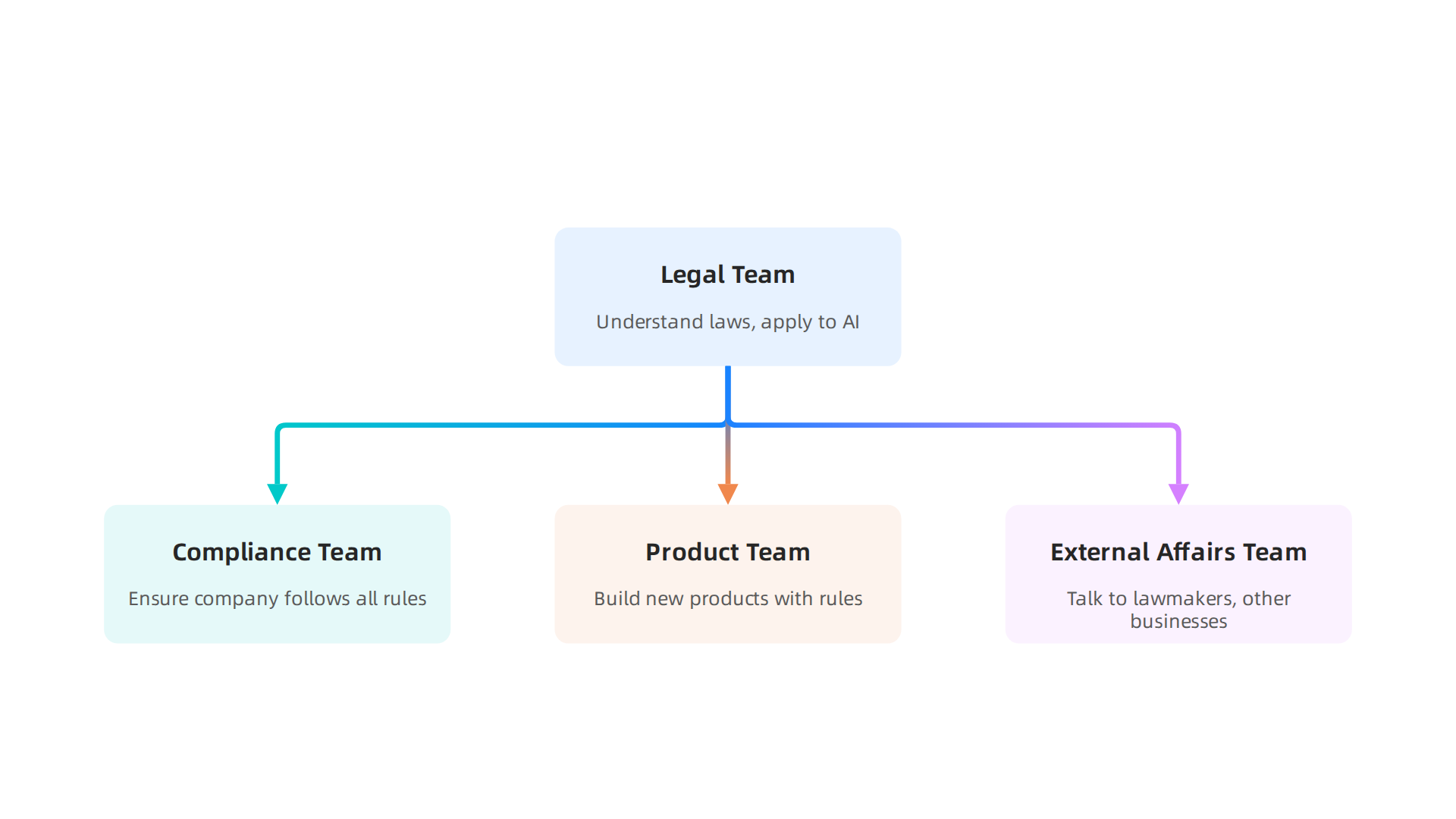

- Legal Team: These are the experts in law. They help you understand what the laws actually mean and how they apply to your AI. An AI scientist can help them understand how the AI works deep down.
- Compliance Team: This team makes sure the company is following all the rules. They will help you put plans in place so that your AI projects meet legal standards. Keeping a clear record of how your AI works and why it makes certain choices is important for compliance, as highlighted in guides for enterprise AI compliance and governance.
- Product Team: This team designs and builds the AI products. An AI scientist needs to work with them to make sure new products are built with the rules in mind from the very start. This prevents problems later on that could make people think AI is bad.
- External Affairs Team: This group talks to people outside the company, like lawmakers or other businesses. They can share what the company is doing to be responsible with AI and also bring back important information about upcoming rules.
By working closely with these teams, an AI scientist can help guide the company’s efforts. This includes setting up clear ways to check AI, deciding who is in charge of what parts of an AI project, and approving or stopping projects based on their risk and how they follow the rules. Building a good plan for how the company manages AI is called AI governance. This kind of teamwork makes sure that everyone understands the goals and the risks. For more on how to set up these important structures, you can read about AI Governance Committee Charter and Decision Rights.
Understanding and acting on policy changes helps your company stay safe and become a leader in AI. It helps make sure that the AI you build is not just smart, but also fair and trustworthy.
Get clear daily AI updates from The Deep View Newsletter.
The AI Newsletter Worth Reading
To make sure your company’s AI efforts are truly good and follow all the rules, an AI scientist needs to take practical steps every day. This means having clear ways to build AI, handle data, keep records, and work with outside helpers.
Practical Steps for Building AI
When an AI scientist builds new AI models, they need a plan. This plan helps make sure the AI is fair and safe. It’s not just about making the AI smart, but also about making sure it doesn’t cause problems.
Here are some things to think about for model development:
- Fairness Checks: Before an AI model is used, check if it works fairly for everyone. This means making sure it doesn’t have biases that could treat some groups of people unfairly. You need to test the model very carefully to find and fix any unfairness. For example, a 2026 report talks about setting clear rules for checking fairness, like an 80 percent rule for good results for everyone.
- Data Handling: The data used to train AI is very important. An AI scientist must make sure this data is collected and used in the right way, following privacy rules. This means keeping personal information safe and making sure the data is accurate. A guide on AI regulation in 2026 talks about making sure only certain people can get to AI data and that it is kept safe through encryption.
- Documentation: Keep good records of everything you do. This includes how the AI was built, what data was used, and why certain choices were made. Good documentation makes it easier to understand and fix the AI later, and it’s key for audits. Experts say that having strong documentation is needed for AI vendor documentation standards in 2026. This also helps others understand the different types of artificial intelligence you are using.
- Vendor Risk: Many companies use AI tools or data from other companies. An AI scientist needs to check these outside vendors carefully. You must make sure their AI tools also follow all the rules and don’t bring new risks to your company.
Designing AI for Clear Checks and Records
One big part of making AI trustworthy is being able to check its work. This is called auditing. An AI scientist should design AI systems from the start so that their actions can be easily seen and understood.
Here’s what that looks like:
- Reproducible Audits: This means you should be able to look back at an AI’s past decisions and understand why it made them. For high-risk AI, like those used in banks, there’s a checklist for what needs to be recorded for every AI-influenced decision in 2026. This includes things like when the decision was made, who the user was, and which AI system and version were used, as outlined in requirements for an AI Audit Trail in 2026.
- Logging: AI systems should keep a detailed diary of what they do. This diary, or log, should record every important action or decision the AI makes. This helps you track what happened if there’s ever a problem or a question about how the AI worked. This kind of logging is a key item on a 2026 AI compliance checklist.
- Provenance Tracking: This is like knowing the full history of your AI and its data. Where did the data come from? How was the AI model trained? Who made changes to it? Knowing all this helps prove that your AI is well-built and safe. The goal is to make sure every part of your AI can be traced back to its origin.
By building these practices into their work, an AI scientist helps their company meet important compliance goals. This helps make sure AI is used in a good way, which can stop people from thinking AI is bad. It also helps build trust in AI systems. To help you stay on top of daily changes in this fast-moving field, you might find a helpful resource.
Get clear daily AI updates from The Deep View Newsletter.
The AI Newsletter Worth Reading
Making sure AI is trustworthy isn’t just about building it right; it’s also about checking its work and showing others that it’s good. This is where measuring its impact, doing audits, and reporting on its actions become very important.

An AI scientist plays a key part in setting up these checks and balances.
Key Ways to Measure AI’s Goodness
To truly know if an AI system is working responsibly, you need clear ways to measure it. Think of these as report cards for your AI.
- Measuring Compliance: Companies need to make sure their AI follows all the rules. This means looking at how well control measures are put in place and how complete the records are. For instance, measuring how quickly you fix problems found in audits is a key part of showing good AI governance in 2026. Experts say that five main numbers, like how much control you have over your AI and how fast you fix issues, are needed to measure if your AI follows all the rules properly How to measure AI governance compliance.
- Assessing Impact: Before an AI goes live, an AI scientist should do an "algorithmic impact assessment." This is like checking ahead of time to see if the AI might cause any harm or unfairness. It helps you understand the possible good and bad effects of your AI system on people and society. Such assessments are especially important in sensitive areas, like healthcare, to rank potential impacts Algorithmic impact assessment: a case study in healthcare.
- Transparency Reports: Companies should openly share how their AI models are built, tested, and used. This helps everyone, including regulators and the public, understand the AI better. However, a 2026 report found that transparency scores for AI models actually dropped, showing there’s more work to do in this area Stanford’s 2026 AI Index Found Transparency Scores Dropped as Capability Soared. Clear guidelines are available to help companies meet their transparency duties for AI systems Guidelines on transparency obligations for providers and deployers of AI systems.
The Power of Audits and Outside Checks
Even with good internal measures, outside eyes are vital. Independent audits and other external checks build much-needed trust.
- Independent Audits: These are like getting a fresh pair of eyes to check your AI. Outside experts look at your AI systems to make sure they are fair, safe, and follow all the rules. In 2026, auditors check AI model outputs against set standards, looking for things like correct sources and accuracy The Closing Report. Getting these audits done can even help a company financially by reducing legal and regulatory costs Deloitte AI Audit: ROI & Implementation Guide 2026. AI is also changing how audits are done, making them faster and more accurate in areas like finding problems AI for Auditors: Revolutionize 2026 Audits. You can learn more about the role of AI in auditing through resources like the Examining the Role of AI and Automation in IT Audit.
- Red-Teaming: This is a special kind of test where a team tries to find ways to break the AI or make it do bad things. It’s like having a group of ethical hackers trying to uncover weaknesses before bad actors do. This helps an AI scientist make the AI stronger and safer.
- External Transparency: Being open with the public and regulators is key. When companies share how they are handling their AI responsibly, it builds trust. It shows that they are not hiding anything and are committed to using AI for good. This also helps shape how an AI development company navigates regulation and opportunity in 2026.
By putting these checks in place, companies can show that their AI efforts are not only innovative but also responsible. This is essential for navigating the complex world of AI today.
Summary
This article explains why every AI scientist in 2026 must be fluent in policy as well as technical work, and gives a practical playbook for doing so. It describes how rapidly evolving national and regional laws are changing what AI teams can build, deploy, and fund, and why ignoring policy risks making projects unusable or harmful. The piece defines an expanded AI scientist role that combines model development with policy-facing duties like advising regulators, shaping internal rules, and spotting risks early. It walks through the core policy domains—privacy, safety, competition, and security—then shows how to compare rules across the EU, U.S., U.K., and APAC markets. The guide outlines concrete steps: keep an AI inventory, classify risk, work with legal and compliance, apply fairness and data controls, document thoroughly, and build audit trails. Finally, it covers how to measure compliance, use external audits and red‑teaming, and translate policy signals into better product and research decisions so your AI is both powerful and trustworthy.