

The rapid integration of AI into the workforce is reshaping industries faster than policy can respond. A recent report from BCG shows that over the next two to three years, 50% to 55% of jobs in the United States will be reshaped by AI reshaping more jobs than it replaces. That is a massive shift. And it creates a big question: how do we navigate this change without leaving people behind?
Decision-makers face information overload and regulatory complexity.

They are trying to understand what jobs are safe from AI and how to prepare for generative AI jobs. They need a clear, structured framework based on solid evidence, not hype. An AI powered collaboration platform might help in some cases, but the core challenge is turning data into real policy.
This article provides an evidence-based analysis of human-AI interaction, workforce impact, and actionable policy insights for 2026. We will look at how the shift from AI to human decision-making plays out in practice. For more on this topic, you can read our new human-AI interaction guidelines for policy professionals. To stay on top of these fast-moving changes, get The AI Newsletter Worth Reading for clear daily updates.
The Automation Paradox: Job Loss vs. Job Creation in the Age of AI
Here is the confusing part. One day you read that AI will eliminate 300 million jobs. The next day you see reports that AI will actually create millions more than it destroys. Both are true, and that is the automation paradox.
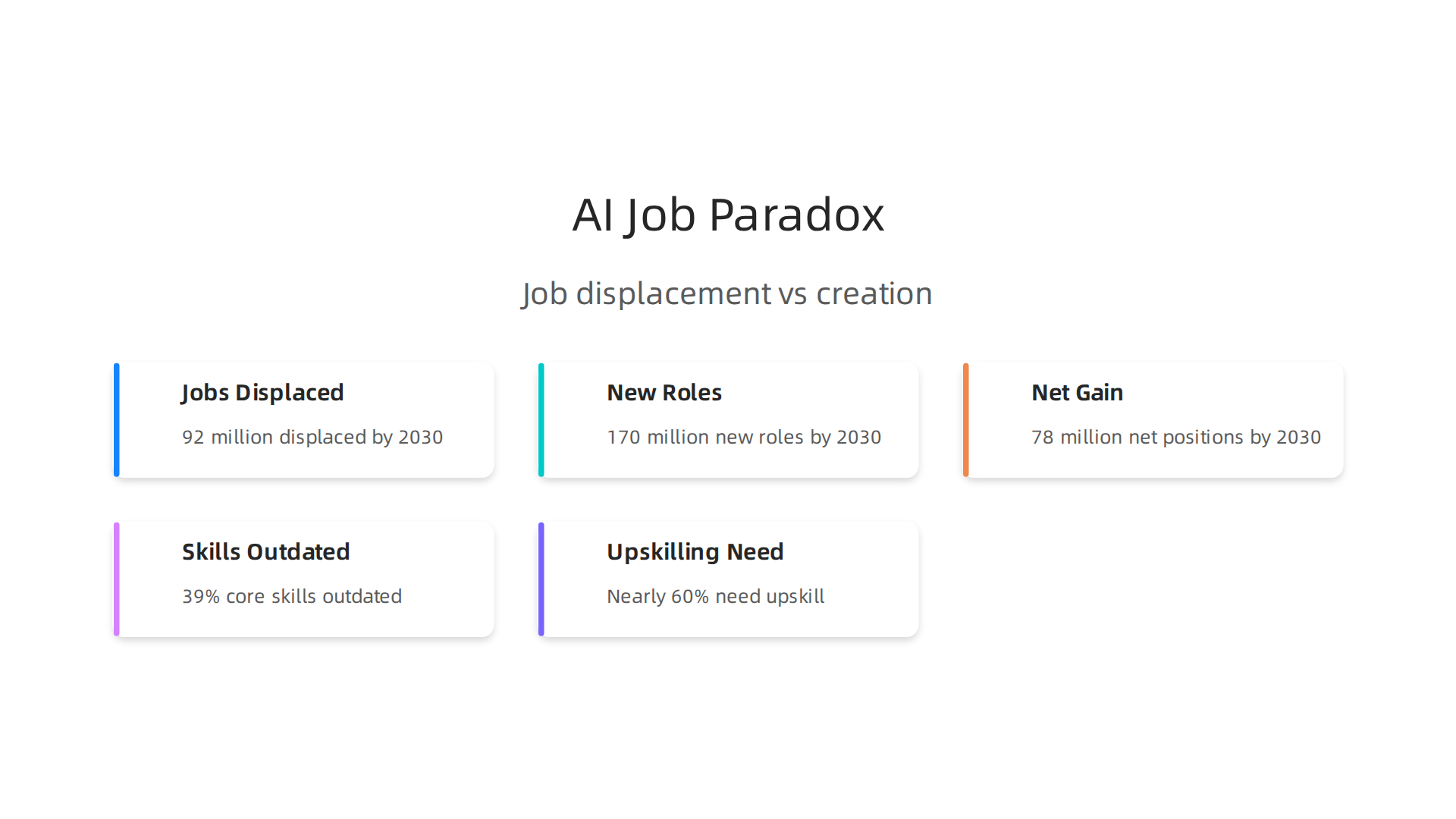
On one hand, displacement is real and accelerating. According to recent data, roughly 92 million jobs could be displaced globally by 2030. But in the same breath, the World Economic Forum projects that 170 million new roles will appear over that period, resulting in a net gain of 78 million positions. The same WEF report shows that 39% of core job skills will become outdated by 2030, which means nearly 60% of workers will need to upskill or reskill to stay relevant. You can find the full breakdown in these AI job displacement statistics and trends.
The real story is not a simple battle between AI and human labor. It is about how AI reshapes what work looks like. Most experts agree that the majority of jobs will be augmented rather than replaced. That means your day-to-day tasks change, but your role does not vanish. The shift from ai to human collaboration becomes the new normal. In fact, many routine-cognitive tasks get handed off to machines, freeing you up for judgment-heavy work that requires creativity, empathy, and strategic thinking.
So what does this mean for policy? Leaders need to focus on distributional impacts. Some industries and regions will feel more pain than others. That is why governments and organizations must invest heavily in reskilling programs. If you are wondering what jobs are safe from ai, the answer often lies in roles that demand human connection and complex problem-solving. On the flip side, entirely new generative ai jobs are emerging in fields like prompt engineering, AI ethics, and model training. Companies are also turning to an ai powered collaboration platform to help teams work alongside AI tools more effectively.
Policy must also address the speed of change. The timeline for major disruption has accelerated to 2027-2028, with tens of thousands of positions already eliminated during the early adoption phase. For a deeper look at how organizations are navigating this shift, check out this analysis on the enterprise AI adoption gap.
The automation paradox is not about winners and losers. It is about managing a transition that touches every sector. The key is to move from fear to preparation, and that starts with understanding the numbers.
Reskilling at Scale: National Strategies and Corporate Responsibility
Understanding the numbers is one thing. Acting on them is another. That is why governments around the world are launching large-scale reskilling initiatives. The World Economic Forum’s Reskilling Revolution aims to empower one billion people with better skills by 2030. But the reality is that national programs vary widely in effectiveness. Some countries move faster than others, and many struggle to keep pace with the speed of change.
The corporate side matters just as much. The truth is that only 31% of organizations are actively investing in reskilling and upskilling their workforce, according to 2026 reskilling statistics. That is a massive gap when you consider that nearly 80% of the workforce will need to acquire new AI-related skills within the next year or so, as outlined in this AI upskilling guide for 2026. Companies that fail to invest risk falling behind.
This is where public-private partnerships come in.
Governments provide funding and policy frameworks. Corporations provide real-world training and job placements. When both sides work together, reskilling programs become more scalable and relevant. For example, organizations like Trane Technologies have seen internal recruitment rise from 38.7% to 55% after investing in structured skills development.
If you are wondering how to navigate this shift personally, you can check out this roadmap to build a future-ready career in AI. And if you want to stay on top of policy changes and reskilling trends, subscribing to a daily update can help. The AI Newsletter Worth Reading delivers clear daily AI insights straight to your inbox.
The bottom line? Reskilling is not optional anymore. It is the bridge between fear and opportunity. And the sooner you start, the better off you will be.
Navigating the AI Policy Mosaic: EU AI Act, US Executive Orders, and the Global Race
Reskilling gets you ready for tomorrow’s jobs. But none of that training matters if you don’t know the rules of the road. That is where AI policy comes in. And right now, the policy landscape is a patchwork of different laws and guidelines that vary wildly from one country to the next.
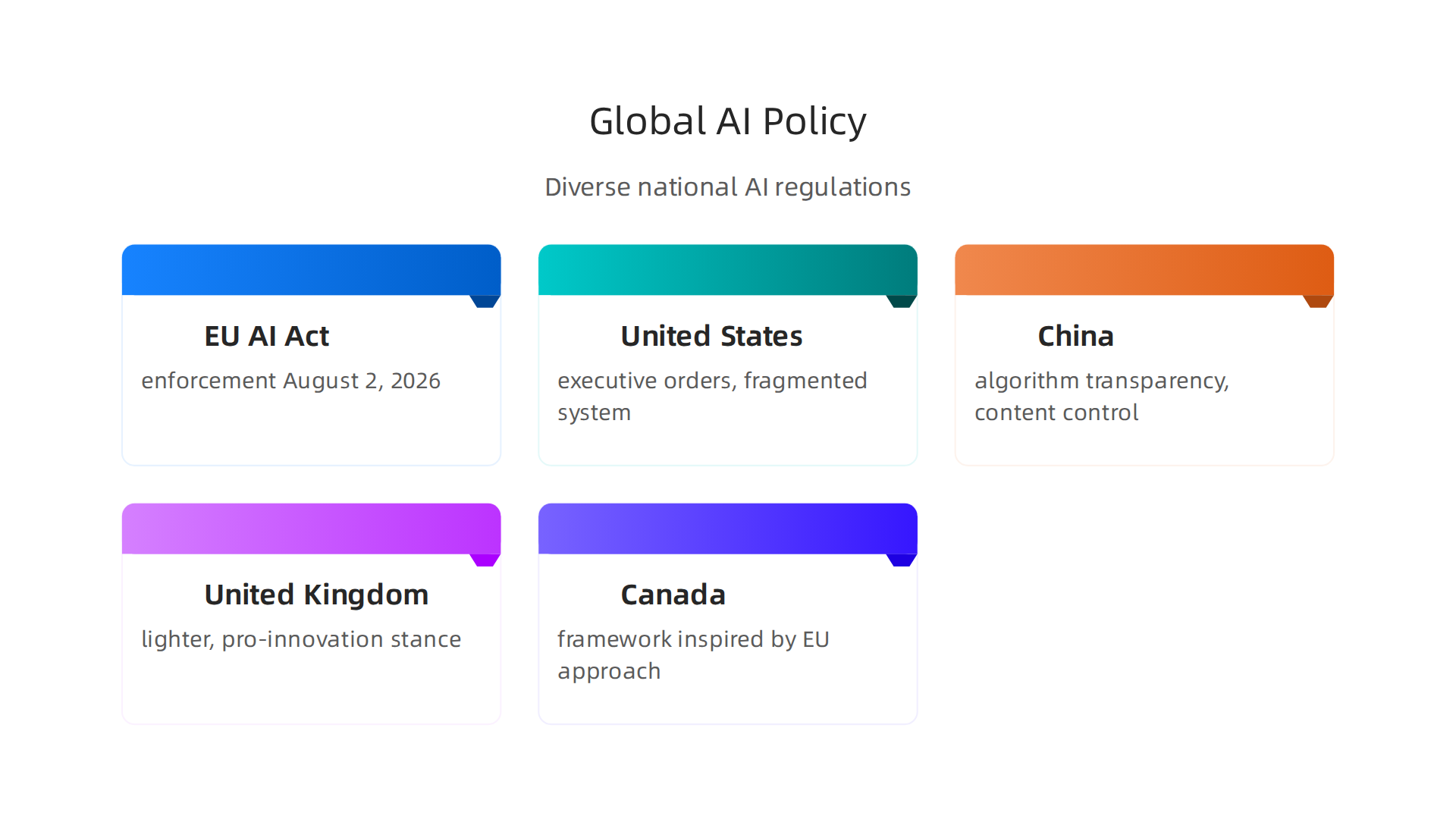
The biggest development in 2026 is the enforcement of the EU AI Act. August 2, 2026, is the key date when most of its rules become active. High-risk AI systems now have to meet strict requirements around risk management, data governance, transparency, and human oversight. Fines can go as high as EUR 35 million or 7% of annual global turnover, as explained in this overview of EU AI Act 2026 enforcement. That is a serious incentive for compliance.
In the United States, the approach is different. Executive orders have created a patchwork of guidelines across different federal agencies. Congress is still debating a comprehensive law. Some states are moving ahead on their own, making it hard for companies to keep up. The result is a fragmented system where businesses operating across states face different rules.
Other major economies are not waiting either. China is pushing its own set of regulations focused on algorithm transparency and content control. The UK has taken a lighter, pro-innovation stance. Canada is developing a framework inspired by elements of the EU approach. Each country has its own priorities, and that makes compliance a global puzzle.
To stay on top of these fast-moving changes, you need reliable analysis. This roundup of major technology policy shifts in 2026 breaks down what the biggest regulatory moves mean for professionals like you.
The bottom line is simple. No matter where you work, understanding the AI policy mosaic is just as important as learning the technical skills. The rules are here, and they are only getting more complex.
Human-Centered Design: Principles for Trustworthy Human-AI Interaction
Knowing the rules is only half the battle. The other half is building systems people actually want to use. That is where human-centered design comes in. If you want to move from just following regulations to creating real value, you need to design AI that feels like a helpful teammate, not a black box.
Trust is the foundation. If users do not understand why an AI made a certain decision, they will not rely on it.
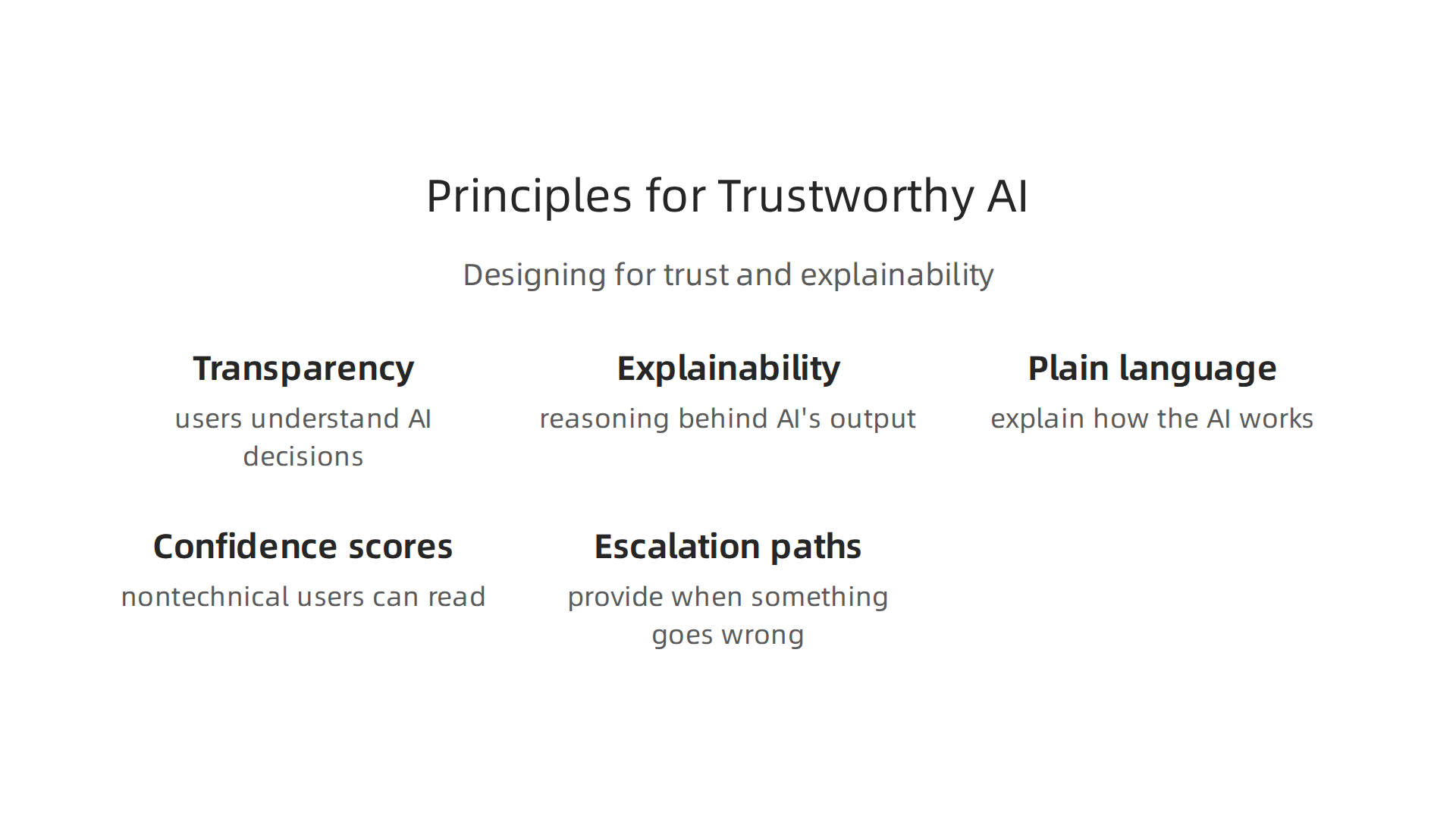
That is why transparency and explainability are so important. When you can see the reasoning behind an AI’s output, you are far more likely to act on it. This idea of converting complex model behavior into something humans can easily grasp is what we call the ai to human handoff. It is the moment the machine logic becomes a clear, usable insight.
One powerful way to build this trust is by designing transparency checkpoints directly into the experience. The team at Thoughtworks recommends using plain language to explain how the AI works, showing confidence scores that nontechnical users can read, and providing clear escalation paths when something goes wrong. You can read the full five Cs framework in their guide on how to keep humans at the center of your AI efforts.
When you put people first, you also make compliance easier. User-centric design helps you meet regulatory requirements around fairness, privacy, and human oversight. The same features that make your AI trustworthy make it easier to pass audits. This is especially true for the generative ai jobs now emerging across industries, where explainability is a must.
Ethical guidelines are no longer optional suggestions. They are becoming formal standards baked into procurement contracts and industry certifications. Companies that ignore this will find themselves locked out of government deals and enterprise partnerships. The smart play is to adopt these principles early and use them as a competitive advantage.
For a deeper look at the specific interaction patterns that build trust, check out these human AI interaction guidelines for policy professionals. They walk through practical ways to design conversations, feedback loops, and fail safes.
Staying on top of these design best practices takes continuous learning. To make that easier, I recommend The AI Newsletter Worth Reading. It delivers clear daily updates on AI trends and policy, so you never miss a shift that could affect your work. Subscribe and stay ahead.
Workforce Analytics: Measuring the Productivity Gains of Human-AI Teams
Design principles are essential, but how do you know if they are actually working? That is where workforce analytics comes in. To justify investment in any ai powered collaboration platform, you need hard numbers that show real improvements.

The good news is that the data supporting human-AI teams is growing fast.
The most common metrics for measuring these gains are time saved, error reduction, and output quality. For example, studies on employee training programs find that error rates drop by about 13% on average, according to peer-reviewed meta-analysis data on upskilling effectiveness. When you layer AI assistance on top of that, the improvements multiply.
Hybrid teams perform better than humans or AI alone in many tasks. The key is measuring that gap. Look for leading indicators like confidence scores, task completion times, and the frequency of the ai to human handoff. When a system clearly explains its reasoning, your team can act faster and make fewer mistakes.
You also need to track business outcomes. A structured 60-day upskilling plan can move a professional from AI enabled to AI fluent, with concrete evidence of time saved and quality improved. You can find a solid framework for that in this AI upskilling guide for staying relevant in 2026.
Another smart move is connecting learning data to core KPIs. If your training programs reduce time to proficiency by 20 to 40 percent, that directly boosts productivity. These are the metrics that earn buy-in from leadership and make the case for scaling up human-AI collaboration.
For more on how enterprises are bridging the gap between AI adoption and measurable results, check out this piece on world wide technology bridges the enterprise ai adoption gap. It explores the practical steps organizations are taking right now.
Sector Deep Dives: Healthcare, Finance, and Manufacturing
Now let’s look at how human-AI teams are transforming three major sectors: healthcare, finance, and manufacturing.

Each faces unique challenges, but the principle of keeping humans in control stays the same.
Healthcare has high hopes for AI in diagnostics and administrative tasks. Tools that read scans or predict patient risks can save hours per day for doctors. But the sector also carries heavy regulatory hurdles. Patient safety rules and data privacy laws slow down adoption. Still, clinics that use human-in-the-loop models see fewer missed diagnoses. For example, radiologists who check AI suggestions catch more issues than those working alone. The key is designing systems that explain their reasoning clearly. That matches the framework for keeping people at the center, as discussed in the 2026 AI Trends: Human-Centered Intelligence guide. For deeper insight into how regulations differ by medical use case, read about how doctor ai regulation differs between healthcare and entertainment.
Finance has embraced AI for fraud detection and risk assessment. Algorithms spot unusual transactions in milliseconds, much faster than any human team. The big gain comes from pairing that speed with human judgment. Analysts review flagged cases and make final calls. This ai to human handoff cuts false alarms and keeps customers happy. Productivity shoots up because teams focus on complex cases instead of sifting through normal activity.
Manufacturing leads the pack in putting collaborative robots on factory floors. These cobots handle repetitive lifting and welding, reducing injuries and strain. Workers stay in charge of quality checks and problem solving. The result is safer jobs and fewer ergonomic issues. Companies that train their people alongside robots see the biggest improvements.
Staying current on how these sectors evolve is tough. That is why getting a clear, daily briefing on AI policy and adoption can help you stay ahead. Consider signing up for The AI Newsletter Worth Reading for straightforward updates.
Beyond the sector trenches, a bigger battle is unfolding on the world stage. Countries are racing to lead in artificial intelligence, and that race touches everything from who gets hired to where computer chips come from.
The talent war is real. Top AI engineers and researchers are in short supply. Companies and governments are fighting for the same small pool of skilled people. This has big effects on immigration policy, as nations compete to attract the best minds. If you are wondering what jobs are safe from ai, think about roles that require deep policy knowledge, ethics oversight, and strategic decision-making. The people who design, govern, and audit AI systems will be in high demand. For a practical look at how to break into this field, read this guide on how to learn AI and build a future-ready career.
Supply chains are the hidden pressure point. The hardware that powers AI, especially advanced semiconductors, is produced by only a handful of countries. This creates serious dependencies. A natural disaster or trade conflict in one region can slow down AI development everywhere. So nations are pouring money into domestic chip manufacturing and forging new alliances to secure supply.
International governance is taking shape. The EU AI Act is the most ambitious attempt so far to create global rules for AI. Its key enforcement date is August 2, 2026, when most provisions for high-risk systems kick in. This sets a standard that other countries may follow. You can check the full EU AI Act regulatory framework for details. The ai to human handoff is central here: the law requires human oversight for high-risk systems, making sure that people, not algorithms, have the last word.
All of this means that staying on top of policy is no longer optional. It is part of competing on the global stage.
The 2026 Outlook: Preparing for the Next Wave of Policy and Technology
So how do you get ready for what’s coming? The answer lies in understanding where the lines are being drawn and redrawn.
Generative AI is blurring the old boundaries. Multimodal models can now create text, images, code, and even video. This means the classic ai to human handoff is getting more complicated. It is not just about automating tasks anymore. It is about systems that generate creative work, make decisions, and interact with people in real time. Roles are shifting fast. What used to be a clear division between human judgment and machine output is now a messy mix. Understanding where human oversight still matters is critical. That is why new guidelines for how people and AI collaborate are becoming essential. You can explore some of the latest thinking in these new human-ai interaction guidelines for policy professionals.
Regulatory frameworks are heading toward consolidation. Right now, rules vary wildly from state to state and country to country. But experts predict that by 2027, many of these separate laws will start to merge into simpler, more unified standards. As one analysis notes, harmonization at the national and international level could replace the current patchwork of red tape. This shift toward harmonized AI policy frameworks will make compliance clearer for businesses while raising the stakes for those who ignore early signals.
Proactive adaptation is your best bet. Waiting to see how things settle is not a strategy.

The organizations and professionals who thrive will build continuous learning ecosystems and adopt agile governance models. That means regularly updating skills, staying flexible on compliance, and using tools that help teams work smarter. An ai powered collaboration platform can make this easier by keeping knowledge sharing and policy updates flowing in real time.
The best way to navigate all this uncertainty is to stay informed every day. That is why getting clear, daily AI updates matters so much. If you want to keep up without spending hours digging through news, consider subscribing to The AI Newsletter Worth Reading. It delivers the insights you need straight to your inbox.
Summary
This article takes an evidence-based look at how AI is reshaping the workforce and what decision‑makers must do to manage that transition without leaving people behind. It explains the automation paradox—how millions of jobs may be displaced while even more are created—and shows why most roles will be augmented rather than extinguished. The piece covers large-scale reskilling needs, corporate responsibility, and public–private partnerships, and it highlights the urgent policy work underway worldwide, including enforcement of the EU AI Act in 2026. You’ll learn human-centered design principles that build trust in AI, practical workforce metrics to measure gains from human–AI teams, and concrete sector examples in healthcare, finance, and manufacturing. The article also outlines how to prepare for rapid regulatory changes and where to focus skills and governance efforts so organizations and professionals can adapt proactively. After reading, you should understand which roles are more resilient, how to approach reskilling, and what policy and design levers will matter most in 2026–2028.