
Introduction
If you are reading this, you already know that tech jobs in 2026 look very different than they did just a few years ago. AI is moving fast, and it is changing the rules for everyone. Companies are adopting AI platforms at a record pace, and this directly affects what hiring managers look for and how teams are built.
Actually, the numbers behind this change are huge. According to AI Adoption Statistics in 2026, 78% of organizations now use AI in at least one business function, up from just 55% a year earlier. This kind of growth means two things at once. First, some routine tasks are disappearing. Second, entirely new roles are emerging that require a mix of technical skills and sound policy judgment.
The best AI tools are not replacing workers entirely. Instead, they are changing the job itself. For decision-makers, the challenge is clear. You need to understand how technology, policy, and workforce dynamics connect. One wrong move can lead to compliance risks or missed opportunities.
That is why we created this article. It gives you a clear, data-driven look at how AI will keep reshaping tech employment in 2026 and what that means for your strategy.
We have covered similar ground before. You can read our AI job displacement statistics report for a closer look at the numbers and what they mean for policy.
The key takeaway? The tech job market is not ending. It is transforming. And the people who understand this shift will be the ones who thrive.

Staying ahead of these changes requires a steady stream of reliable information. That is why we recommend The AI Newsletter Worth Reading. Get clear daily AI updates from The Deep View Newsletter.
Current State of AI in Tech Jobs
The change is already here. In 2026, AI adoption among tech companies has reached a tipping point. According to the AI Adoption Statistics (2026) from Omniflow, over 75% of organizations now use AI in at least one business function. But for tech firms, the number climbs even higher. Some reports say 93% of companies are already using AI, with 80% using it directly. That comes from the State of AI 2026 report by Vention.
This widespread use is transforming the roles we know well. Software developers now rely on AI platforms to write code outlines, fix errors, and suggest improvements. Instead of spending hours on routine tasks, they focus on architecture and design. Data analysts use AI to handle data cleaning so they can dig deeper into trends. IT support teams answer common questions with AI chatbots, reserving human agents for complex problems. The job is not disappearing. It is shifting toward higher-value work.
New roles are appearing fast. Prompt engineering is now a real career path. These specialists learn how to talk to AI models to get the best results. AI ethicists help companies build fair systems that follow new rules. Companies also hire AI auditors to check models for bias.
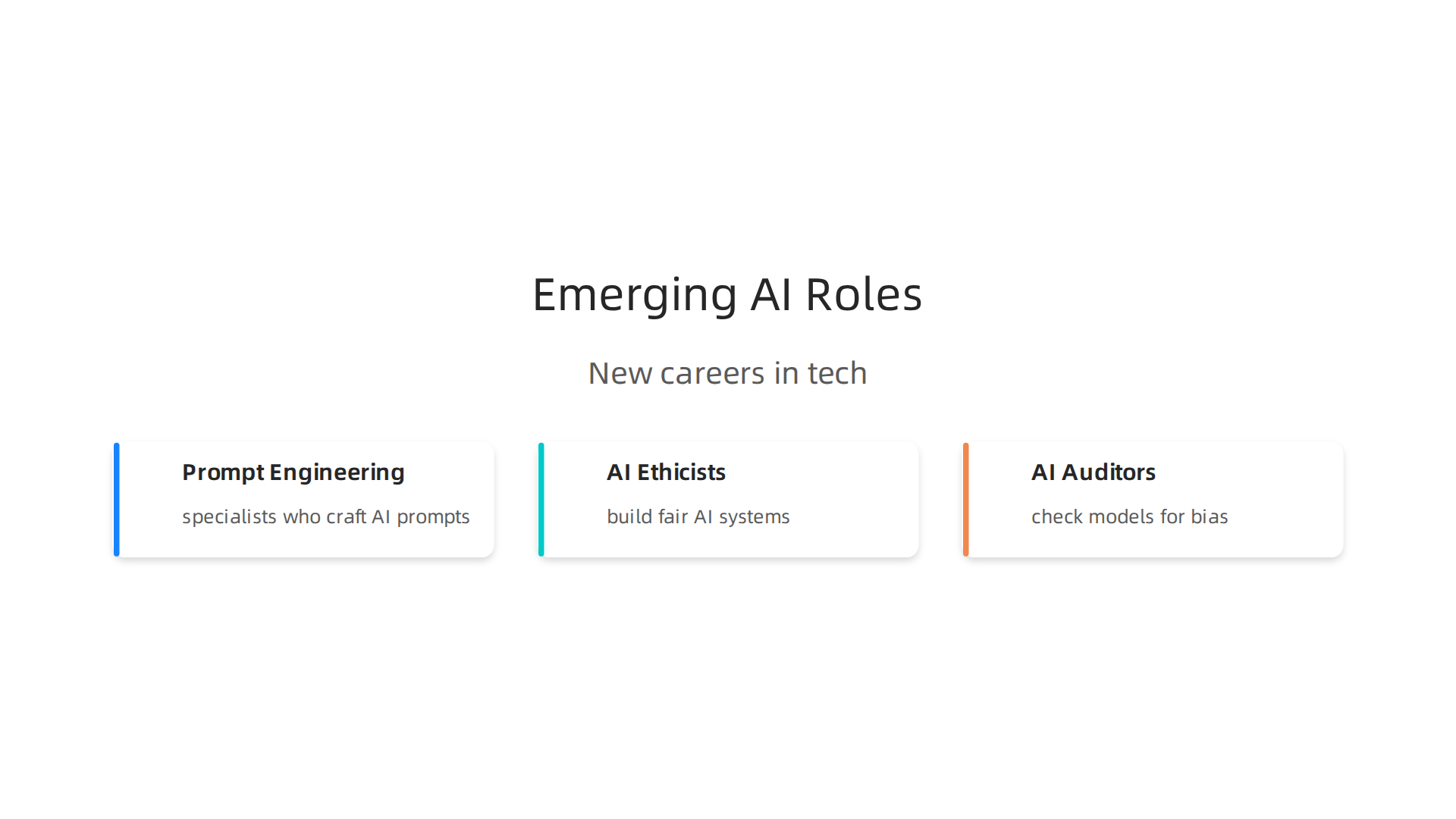
These roles barely existed three years ago. Today they are some of the fastest-growing job titles in tech.
One notable trend is the decline of traditional entry-level roles. Routine coding, data entry, and basic support tasks are increasingly handled by AI. This means that people entering the workforce need to focus on skills like prompt engineering, AI oversight, and problem-solving. It is a shift from doing to directing.
The shift is not just for big companies. Small and medium businesses are jumping in too. They use the best AI tools for everything from marketing to customer service. Many now rely on virtual assistant services for small businesses to automate daily tasks like scheduling and follow-ups. This creates new tech jobs for developers who build and support those systems. It also means that AI skills are becoming valuable everywhere, not just in Silicon Valley.
For policy professionals and tech leaders, understanding this landscape is crucial. New roles bring new questions about training, ethics, and regulation. If you want to prepare for the future, check out this guide to becoming an AI engineer with policy expertise. It maps out a clear path for career growth in this changing market.
The key takeaway? AI is reshaping tech jobs in real time. The workers and companies that adapt will be the ones that thrive.
Policy and Regulatory Landscape Impacting AI Employment
Regulations are now shaping tech jobs just as much as technology itself. In 2026, new rules are forcing companies to rethink who they hire, how they design roles, and where they invest. If you work in or around tech, understanding this regulatory shift is no longer optional. It is becoming part of the job.
The biggest change comes from Europe. The EU AI Act is the world’s first comprehensive law for artificial intelligence. It entered into force in 2024, and its core rules for high-risk AI systems become fully enforceable in August 2026. According to the 2026 Guide to AI Regulations and Policies in the US, UK, and EU from MetricStream, this phased rollout creates immediate compliance deadlines for any company whose AI systems touch EU users. That includes many US firms. Fines can reach up to 35 million euros or 7 percent of global annual turnover.
What does this mean for jobs? Companies now need people who understand these rules. Compliance roles related to AI governance are growing fast. Businesses are hiring AI auditors to check models for bias and risk. They need AI governance specialists to manage documentation, human oversight, and conformity assessments. They also need legal teams who can navigate the four-tier risk classification system under the Act.

These roles barely existed as separate job titles two years ago. Now they are among the fastest-growing career paths in the regulatory side of tech.
The US approach looks different but creates similar hiring pressure. There is no single federal AI law in America. Instead, multiple agencies apply existing rules to AI, and states like Colorado, California, and Texas are passing their own laws. This creates a complex patchwork. As the AI Regulation Compared: EU, US, UK, China (2026) report from Legalithm explains, the US relies on sector-specific oversight from agencies like the FTC, EEOC, and SEC. Companies must track requirements across every state they operate in. That takes specialized staff.
This regulatory complexity is directly affecting employer decisions on automation and hiring. Many companies are pausing AI deployments until they understand the compliance landscape. Others are investing heavily in audit and governance teams before scaling new tools. A few are pulling back on automation entirely to avoid risk. The uncertainty slows down some AI adoption while accelerating demand for policy-savvy professionals.
For policy professionals and technology executives, the message is clear. The companies that thrive will be the ones that treat regulation as a strategic advantage, not a burden. If you want to stay ahead, keeping up with the biggest information technology policy shifts of 2026 is a smart first step.
The regulatory landscape is still shifting fast. But one thing is certain. AI governance is creating a whole new category of tech jobs. The people who understand both the technology and the rules will be in high demand for years to come.
Want to keep your finger on the pulse of these changes without drowning in noise? Try The AI Newsletter Worth Reading. It delivers clear daily updates on AI policy and regulation straight to your inbox.
Skill Shifts and Reskilling Needs
All those new regulations we just covered? They are creating fresh demand for skills most people didn’t need five years ago. In 2026, the job market wants professionals who can blend traditional tech know‑how with strong AI literacy. If you worry about your current skill set becoming outdated, you are not alone. The key is knowing what to learn next.
AI literacy, machine learning, and data science are the top three skill areas employers are hunting for. According to the latest data on the most in‑demand tech skills in 2026 with skill tests from Pluralsight, cloud computing and cybersecurity actually rank above AI for upskilling priority among tech professionals. That is a surprise for many. But agentic AI and generative AI skills are climbing fast. So do not ignore them.
Traditional coding skills like Python, SQL, Java, and JavaScript are still essential. But here is the twist. In 2026, employers do not want coders who only write code. They want developers who can use AI tools to speed up their work, check their own code for errors, and build smarter systems. AI‑augmented workflows mean every developer needs to know how to work alongside AI co‑pilots and automation. The old separation between "developer" and "AI user" is gone.
Reskilling programs are now critical to closing this talent gap. Big companies and governments are pouring money into training. But the smartest move you can make is to take charge of your own learning. A great starting point is to learn AI and build a future‑ready career with a clear roadmap tailored for 2026.
And do not forget the soft skills. In a recent survey, 67 percent of tech leaders said critical thinking and problem solving are the top non‑technical skills they need, followed by adaptability and continuous learning. The most in‑demand skills for 2026 and how to learn them includes communication, emotional intelligence, and transformational leadership. These human‑centered abilities make AI tools more effective. They also protect your career from being automated away.
So what does this all mean for you? The best time to start reskilling was last year. The second best time is today. Pick one skill from the list above and commit to it for the next 90 days. That single step will put you ahead of most people in the race for the best tech jobs of 2026.
Emerging Skill Categories: AI Ethics and Governance
The push for new tech skills does not stop at coding or cloud computing. A fresh category is growing fast: AI ethics and governance. As governments around the world roll out stricter rules, companies need people who understand how to keep AI systems fair, safe, and legal. This is not just a job for lawyers anymore. Tech professionals are now expected to know about policy analysis, risk management, and regulatory compliance.
In 2026, AI compliance and governance expertise ranks among the most sought‑after tech skills. That makes sense. Every new regulation creates demand for someone who can translate legal jargon into technical requirements. If you already have a background in data or software, adding a layer of policy know‑how makes you extremely valuable.
A good place to start is learning how AI policy in the public sector is transforming government compliance. The same principles apply in private companies too. Risk management, ethical review processes, and audit skills are quickly becoming standard parts of tech roles.
To keep up with these fast‑moving rules, you need reliable daily updates. That is exactly what The AI Newsletter Worth Reading delivers. Clear, practical AI news that helps you spot regulatory shifts before they catch you off guard.
Building skills in AI ethics and governance now will open doors to roles like AI compliance analyst, policy advisor, or ethics reviewer. These jobs pay well and are only going to grow in importance.
Generative AI and Job Displacement vs. Augmentation
It is easy to feel nervous when you hear that generative AI can write code, design graphics, and create content in seconds. Many people worry their jobs will vanish. But here is the thing: history shows that new technology usually changes jobs more than it kills them. The real story in 2026 is about augmentation, not just displacement.
Think of it this way. When spreadsheets arrived, they did not wipe out accountants. They just made calculations faster. The same thing is happening now with generative AI. Tasks like drafting emails, summarizing reports, or even writing basic code are being automated. But that frees up your time for the work that needs a human touch.
According to BCG analysis, 50% to 55% of US jobs will be reshaped by AI over the next few years, not eliminated. That means your role might change, but you will likely still have one. The key is that the tasks you do will shift toward higher-level thinking, strategy, and creativity.
The data backs this up. A report on AI’s impact on jobs shows that while some routine roles shrink, AI is expected to create 170 million new roles globally by 2030. Many of these roles involve managing hybrid teams of humans and machines. That is exactly the kind of work that benefits from human judgment and emotional intelligence.

So which tech jobs are safest? Any role that requires creativity, strategic thinking, or complex problem solving will stay in demand. For example, a software developer who uses best AI tools like GitHub Copilot to write boilerplate code can spend more time designing smart architecture. A marketing professional using AI platforms to generate ad copy can focus on brand strategy and audience insight. Even virtual assistant services for small businesses are increasingly AI-powered, but the human element of understanding client needs remains irreplaceable.
This shift means you need to think about how AI can make you better, not obsolete. If you are in a routine-heavy role, start learning how to use best AI tools to handle the tedious parts. If you are in a creative or strategic role, lean into those skills even more.
For a deeper look at how job displacement statistics are shaping new policies, check out this detailed breakdown of the AI job displacement policy roadmap for 2026. It explains the numbers behind the headlines and what they mean for your career.
The bottom line? Generative AI will change the way you work. But if you focus on the human skills that machines cannot copy, you will not just survive this shift. You will thrive in it.
International Perspectives and Global Talent Competition
The race for the best AI workers is not just happening in one country. It is a global fight. Countries like China, India, the UK, and the United Arab Emirates are pouring money into building their own AI talent pipelines. And the competition is getting tougher every year.
Why does this matter to you? Because the tech jobs you want might be shaped by where companies decide to hire. And those decisions depend on each country’s policies on immigration, remote work, and AI regulations.
China has been aggressive. Through programs like the Thousand Talents Plan, it has recruited top researchers from around the world. At the same time, it has grown its own domestic talent pool. According to the Forbes breakdown of the AI talent pipeline, the share of top AI researchers from China has jumped dramatically in recent years. The US still holds the most elite AI talent, but that lead is shrinking.
Meanwhile, the United States faces a challenge. Its H-1B visa system only allows 65,000 skilled foreign workers each year, plus 20,000 more for advanced degree holders. This cap makes it harder for US companies to bring in top AI experts from abroad. Many companies have responded by opening research centers in cities like Toronto and London, not because costs are lower, but because the talent is there.
Immigration policies and remote work laws are game changers. The ManpowerGroup’s 2026 Talent Shortage Survey found that AI skills are now the hardest to find globally. A full 72% of employers say they struggle to fill roles. To compete, companies are using flexible schedules and remote work options to attract talent from anywhere in the world.

That opens up opportunities for people in countries with growing AI education programs, like India and the UK.
Multinational tech companies are also shifting their hiring strategies based on policy environments. If a country makes it easy to get work visas and offers light-touch AI regulations, it becomes a magnet for top workers. On the other hand, strict rules can push companies to set up shop elsewhere. This means the tech jobs of tomorrow might depend as much on government decisions as on your own skills.
To stay ahead in this global race, you need a clear path. If you are thinking about a career in AI, check out this guide on how to become an AI engineer in 2026 with policy expertise. It shows how understanding both technology and regulations can make you more valuable.
And if you want to keep up with the fast-moving changes in AI policy around the world, subscribing to a focused newsletter can help. Get clear daily AI updates from The AI Newsletter Worth Reading to know what is happening in Brussels, Beijing, and Washington before it affects your job.
Preparing Your Organization for an AI-Driven Future
The global race for AI talent is heating up, but for most organizations, the bigger challenge is right at home. How do you prepare your workforce for a future where AI changes almost every role? The answer is not to panic. It is to plan.
Over the next two to three years, 50% to 55% of US jobs will be reshaped by AI, according to a BCG analysis on how AI will reshape more jobs than it replaces. Notice that word: reshaped. Most people will keep their jobs, but the work they do will change. That means your company needs a strategic workforce plan today.
Start with upskilling and flexible role design. Do not wait for employees to figure things out on their own. Build training programs that teach AI fluency, critical thinking, and emotional intelligence. These are the skills that matter most in an AI-augmented workplace. At the same time, redesign roles so that humans and AI work side by side. A customer service rep might use an AI platform to draft responses while focusing energy on complex cases. A data analyst might rely on best AI tools for routine cleanup and spend more time on interpretation. The goal is augmentation, not replacement.
Next, monitor policy developments closely. Rules around AI are changing fast in the US, Europe, and Asia. A compliance requirement in one region could affect how you deploy AI tools across your whole organization. Make sure someone on your team watches these changes. If you miss an update, you could face fines or lose a competitive edge. To stay on top of these shifts, consider subscribing to The AI Newsletter Worth Reading for daily updates on policy and regulation.
Finally, foster a culture of continuous learning and human-AI collaboration. This is not a one-time training event. It is an ongoing mindset. Encourage your people to experiment with new tools, share what they learn, and treat mistakes as learning moments. For a deeper look at how to set up these workflows, check out these new human-AI interaction guidelines for policy professionals and executives. They offer practical steps for building trust and efficiency between people and machines.
The organizations that succeed in 2026 and beyond will be the ones that start preparing now. They will invest in their people, stay aware of new rules, and embrace AI as a partner, not a threat. That is how you turn disruption into opportunity.
Summary
AI adoption has accelerated rapidly and is actively reshaping tech employment in 2026, turning routine tasks into automated workflows while creating new roles that blend technical skill with policy judgment. This article explains where adoption stands, which jobs are transforming, and why compliance and governance now drive hiring decisions—highlighting the EU AI Act, U.S. regulatory patchworks, and rising demand for AI auditors and governance specialists. It outlines the top technical skills (AI literacy, machine learning, data science, cloud, cybersecurity) plus human skills (critical thinking, adaptability) that employers want, and argues that generative AI mostly augments rather than eliminates work. You’ll learn practical reskilling steps, which roles are safest, how global talent competition affects hiring, and how organizations should plan training, role redesign, and regulatory monitoring to turn disruption into opportunity.