

Why a practical, policy-aware approach to building AI matters now
Building smart AI tools is super exciting in 2026. We see new examples of AI everywhere, from simple assistants like Siri to very advanced systems. But creating these new technologies is not just about writing code. It’s also about understanding a lot of new rules and laws that are changing very fast.

This mix of hard technical work and quickly changing rules can make things tricky.
Think of it this way: when you want to build AI, you have to think about many things. You need to make sure your AI works well and is fair. You also have to follow rules about how you use data and how your AI makes decisions. In 2026, new laws like the EU AI Act are becoming very important for businesses that want to build AI solutions and use them safely and responsibly. This act helps make sure that AI is trustworthy and respects people’s rights, with clear steps for compliance and audits outlined in resources like The EU AI Act: A Compliance Checklist & AI Systems Audit.
This article is here to help you understand all of this. We will give you a clear, step-by-step plan for how to build AI. This includes everything from how to plan your AI project, to gathering data, making your AI models, testing them, and putting them to use. We will also show you how to keep up with the rules and policies, so you can build AI that is both powerful and safe. For more on the groundwork needed, you can learn about AI infrastructure 2026 navigating cost security and compliance. Our goal is to make sure you know exactly what to do to create responsible AI that follows all the necessary guidelines.
Stay ahead of the curve and get detailed daily insights on AI and technology policy.
The AI Newsletter Worth Reading
To successfully build smart AI, the very first step is to plan everything out with great care.

This means thinking about design principles from the beginning, long before you write any code. A strong plan helps you create responsible AI that not only works well but also follows all the necessary rules.
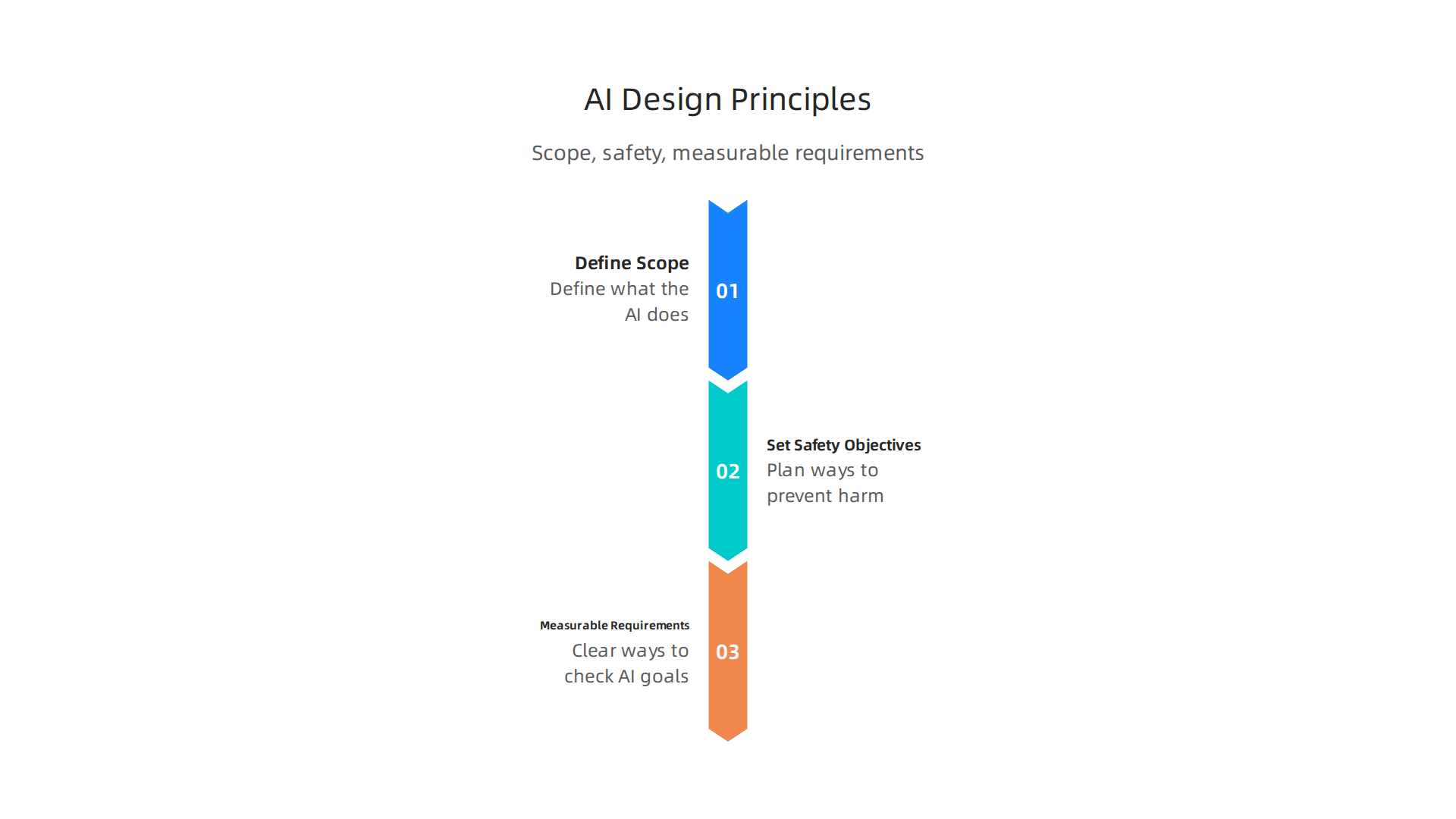
Defining What Your AI Will Do
The first part of good design is to clearly define the scope of your project. This is like drawing a clear picture of what your AI will be able to do. You need to turn big ideas about your product into small, clear goals that your machine learning (ML) system can aim for. For example, if you want to build an AI that helps customers, you need to decide exactly what kind of help it will give. Will it answer simple questions, or will it handle complex problems? This helps make sure everyone understands the AI’s purpose and limits.
Making Safety a Top Priority
Next, you must set clear safety goals. When you build AI, it’s not enough for it to just be "smart." It must also be safe and fair for everyone who uses it. This means thinking about what could go wrong and planning ways to prevent harm. Putting safety first helps you create truly responsible AI from the ground up. Experts agree that taking your data seriously throughout the whole process is a key part of AI engineering, helping to build robust and trustworthy systems from the start AI Engineering: Twelve Foundational Practices.
Setting Measurable Requirements
It’s also important to have measurable requirements. This means you need clear ways to check if your AI is meeting its goals. For instance, if your AI is meant to be fair, how will you measure fairness? If it needs to be fast, how fast is fast enough? These clear targets help you know if your AI is working as planned and if it’s fair to all users. Without measurable goals, it’s hard to improve or even know if you’ve succeeded.
As you design your AI, you also need to make sure your choices match how much risk you’re willing to take and what the rules say. Different AI projects have different levels of risk. Some are very low risk, like a simple tool that suggests movie titles. Others, like AI in healthcare or self-driving cars, have very high risks. Your design choices for how the system is built must keep these risks and all the compliance rules in mind. This includes ensuring the quality, reliability, and fairness of the data you use NTIA Artificial Intelligence Accountability Policy Report.
By carefully planning your AI’s scope, setting safety objectives, and defining clear, measurable requirements, you create a strong foundation.
This careful planning helps you build AI solutions that are powerful, safe, and ready to meet the challenges of 2026’s changing policy landscape. To understand more about keeping your AI compliant, consider learning about a Rigorous Artificial Intelligence Review for Policy Compliance.
After setting up a solid plan for your AI, the next big step is all about data. Think of data as the building blocks for your smart AI. How you collect, sort, and check this data makes a huge difference in how well and how fairly your AI will work. This is called your data strategy, and it covers collecting data, labeling it, making sure it’s good quality, and knowing where it came from.
Collecting Your Data with Care
When you start to build AI, gathering data needs careful thought. You need to design ways to collect information that also tracks where the data came from. This is called data provenance, and it’s like keeping a clear record of your data’s journey. Knowing the source helps you trust the data and fix issues later if needed. You also need to make sure you have permission to use the data, especially if it’s about people. This means collecting consent metadata, which shows that people agreed for their information to be used for your AI.
It’s also very important that the data you collect is a good picture of the real world. You want to gather samples that represent everyone fairly. If your data only shows one type of person or situation, your AI might not work well for others. This can lead to bias, which makes your AI unfair. So, make sure your data collection plans include a variety of samples to help create truly responsible AI. Experts agree that to build trustworthy systems, organizations should document where data comes from and make sure it’s reliable and fair Practice responsible dataset development.
Labeling Data for Your AI
Once you have your data, it often needs to be labeled. This means adding tags or notes to the data to teach the AI what to look for. For example, if you’re building an AI that recognizes cats, you’d label pictures of cats as "cat." This process needs its own set of rules and checks.
To ensure your data is correctly labeled, you should put quality checks in place. This helps catch mistakes early. One way to do this is by using "inter-annotator metrics." This means if several people are labeling the same data, you check how much they agree. If they agree a lot, your labels are probably good. If they don’t agree, you might need to give clearer instructions. Tools like Cohen’s Kappa are common ways to measure how much agreement there is between different labelers, helping to improve the quality of your training data How to Improve Data Labeling Accuracy and Quality for ML. These metrics are key to a good "labeling workflow."
You should also keep "audit trails." This is like a history book for your data labeling. It tracks who labeled what, when they did it, and any changes they made. This helps ensure transparency and makes it easier to trace problems back to their source. By focusing on these steps, you build AI that uses high-quality, trustworthy data. This groundwork is vital for making smart AI that works well for everyone. To learn more about how tech data is managed, check out this guide for unpacking tech data a policy professionals guide.
After you have put together your data with care, the next big step is to pick the right kind of brain for your AI: its model. This is like choosing the engine for a car. The type of model you pick, and how big it is, needs to fit what you want your AI to do and the limits you have. These limits can be how fast it needs to work, how much computer power it can use, and if you need to understand why it makes certain choices.
Matching Your AI Model to Your Needs
When you build AI, you need to think about different kinds of models.
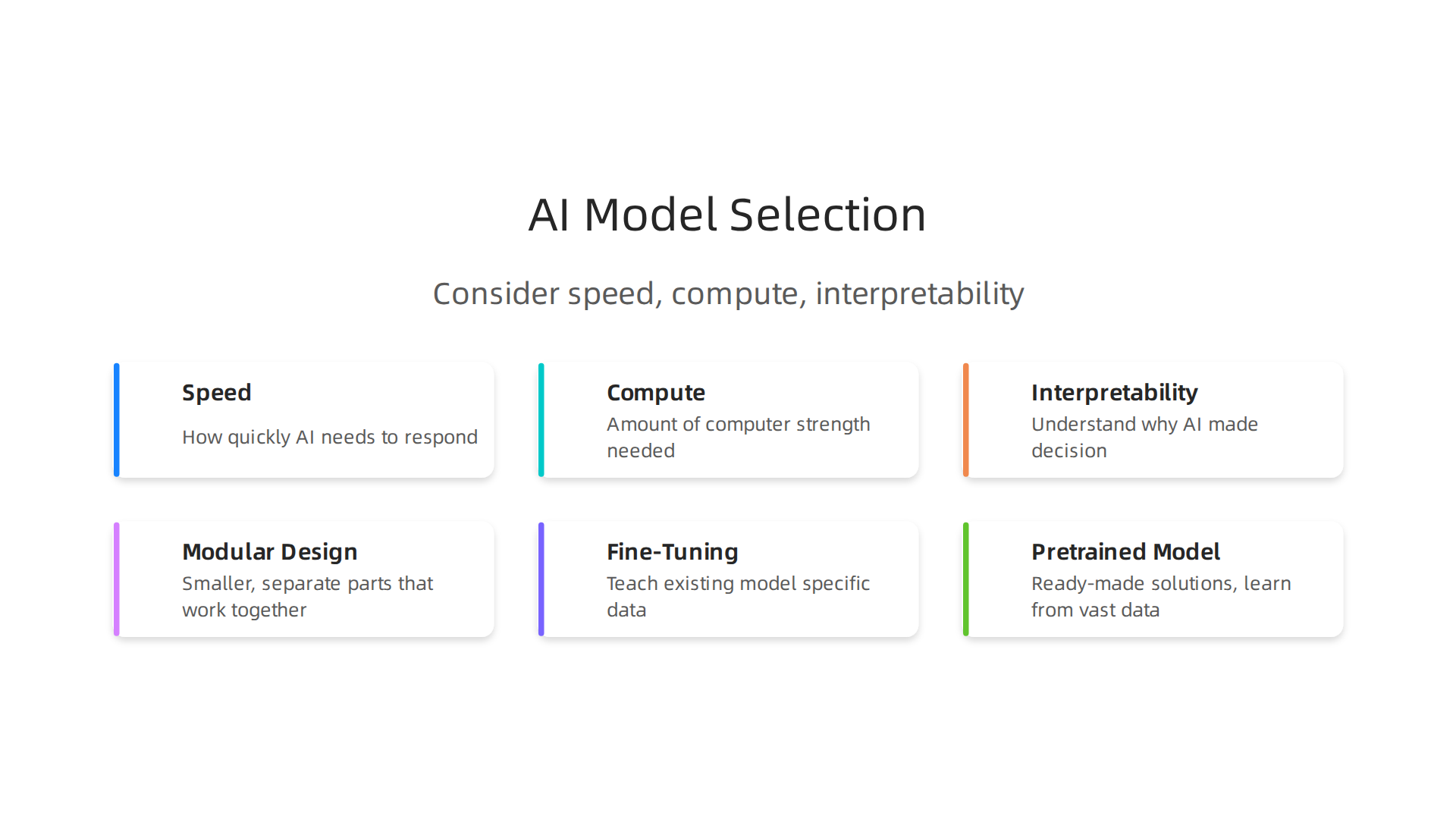
Some are simple, like a basic checklist. Others are very complex, like those that can understand human language. You must match the model family and its size to your everyday needs.
- Speed (Latency): How quickly does your AI need to give an answer? For things like self-driving cars or virtual assistants like Siri, every second counts. If a smart AI needs to respond right away, you might pick a smaller, faster model.
- Computer Power (Compute): Do you have a super powerful computer or a small device? Some AI models need a lot of computer strength to run, while others can work on simpler machines. Knowing your limits here helps you choose.
- Being Able to Explain (Interpretability): Can you understand why the AI made a certain decision? For tasks that affect people a lot, like in medicine or banking, it’s very important that the AI can explain its steps. This helps create responsible AI and builds trust. Choosing a model that allows for clear explanations is key here.
You also need to think about how to best develop your chosen model. This includes considering how GPT 3 architecture and capabilities still drive AI policy in 2026 for large language models, or other approaches for different tasks.
Smart Ways to Build and Improve Your AI
To build AI efficiently and effectively, you don’t always have to start from zero.
- Modular Designs: Think of AI as building blocks. You can create your AI using smaller, separate parts that work together. This makes it easier to update or fix one part without breaking the whole thing. It’s a smart way to make complex systems more manageable.
- Fine-Tuning: Imagine you have a very smart student who knows a lot about general topics. Fine-tuning is like giving that student a special lesson on your specific topic. You take an existing, "pretrained" AI model that has already learned from a huge amount of general data, and then you teach it a bit more using your own specific data. This often saves a lot of time and resources compared to training a model from scratch.
- Using Pretrained Models vs. Building from Scratch:
- Pretrained models are like ready-made solutions. They are often very powerful and have learned from vast amounts of information. For many tasks, using a pretrained model and fine-tuning it is the best approach. It helps you get a good AI up and running faster.
- Building a model from scratch means starting with nothing and teaching the AI everything from the beginning. This is usually only done for very unique problems where no existing pretrained model fits, or when you have enormous amounts of unique data and computational resources.
To make sure your AI works as expected, it’s important to test it well. Standardized tests, called benchmarks, are used to compare how well different AI systems perform on specific tasks. These benchmarks help assess things like accuracy, fairness, and safety. For instance, in 2026, many new benchmarks have emerged to cover various aspects of AI safety, from preventing harmful content to checking for bias AI Safety Evaluation Benchmarks: HELM, HarmBench, TruthfulQA …. Choosing the right model and development approach is crucial for creating effective and smart AI that meets your needs while being responsible.
When you build AI, making sure it works well and is safe is just as important as building it.

This means looking at more than just if the AI gives the right answer most of the time. You also need to check if it’s fair, strong, and won’t cause harm. This process is called evaluation and testing.
What to Look for When Testing Your AI
Think of AI evaluation as a full check-up for your smart helper. You want to see how it acts in different situations, especially unexpected ones.
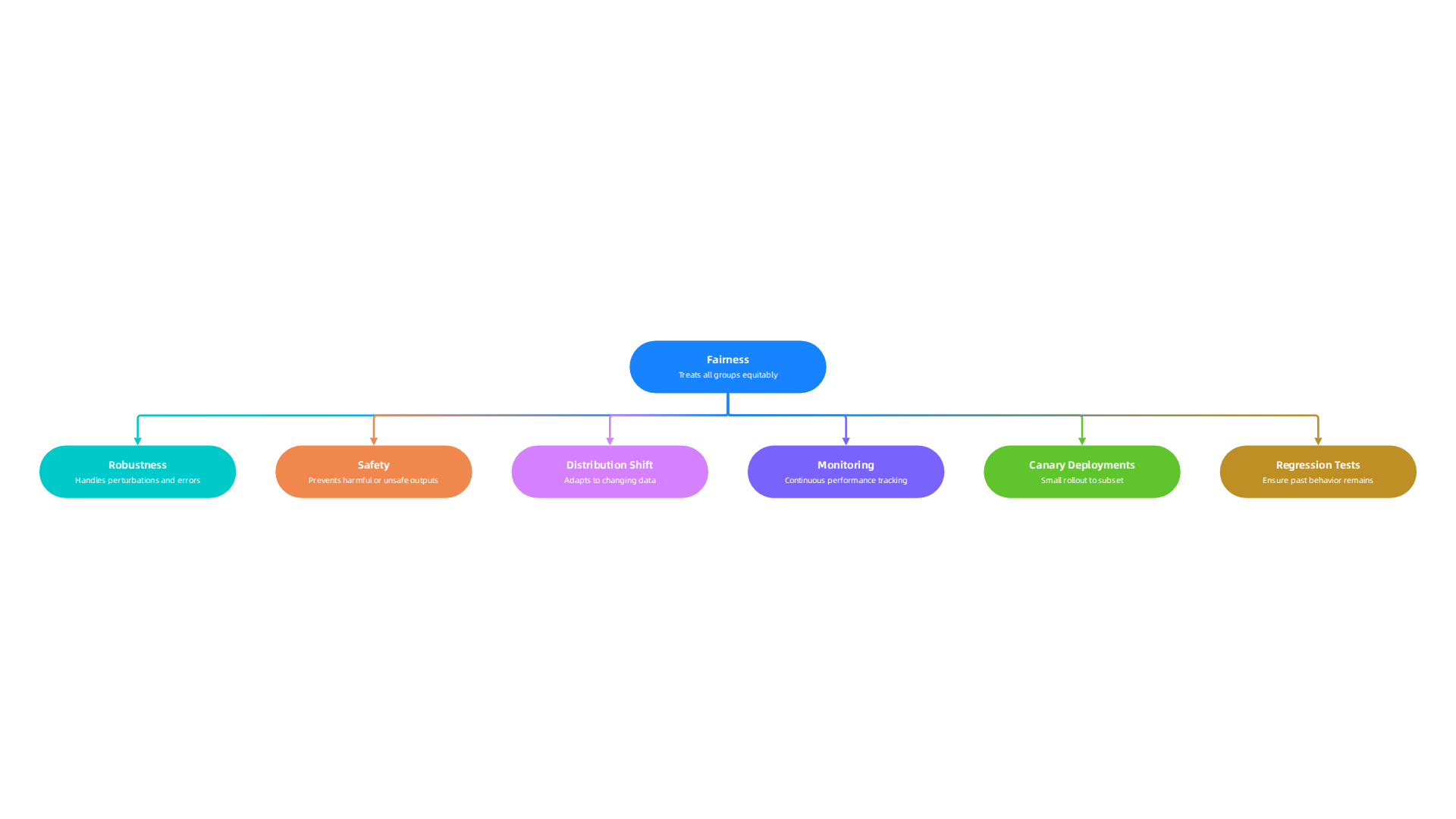
- Fairness: Does your AI treat everyone fairly? For example, if you build AI that helps with job applications, you don’t want it to favor certain groups of people over others. Fairness metrics help you measure this.
- Robustness: Can your AI handle small changes or unexpected inputs without breaking down? This is called robustness. Sometimes, tiny changes to the information given to the AI can make it give a completely wrong answer. This is known as an "adversarial attack." Testing for this helps make sure your AI is strong against tricky data.
- Safety: Most importantly, is your AI safe? This means it shouldn’t create harmful content or make dangerous choices. In 2026, there are many new ways to test AI safety, from checking for bad content to looking for hidden biases AI Safety Evaluation Benchmarks: HELM, HarmBench, TruthfulQA …. These special tests are called benchmarks and help us compare how safe different AI models are. For example, the HELM Safety suite helps check AI models against important responsibility and safety rules, covering many models from big companies across several areas of responsibility, as noted in a Stanford report CHAPTER 3: Responsible AI. Tools like HarmBench also help compare how well different AI systems resist attempts to make them act harmfully Jo.E: Joint Evaluation Framework for Comprehensive ….
- Distribution Shift: Imagine you train an AI using data from sunny California. What happens if you try to use it in snowy Alaska? The AI might not work as well because the real-world data it sees is different from what it learned from. This is called distribution shift, and your evaluation needs to check how well your AI handles such changes.
For an AI to be truly responsible AI, it needs to pass these types of tough tests. Learning more about these checks is part of gaining AI Literacy for Policy Professionals.
Always Keep an Eye on Your AI
Building an AI and putting it to work isn’t the end. It’s like having a car; you need to keep checking it to make sure it’s still running well. This is called continuous evaluation.
- Monitoring: Once your AI is out in the world, you need to watch it closely. This means tracking things like how accurate its answers are, if the data it’s getting starts to look different from what it learned (data drift), and if it’s running too slowly MLOps in 2026: Best Practices for Scalable ML Deployment. Monitoring helps you spot problems early. Many systems now have built-in ways to keep an eye on these things, like checking for changes in data or how well the model is performing Model monitoring in production – Azure Machine Learning.
- Canary Deployments: Sometimes, when you make a change or update your AI, you first release it to a very small group of users. This is like sending out a "canary in a coal mine." If anything goes wrong, only a few people are affected, and you can fix it before releasing it to everyone.
- Regression Tests: Every time you make a change, you should run tests to make sure that the old parts of your AI still work correctly and that your new changes haven’t broken anything. These are regression tests.
- Mapping to Requirements: All these tests and checks should link back to what you wanted the AI to do in the first place. This helps ensure that your smart AI truly meets your goals and works as it should, helping you maintain a Rigorous Artificial Intelligence Review for Policy Compliance.
Staying informed about the newest ways to build AI responsibly is a big task. Get clear daily AI updates from The AI Newsletter Worth Reading.
5) Deployment, MLOps, and Security: Monitoring, Incident Response, and Scaling
After all the careful planning, building, and testing, your smart AI is ready to go out into the world. But putting it into action, called deployment, isn’t the final step. It’s really just the beginning of making sure your AI stays helpful and safe. This ongoing care is a big part of what we call MLOps, which stands for Machine Learning Operations. In 2026, MLOps is about keeping a constant eye on your AI, handling problems quickly, and making sure it can grow as needed.
Always Watching: Operationalizing Model Monitoring
Imagine your AI as a helpful employee. You wouldn’t just send them off to work without checking in. MLOps involves always watching your AI model’s performance in the real world. This "model monitoring" helps you see if your AI is still doing its job well or if something has changed that might affect it. Key things to monitor include:
- Performance Drift: Is your AI’s accuracy or quality going down over time? This can happen as the world changes or new types of data appear. Monitoring tools track how well your AI is performing compared to when it was first launched MLOps Lifecycle: Stages, Workflow, and Best Practices.
- Upstream Data Changes (Data Drift): AI models learn from data. If the data they get in the real world starts to look different from the data they learned from, the AI might get confused. This is called data drift. Monitoring looks for these changes in the incoming information Chapter 6: Model Monitoring & System Observability – MLOps …. Many MLOps systems check for shifts in data patterns, also known as population shifts, by comparing current data to what the AI was trained on [PDF] Building Scalable, Observable MLOps Systems on Google Cloud](https://conf42.github.io/static/slides/Ancilia%20Dmello%20-%20Conf42%20Machine%20Learning%202026.pdf).
- Abuse Signals: Sometimes, people might try to use your AI in ways it wasn’t meant for, or even to cause harm. Monitoring for "abuse signals" helps you spot unusual or bad behavior early on. This can be part of making sure your responsible AI stays that way.
Staying on top of these things means you can fix small issues before they become big problems. It’s about maintaining the health of your AI system over its entire life.
Planning for Problems: Incident Response
Even with the best monitoring, things can still go wrong. That’s why having a plan for problems is super important when you build AI. This plan is called an "incident playbook." It’s like a step-by-step guide for what to do if your AI stops working right, makes a mistake, or is used in a bad way. These playbooks help your team react quickly, understand what happened, and fix it fast. They help keep your smart AI reliable and trustworthy, even when unexpected issues pop up.
Keeping AI Safe: Secure Deployment Pipelines and Controls
When you deploy your AI, you need to make sure it’s secure. Think of it like building a safe path for your AI to travel from creation to being used by people. This involves:
- Secure Deployment Pipelines: These are the safe steps and tools used to get your AI from the testing phase to being live. They prevent bad actors from changing your AI or its data along the way.
- Access Controls: Not everyone should be able to change your AI. Access controls mean only the right people have permission to work on, update, or change the AI system.
- Model Provenance Tracking: This is like keeping a detailed history book for your AI. It tracks every change, every update, and who did what. This is super helpful for audits, where you might need to show exactly how your AI was built and changed over time to meet rules and standards. Knowing this history helps ensure your AI is accountable.
Proper security measures are a must for any responsible AI system, especially when considering AI Infrastructure 2026 Navigating Cost Security and Compliance. By focusing on these deployment and security steps, you help build AI systems that are not only powerful but also trustworthy and robust for the future.
6) Policy, ethics, and compliance: mapping legal obligations to engineering controls
Building AI systems that are both powerful and trustworthy means we also have to think about the rules and good practices that guide them. This is where policy, ethics, and compliance come in. In 2026, these are not just legal words, but practical guides for how to build AI in a way that is fair, safe, and respectful to everyone.

Turning Rules into Action for Responsible AI
It’s one thing to have a law or an ethical guideline; it’s another to make sure your smart AI actually follows it. This involves translating big ideas from legal papers into small, clear steps for engineers. For example, if a law says your AI must be fair and not show bias, engineers need to set up specific checks during the AI’s learning phase. They also need to make sure the data used to train the AI is fair. This is how we map legal obligations to engineering controls.
Think of it like following a recipe. The recipe might say "add a pinch of salt." The engineer’s job is to figure out exactly how much a "pinch" is in machine code. Companies that build AI need to understand global rules like the EU AI Act or guidelines like the NIST AI Risk Management Framework. These frameworks help them make sure their AI is responsible and follows the law AI Governance in 2026: The Compliance Reckoning. Many companies are looking at checklists to make sure they meet all the requirements for AI compliance in 2026 AI Compliance Checklist 2026: EU AI Act, GDPR, ISO ….
Keeping Records and Showing Your Work
When you build AI, it’s super important to keep good records. This is called documentation, and it helps you explain how your AI works and how you made sure it follows all the rules. From day one, you should document everything: what data you used, how the AI was trained, and what steps you took to make it fair and safe. This documentation is crucial for audits, which are like checks by outside experts to ensure your AI meets all legal and ethical standards. Having clear records from the start helps you manage risks and show that your AI is accountable AI Governance & Risk Readiness 2026: EU AI Act & Global ….
Knowing What Matters Most
With so many rules and guidelines, where do you start? Businesses need to figure out which compliance tasks are most important based on where they operate and how much impact their AI will have. An AI used for simple tasks might have fewer rules than an AI that makes big decisions about people’s lives. By understanding these risks, companies can prioritize their compliance work and make sure they focus on what truly matters to build ai safely and ethically. This planning helps navigate the often complex landscape of regulations, which can differ greatly from one part of the world to another. To understand more about these differences, you can read about a global comparison of AI regulations.
Staying on top of these rapidly changing rules is a big task. Get clear daily AI updates from The Deep View Newsletter. The AI Newsletter Worth Reading
Summary
This article explains why building AI in 2026 requires both strong engineering and close attention to fast-changing policy and compliance. It walks through a practical, step-by-step approach: defining scope and safety goals, setting measurable requirements, crafting a data strategy (collection, labeling, provenance), selecting and tuning models, and using modular design and pretrained options where appropriate. You will learn how to evaluate systems with modern benchmarks for fairness, robustness, and safety, and how to operationalize continuous monitoring, canary deployments, and incident playbooks via MLOps. The piece also shows how to translate legal obligations—like the EU AI Act and risk frameworks—into concrete engineering controls, documentation, and audit trails. After reading, you will have a clear framework to design, test, deploy, and maintain responsible AI that meets both technical needs and regulatory demands.