
Introduction
If you work in policy, you have probably noticed a big shift in 2026. AI note-taking tools are everywhere now. Open any app store or browse any productivity blog and you will see tools promising to transcribe your meetings, summarize your calls, and organize your notes automatically. The numbers back this up. The global market for these tools was valued at USD 740 million in 2026 and could reach USD 3.47 billion by 2035, according to the latest AI Note Taking Market Size report. That kind of growth means new tools launch almost every week.
Here is the thing. Policy professionals handle sensitive information daily. Confidential briefings. Draft legislation. Closed-door strategy sessions. Handing that data to an AI tool without understanding the risks is a gamble.

Privacy concerns, compliance requirements, and security standards all come into play. One wrong choice could expose protected information or violate regulations. The sheer number of options makes it hard to separate real innovation from flashy marketing.
This guide cuts through the noise. I walk through the major market trends shaping the notes ai space right now, the legal frameworks you need to know, and the security standards that matter for policy work. You will also get actionable best practices for adopting AI note-takers safely in your daily workflow. If you want to stay ahead of the fast-changing tech policy landscape, consider signing up for a daily briefing that tracks these shifts.
Whether you are evaluating your first AI note-taking tool or rethinking your current stack, this guide gives you a clear path forward without the hype.
The Rise of AI Note‑Taking: A Primer for Policy Professionals
Picture this. You sit through a two‑hour hearing on a new data privacy bill. The discussion is fast. Multiple voices. Key amendments are proposed and withdrawn. By the time you walk out, you already know you missed something important. Later, scouring your handwritten notes, you find gaps.
That is where notes ai tools come in. These are software programs that use artificial intelligence to record, transcribe, and summarize conversations in real time. Popular tools include Otter.ai, Fireflies, Fathom, and Rev AI.
They listen to meetings, hearings, or briefings and turn spoken words into searchable text. Many also pull out action items, decisions, and questions automatically. Instead of scribbling frantically, you can focus on the substance.

The adoption of these tools is growing fast. The note‑taking app market as a whole was valued at USD 13.3 billion in 2026, according to the Global Note Taking App Market Trends to Watch in 2026 report. That number includes both traditional note‑taking apps and newer AI‑powered tools. Today, policy meetings at all levels from local city council hearings to federal agency briefings are using notes ai to capture every word.
The benefits are real. You save hours of manual note‑taking. You get near‑perfect recall of who said what. Your team can share automated minutes across departments. And extracting action items becomes a matter of seconds rather than deliberation.
Here is the catch. Most of these tools process your data on third‑party servers. When you upload a sensitive policy briefing, that text travels outside your control. Privacy and compliance risks follow quickly. Before you adopt any notes ai tool, you need to understand where your data goes and who can access it. That is why the next section covers the legal frameworks that apply to your work.
For now, know this. AI note‑taking is a powerful ally. But it is one you must handle with care. If you want to stay on top of how these tools shape policy and regulation, you can get clear daily AI updates from The Deep View Newsletter. It will help you track the fast‑moving changes in this space. And for a deeper look at what the new rules mean for your team, check out this guide to navigate AI privacy and cybersecurity changes in 2026.
Regulatory Compliance: Key Frameworks Governing AI Note‑Taking Tools
You finally found a notes ai tool that saves you hours every week. But now a question nags at you. Is this tool legal to use for policy work? The answer depends on where you are and what kind of data you are recording.
Three major frameworks shape the rules around AI note‑taking tools today. The first is the General Data Protection Regulation (GDPR) in Europe. The second is the California Consumer Privacy Act (CCPA) in the US. The third is the brand new EU AI Act, which started rolling out in 2025 and 2026.

Each one affects how you can use notes ai in a policy setting.
How the EU AI Act Classifies Your Tool
The EU AI Act sorts AI systems by risk. Most notes ai tools fall into the limited risk or minimal risk categories. That means you face lighter rules than high‑risk systems used in healthcare or law enforcement. But you still have to follow transparency rules. Users must know they are interacting with AI. The EU AI Act risk‑based classification page explains that limited risk systems need clear labeling so people know when AI is involved.
If your policy work involves sensitive topics or vulnerable groups, your notes ai tool could be seen as higher risk. Always check the classification against the official rules.
Data Controller vs. Processor: Who Owns the Risk?
Here is a key idea you need to understand. Your organization is the data controller. The notes ai company is the data processor. The controller decides why and how to collect data. The processor just handles it on your behalf. Under GDPR and CCPA, you must have a Data Processing Agreement (DPA) with the tool provider. This contract spells out how data is stored, who can see it, and what happens if a breach occurs. Without a DPA, you could be violating the law.
Cross‑Border Transfers and Record‑Keeping
Many notes ai tools store data on servers in other countries. GDPR restricts transfers outside the European Economic Area unless the destination country has adequate protections. You need to check where your recordings are stored. The ISACA white paper on understanding the EU AI Act details the record‑keeping requirements for high‑risk AI systems.
Even for lower risk tools, keeping logs of when and how you use notes ai is a best practice.
You also need user consent. If you record meetings with external stakeholders, you must tell them and get permission. Some jurisdictions require explicit opt‑in consent.
Getting compliance right takes time. But it is better than facing a fine. For a deeper look at the overall policy landscape, read this guide on how AI policy in the public sector is transforming government compliance. It will help you understand how these rules affect your daily work.
Data Privacy and Security: Assessing Risks in AI Note‑Taking
Compliance frameworks tell you the rules. But rules don’t stop bad things from happening. The real test of a notes ai tool is how well it protects your data every single day. And the risks are bigger than most people realize.
The Main Privacy Risks You Need to Know
When you use a notes ai tool, you are handing over raw meeting data. That includes every word said, the names of participants, and often the time and date of the call. Here is what can go wrong if the tool is not built with security in mind:
-
Unencrypted data in transit or at rest. If a tool does not encrypt your recordings while they move across the internet and while they sit on a server, anyone with access to that network can read them. An article from UE on AI notetakers as a hidden liability explains that poor encryption opens the door to unauthorized access and cybersecurity incidents.
-
Third‑party model training. Some AI note‑taking companies use your meeting transcripts to train their language models. That means your sensitive policy discussions could end up baked into a public AI tool. Always check the provider’s terms of service to see if your data is used for training.
-
Inadequate access controls. If any employee at the vendor can open your transcripts, you lose control over who sees your information. The Silent Guest in Your Meetings legal risks article warns that cloud‑stored recordings are attractive targets for cyberattacks, and a breach can expose confidential business strategies or privileged legal discussions.
-
Metadata exposure. Even if the transcript is locked down, the fact that you met with certain people at a certain time can reveal strategic moves. Metadata like meeting participants, duration, and frequency can be just as sensitive as the content.
What Security Certifications Actually Mean for You
You will see acronyms like SOC 2 Type II, ISO 27001, and FedRAMP on vendor websites. Here is what they tell you:
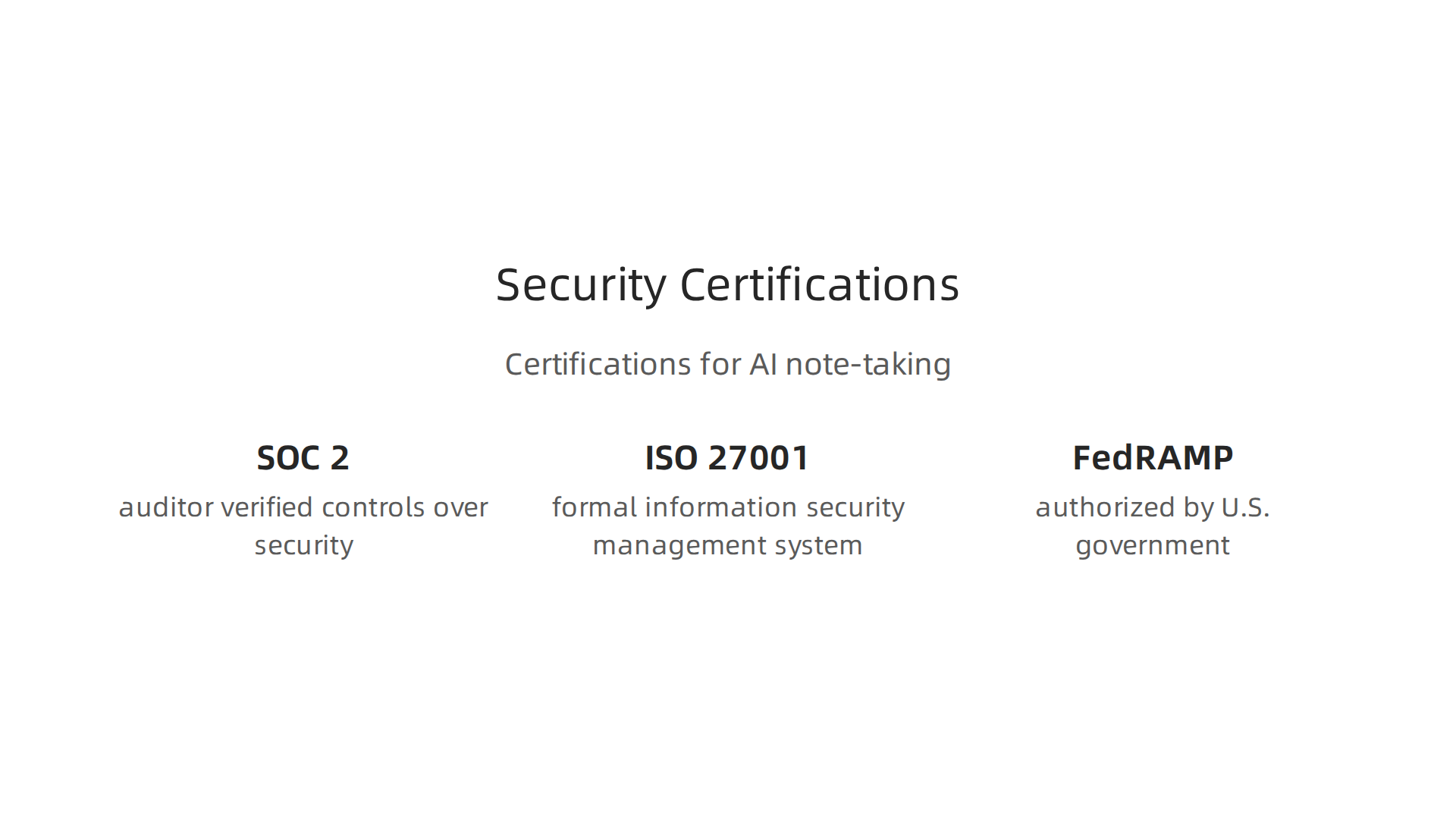
| Certification | What It Means | Why It Matters for Policy Work |
|---|---|---|
| SOC 2 Type II | An independent auditor verified the vendor’s controls over security, availability, and confidentiality over a period of time. | Shows the company takes data protection seriously and has been tested. |
| ISO 27001 | The vendor has a formal information security management system that meets international standards. | Indicates a mature, repeatable security program. |
| FedRAMP | The vendor has been authorized by the U.S. government to handle federal data. | The highest bar for security; required if your policy work involves federal contracts. |
If a vendor lacks any of these, ask why. For policy work, SOC 2 Type II or ISO 27001 should be a minimum requirement.
Real‑World Consequences You Cannot Ignore
These risks are not theoretical. Consider what happened in one law firm. An attorney held a teleconference about a colleague who was not invited to the call. The person who missed the call later received a full transcript of the discussion that happened in their absence. The legal risks of AI note‑takers article recounts how this created real friction and exposed sensitive internal commentary.
Another example: Otter.ai faced legal action under GDPR for failing to obtain explicit consent from all meeting participants before processing their data. This shows that even popular tools can run into serious compliance trouble when privacy protections are weak.
How to Stay Informed
The landscape changes fast. New tools appear, existing ones update their terms, and regulators release fresh guidance. To keep your knowledge current, subscribe to a trusted source that tracks these developments daily. The AI Newsletter Worth Reading delivers clear updates on AI governance, privacy risks, and security best practices straight to your inbox.
For a deeper look at how these privacy risks fit into the broader regulatory picture, read our guide on navigating AI privacy and cybersecurity changes in 2026. It will help you connect the dots between data security and the compliance rules we covered earlier.
Tool Selection Criteria: How to Evaluate AI Note‑Takers for Policy Work
So you know the risks. Now you need a notes ai tool you can actually trust with policy work. But how do you pick one when every vendor claims to be secure? You need a repeatable process that weeds out the weak ones fast.

Here is a practical framework built for policy professionals. Use these criteria every time you evaluate a new tool.
Start With the Hard Requirements
Before you look at features like transcription accuracy or summary quality, lock in these non‑negotiables.
| Requirement | Why It Matters for Policy Work |
|---|---|
| SOC 2 Type II or ISO 27001 certification | Shows an independent auditor tested the vendor’s security controls over time. Without it, you are trusting their word alone. |
| Explicit data use policy | The contract must say your data will never be used to train AI models. Period. The enterprise procurement checklist from 2026 lists this as a must have. |
| Data residency controls | You need to choose where your transcripts are stored. For policy work, keeping data inside your country or region may be required by law. |
| Configurable retention windows | The tool should let you set how long audio and transcripts are kept, then auto‑delete them. |
| Audit logs | You must be able to see who accessed what, when. This is critical for compliance reviews and investigations. |
| Bot‑free capture option | Some meetings are too sensitive for a visible recording bot. The tool should offer a zero‑footprint mode that does not alert participants. |
Vendor Due Diligence: Don’t Skip the Paperwork
Even if a tool checks every box above, the contract is where the real protections live. You need to review these documents before signing anything:
- Data Processing Agreement (DPA) . This legally binds the vendor to handle your data according to your rules. Make sure it covers encryption, breach notification timelines, and data deletion.
- Sub‑processor list. The vendor may use other companies to process your transcripts. You need to know who they are and what they do with your data. If the list keeps changing, that is a red flag.
- Right to audit. For high‑stakes policy work, you may want the contractual right to audit the vendor’s security practices yourself. Not every vendor grants this, but it is worth asking.
Your Procurement Checklist
Use this quick checklist when you sit down with a vendor. If they cannot say yes to every item, move on to the next option.
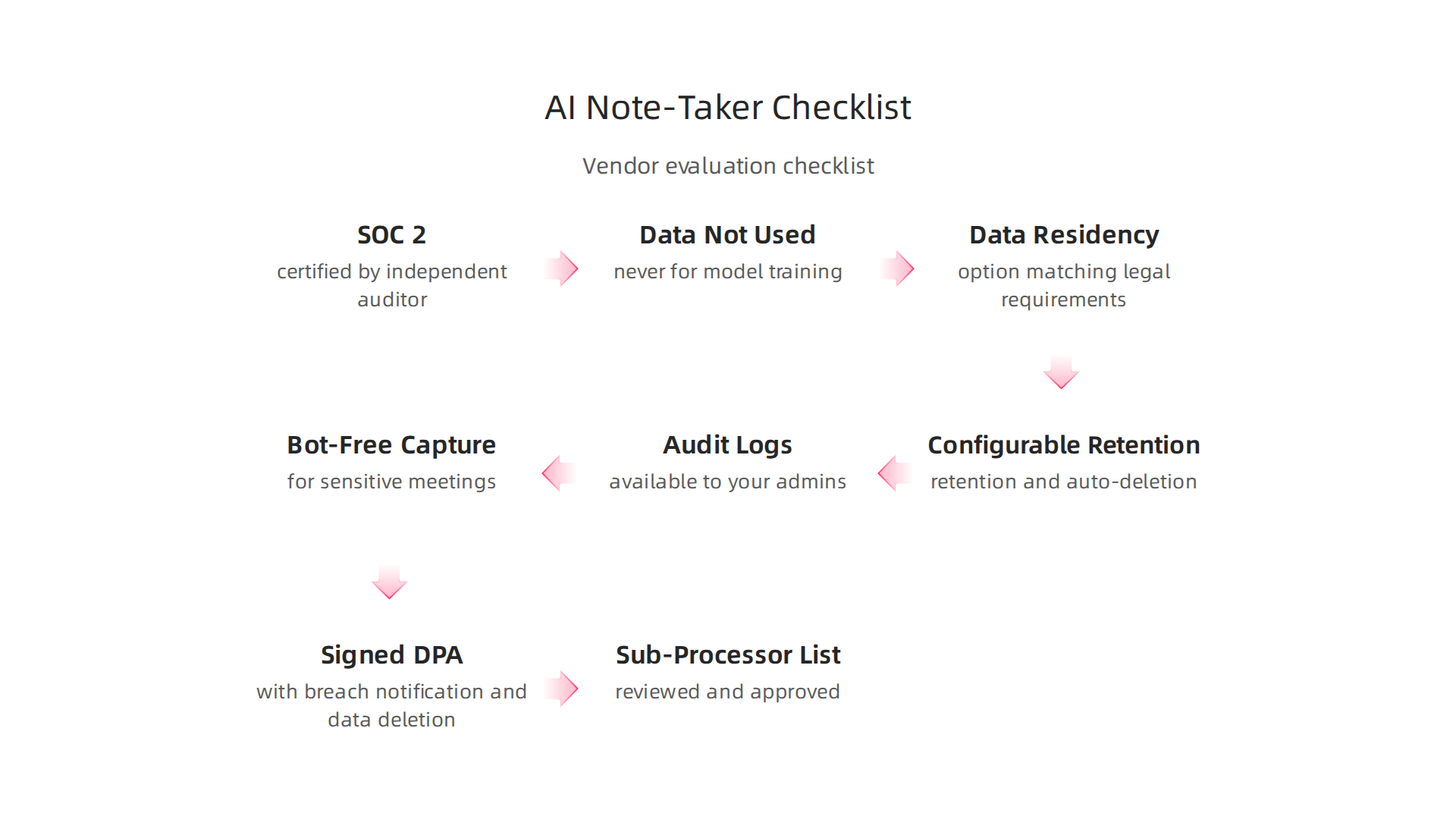
- SOC 2 Type II or ISO 27001 certified
- Data never used for model training (in writing)
- Data residency option that matches your legal requirements
- Configurable retention and auto‑deletion
- Audit logs available to your admins
- Bot‑free capture mode for sensitive meetings
- A signed DPA with breach notification and data deletion clauses
- Complete sub‑processor list reviewed and approved
For a deeper look at how to structure your overall compliance approach, read our guide on conducting a rigorous artificial intelligence review for policy compliance. It will help you build the governance framework that makes tool selection easier.
Best Practices for Secure and Efficient Use of AI Note‑Taking Tools
You have your checklist. You picked a notes ai tool that passes every security test. But the tool alone is not enough. Without the right habits and policies, even the most secure platform can leak sensitive information. Here are the practices that keep your notes ai safe in a policy environment.
Train Users on Data Classification
Not every meeting is the same. A brainstorming session about public feedback is different from a closed-door briefing on classified policy. Your team needs clear rules about which meetings can use the notes ai tool and which ones require manual note-taking or special handling.
Start with simple categories. For example:
- Green – Public or low-sensitivity meetings. The tool can record freely.
- Yellow – Sensitive internal discussions. Recording is allowed but participants must be informed and the transcript must be reviewed before sharing.
- Red – Classified, attorney-client privileged, or legally restricted conversations. The tool must be turned off completely.
Make sure everyone knows these categories. A training session once a year is not enough. Add a quick reminder at the start of every high-stakes meeting. As one legal expert explains in their comprehensive guide to AI note-taking security, notifying all participants before recording starts is a core best practice that builds trust and avoids legal issues.
Set Clear Policies for Retention, Deletion, and Access
Policy work often involves records that must be kept for years or deleted immediately. Your notes ai tool should let you control how long audio files and transcripts live. Set retention rules that match your industry regulations and internal governance requirements.
For example, you might set audio files to delete automatically after 48 hours and transcripts to delete after 90 days unless flagged for archive. Access controls are just as important. Only people who need to see a meeting transcript should have permission to view it. Audit logs let you check who opened which file and when.
These policies are not just good hygiene. They also align with record-keeping laws and data protection frameworks. A report on the legal risks of AI note-takers published by a law firm recommends that organizations “confirm confidentiality protections” and “control automatic activation” to prevent accidental recording.
Conduct Regular Audits and Penetration Testing
Even the best tool can have weak spots. That is why you need to test it like you would any other critical system. Schedule regular audits of your notes ai deployment. Check that retention rules are working. Review audit logs for unusual access. Make sure that staff are following the data classification rules you set.
Penetration testing goes deeper. Hire a security team to try to break into your system through the tool. Can they access old transcripts? Can they intercept the data in transit? If the vendor offers a third-party security assessment, use it. Some tools have SOC 2 Type II reports that you can request annually. But remember, the vendor’s certification does not cover your own configuration mistakes.
For a broader look at building a compliance-minded AI strategy, our guide on how to navigate AI privacy and cybersecurity changes in tech policy provides a framework that applies directly to your notes ai governance.
Make It a Habit, Not a One-Time Fix
The most common mistake is setting up the tool and forgetting about it. Policy work changes fast. New regulations appear. New team members join. Risks evolve. Treat your notes ai security as a living process. Review your policies every quarter. Update your training materials when the tool adds features. And always ask: would this meeting transcript harm our organization if it leaked?
If you want to stay ahead of these issues, get clear daily AI updates delivered straight to your inbox. Staying informed about the latest policy shifts and security trends will help you make smarter decisions about every tool you use.
The Future of AI Note-Taking: Trends and Policy Implications
The notes ai world is changing fast. According to recent AI note taking market size data, the global market was worth about USD 623.50 million in 2025 and could reach USD 3.48 billion by 2035. That growth comes from hybrid work and smarter tools. But the real story is what these tools will do next.
New Features Bring New Regulations
The next wave of notes ai tools will handle more than just audio. They will process video feeds. They will translate meetings in real time. Some will even try to detect emotion from voice tone or facial expressions.
These features are useful. A team negotiating across borders could use live translation. A manager could check if a remote team member seems frustrated.
But emotion detection and video analysis come with real legal risk. The EU AI Act regulatory framework already bans emotion recognition in workplaces and schools. Other regions are writing similar rules. A notes ai tool that analyzes faces or voices could break these laws without you even knowing.
The EU AI Act classifies many AI systems by risk level. Tools that process sensitive data or make judgments about people could fall into the high-risk category. That means strict rules on data handling, transparency, and record-keeping. Breaking these rules can mean fines up to EUR 40 million.
How to Future-Proof Your Tool Choices
More regulations are coming. The United States is drafting sector-specific rules for AI in government. Some countries want to ban certain data collection methods entirely.
Your best move is to choose notes ai tools from vendors with strong compliance track records. Ask about their approach to the EU AI Act. Look for clear documentation about how they train their models and handle data.
One tech expert who reviewed the best AI meeting notes tools in 2026 noted that the most important question is simple: does a recording bot change what people say? That question only gets more important as regulators tighten the rules.
Future-proofing means picking vendors that upgrade their compliance before they are forced to. The regulatory landscape around artificial superintelligence regulations shows how fast these rules change. Staying ahead of the curve is the only way to keep your notes ai stack safe and legal.
If you want to stay on top of these shifts, The AI Newsletter Worth Reading delivers clear daily updates straight to your inbox. Being informed about the latest policy changes will help you make smarter decisions about every notes ai tool you choose.
Summary
This guide explains how policy professionals can adopt AI note‑taking tools without exposing sensitive information or breaking compliance rules. It outlines how modern note‑taking AI works, why teams value automated transcripts and summaries, and the specific legal frameworks—GDPR, CCPA and the EU AI Act—that shape safe use. The article highlights concrete privacy and security risks like unencrypted data, model‑training of transcripts, metadata leaks, and weak access controls, then translates those risks into practical vendor requirements: SOC 2/ISO certification, a binding DPA, data residency, retention controls and audit logs. It gives a step‑by‑step procurement checklist, contract items to insist on, and operational best practices such as data classification, user training, and regular audits. Finally, it looks ahead at new features (video, translation, emotion detection) and the regulatory pressures they bring, helping you choose and manage note‑taking tools that keep your policy work secure and compliant.