

If you follow tech policy trends, you already know the usual startup hotspots. Silicon Valley. New York. Boston. But there is a quieter shift happening that deserves your attention. Startups in Atlanta are growing fast, and the numbers back it up.
Atlanta has become a serious contender among U.S. tech startup hubs. The reason? A powerful mix of corporate investment, top university talent from schools like Georgia Tech, and state policies that encourage new business. This combination is pulling in founders and investors who want lower costs and strong growth.

In 2025 alone, Atlanta startups raised $756.5 million in 2025, a 23% jump from the year before. That kind of money signals real momentum. And while you might hear more about new england tech news or coastal ecosystems, Atlanta is quietly building something that rivals them.
For tech policy professionals, investors, and founders, understanding what is happening here matters. The local dynamics shape regulatory opportunities, funding flows, and growth strategies. You cannot afford to ignore a region that is pulling in billions in venture funding and producing more AI companies every year.
This article gives you a data-driven look at Atlanta’s startup ecosystem. We will cover policy, funding trends, and what comes next.
If you want to stay on top of how these shifts affect regulation and business, you can read more about AI development company regulation and opportunity in 2026.
And to keep getting clear, daily updates on AI and tech policy without the noise, consider subscribing to The AI Newsletter Worth Reading. It delivers the insights you need to make informed decisions.
The Rise of Atlanta’s Tech Ecosystem
The numbers tell a clear story. Atlanta’s tech ecosystem is not just growing. It is maturing into a genuine powerhouse. In 2025, companies in the city pulled in a record $3.0 billion in venture capital funding, according to a report from Avison Young. That is the highest amount Atlanta has ever recorded in a single year. And it is not a fluke.
More than $2.5 billion flows into Atlanta startups annually now across deals of all sizes. The ecosystem supports over 21 unicorns (private companies valued at $1 billion or more) and a combined enterprise value of $122 billion, based on data from Dealroom. Those are not small numbers for a city that often flies under the radar compared to the usual new england tech news coverage.
Where does the growth come from?
Atlanta has developed deep strength in three main sectors:
- Fintech — The city is often called the "Transaction Alley" because so many payment and financial technology companies operate here. Think about the last time you swiped a credit card or used a mobile payment app. There is a good chance an Atlanta company processed that transaction.
- Healthtech — With major hospital systems like Emory and Piedmont nearby, startups in health data, telemedicine, and medical devices are thriving.
- Enterprise SaaS — Many companies build software that other businesses use to run operations, from supply chain tools to HR platforms.
These aren’t random clusters. They grew because of deliberate investment from universities, corporations, and local government.
Who are the key players in the ecosystem?
A handful of organizations make Atlanta’s startup scene special:
- ATDC (Advanced Technology Development Center) — One of the oldest and largest technology incubators in the U.S., housed at Georgia Tech.
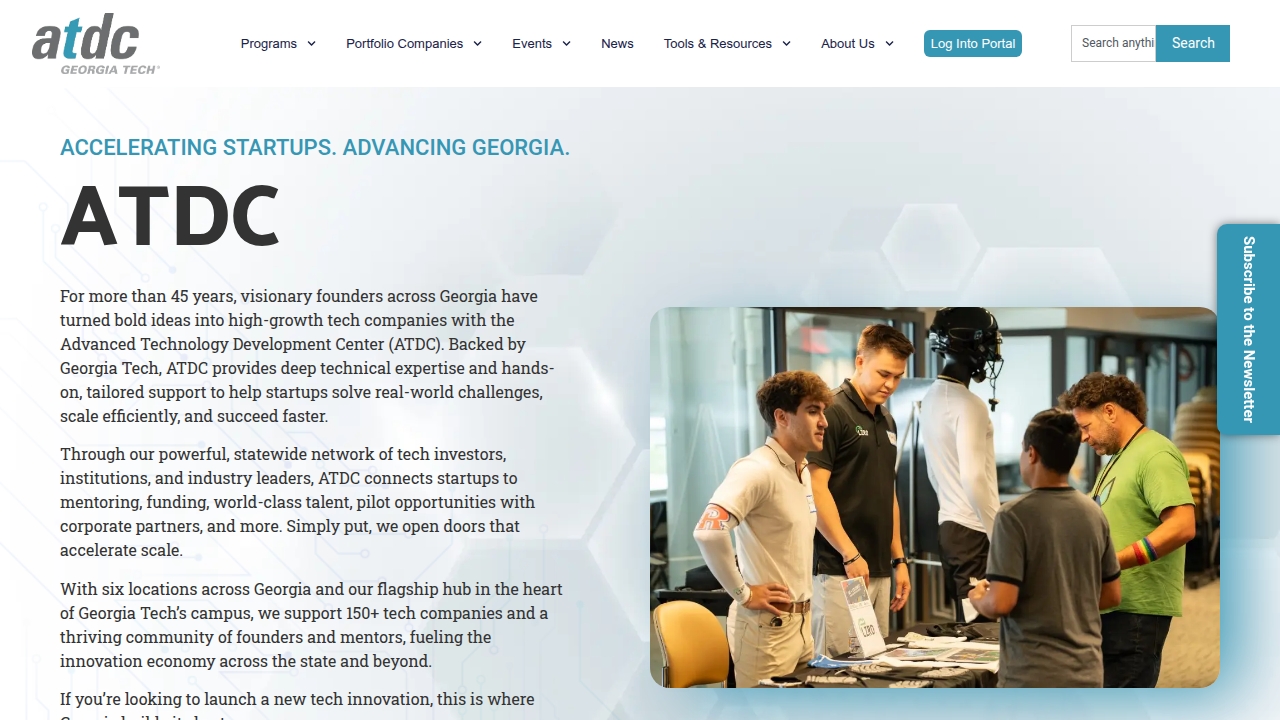
It has helped launch hundreds of companies.
- Tech Square Labs — A venture studio and co-working space in Midtown that connects founders with capital and corporate partners.
- Engage and Flashpoint — Two well-known accelerators that run cohort programs for early-stage startups.
- Corporate innovation labs — Companies like Honeywell, Google, Microsoft, and Delta all have innovation centers in Atlanta. They actively work with local startups on pilots and partnerships.
Infrastructure gives Atlanta an edge
You cannot talk about Atlanta’s rise without mentioning its physical advantages. Hartsfield Jackson Atlanta International Airport is the busiest airport in the world. That means founders can fly to almost anywhere in the U.S. or internationally in a direct flight. Time matters when you are scaling.
The city also has one of the densest fiber optic networks in the country. Low latency and high bandwidth make it attractive for AI companies that need to move large data sets quickly.
All of these pieces are coming together at the right time. As regulatory conversations around AI and data privacy heat up nationally, having a strong local ecosystem that understands both policy and technology becomes invaluable. To explore how AI trends in 2026 are shaping the regulatory landscape, you can read our in depth guide on AI trends 2026 multimodal models and governance challenges.
Policy and Regulatory Climate for Startups in Georgia
Beyond the infrastructure and investment, startups in Atlanta also benefit from a policy environment that actively encourages growth. Georgia has built a strong foundation of incentives and support programs that make the state a smart choice for new companies.

And as regulations around AI and data privacy take shape, the city is positioning itself as a proactive player in compliance and governance.
The R&D tax credit is a game changer for tech companies
If your startup spends money on research and development — and most tech startups do — Georgia offers a serious financial advantage. The state provides a tax credit of up to 10% of qualified research expenses conducted in Georgia. That is a direct dollar for dollar reduction in your state income tax liability. And the credit can be carried forward for future years if you don’t owe enough tax to use it all at once.
Here is how it works:
- You calculate your qualified research expenses for the year.
- You compare them to a base amount (based on your past Georgia gross receipts).
- The credit equals a percentage of the increase over that base.
According to the Georgia R&D Tax Credit breakdown, the credit is available to any business that increases its qualified research spending in the state. And it is not just for big corporations. Early stage ai companies and healthtech startups can qualify too. That means more money stays in your pocket to reinvest in product development and hiring.
Evolving rules around data privacy and AI
Georgia is not sitting still when it comes to technology regulation. As artificial intelligence becomes more central to business operations, the state is working on updated rules that balance innovation with consumer protection. For startups building with AI, this creates both a challenge and an opportunity.
Staying ahead of these changes is critical. A good place to start is learning how to navigate AI privacy and cybersecurity regulations in today’s environment. The regulatory landscape is moving fast, and being proactive saves you from expensive compliance headaches later.
Startup Atlanta and municipal support
The city itself runs programs designed to help young companies grow. Startup Atlanta is a public-private initiative that offers grants, mentorship, and networking opportunities for local founders. It connects you with city resources, corporate partners, and other entrepreneurs who have been through the early stages. Whether you need help applying for a business license or finding your first customer, these programs are built to lower barriers.
The combination of state level tax credits, evolving but supportive regulations, and city run programs creates a solid foundation for startups in Atlanta to scale. And with the conversation around AI governance heating up nationally, staying informed on policy shifts is more important than ever.
That is why many founders and policy professionals turn to a daily source of clear, no fluff updates. If you want to track how regulations affect your business without spending hours digging through dense reports, The AI Newsletter Worth Reading delivers exactly that. It is a quick daily read that keeps you ahead of the curve.
Funding Landscape: Venture Capital and Angel Investment in Atlanta
Now that you know about the policy support, let’s talk about the money. Because even the best idea needs fuel to grow. And the funding scene for startups in Atlanta is stronger than ever.
Record breaking venture capital numbers
In 2025, Atlanta venture capital funding hits record high with a stunning $3.0 billion raised by local companies. That is the highest number ever recorded in the city. And it is a clear sign that investors are taking the Southeast seriously. This growth places Atlanta among the top 10 U.S. metro areas for venture funding, outpacing many peer cities.
A separate report shows that Atlanta startups raised $756.5 million in 2025, a 23% jump from the previous year. So whether you look at the big picture or the year over year trend, the direction is the same: money is flowing into the city.
Who is writing the checks
A mix of local and national funds are fueling this growth. Firms like BIP Ventures are deeply active in the region, and their State of Startups report tracks how the ecosystem is maturing. Corporate venture arms are also paying attention. Big companies want access to the talent and innovation coming out of Atlanta.
Early stage funding is still concentrated in fintech and healthtech, which have been Atlanta’s strengths for years. But new sectors are gaining ground. AI companies focused on enterprise tools, clean energy startups, and logistics tech are all attracting serious attention from angel investors and venture funds alike.
What this means for founders
The takeaway is simple. If you are building a startup, Atlanta offers a funding environment that is both deep and diverse. You do not need to move to the West Coast to find capital. The investors are here, the deal flow is growing, and the city is ranked 34th globally in startup ecosystem strength.
For founders working in AI or regulated industries, understanding how these trends intersect with policy is critical. That is why many turn to resources that explain how an AI development company navigates regulation and opportunity in this fast-changing environment. Staying informed helps you pitch smarter and build compliance into your product from day one.
Talent and Workforce Development
Money is flowing into Atlanta, but startups also need people. Smart, skilled people. And that is one area where the city truly shines. The talent pipeline for startups in Atlanta is deep and getting deeper every year.
A strong foundation from top universities
Atlanta is home to some of the best schools in the country. Georgia Tech produces thousands of engineers and computer scientists each year. Emory University adds strength in health sciences and business. And local HBCUs like Spelman College and Morehouse College send talented graduates into the workforce across tech, finance, and policy. This mix gives startups access to diverse perspectives and fresh thinking.
Coding bootcamps and retraining programs
Not all talent comes from four‑year degrees. Atlanta has a growing network of coding bootcamps and corporate retraining programs. These programs help workers switch careers quickly and fill in demand for tech roles. Companies like Google, Microsoft, and local firms have invested in these training paths. This means the talent pool is expanding beyond just university graduates. It brings in people with real‑world experience who are ready to solve problems.
Competitive salaries that attract top talent
One big reason people move to Atlanta for work is the salary picture. A junior software engineer in Atlanta can earn between $80,000 and $105,000, while senior engineers often see pay in the $150,000 to $220,000 range. These numbers are lower than San Francisco or New York, but the cost of living in Atlanta is much lower too. For many workers, that trade‑off is a big win. And as the city grows, salaries are rising fast. For a deeper look at these numbers, check out the latest Atlanta software engineer salary trends from HackerX.
What this means for founders
If you are building a startup here, you have access to a workforce that is both skilled and affordable compared to coastal tech hubs. You can hire graduates from world‑class universities or people who have retrained through bootcamps. And as more AI companies choose Atlanta, the talent base keeps getting stronger. To stay ahead of how these workforce shifts connect to policy and regulation, it helps to read about how AI is reshaping hiring and skills in 2026. Staying informed on these trends will help you build a team that is ready for what comes next.
And if you want a quick, daily way to keep up with AI and tech policy changes that affect your workforce planning, try The AI Newsletter Worth Reading from The Deep View. It delivers clear updates straight to your inbox so you never miss a shift.
Quality of Life and Infrastructure
Moving a team or starting fresh in a new city is a big decision. You need affordable living, reliable transit, and solid infrastructure. Atlanta delivers on all three.
Cost of living that works for founders
Housing in Atlanta costs much less than in San Francisco, New York, or Seattle. You can rent a modern apartment in a walkable neighborhood for a fraction of coastal prices. Office space is also more affordable, which matters a lot when you are bootstrapping an early-stage startup. With more room in the budget, you can invest in the people and tools that help you grow. This is one reason why so many startups in Atlanta are able to stretch their runway longer than peers in pricier cities.
MARTA and transit improvements
Atlanta has a reputation as a car city, and yes, most people drive. But MARTA, the city’s rail and bus system, serves key neighborhoods and connects directly to the airport. The city is investing in transit expansions that make it easier to get around without sitting in traffic. For founders who want to stay focused on building instead of commuting, these upgrades are a real plus.
The airport advantage
Hartsfield-Jackson Atlanta International Airport is the busiest airport in the world. That might sound like a headache, but for a startup it is a massive advantage. You can fly direct to almost any major city in the US and many international destinations. Meeting investors, clients, or partners is easy when the airport is 15 minutes from downtown. Logistics companies and global startups see this as a huge win.
Why this matters for your startup
A lower cost of living means your team can afford to live well. Good transit and world-class air travel make it possible to work globally from a base that does not drain your budget. Many AI companies and tech startups are choosing Atlanta for exactly these reasons. The quality of life helps you attract and keep the people who will build your future. And as Georgia continues to offer strong business support through incentives and programs, the overall package becomes hard to beat. You can explore the full list of what the state offers by browsing Georgia’s business incentives and support programs.
Staying on top of policy shifts that affect your business environment is also part of building smart. To keep up with how new rules around AI, privacy, and cybersecurity might change your operating landscape, it helps to understand tech policy changes in 2026 before they catch you off guard.
And if you want a simple, daily way to keep up with all the AI and tech policy updates that could affect your startup’s future, try The AI Newsletter Worth Reading from The Deep View. It lands in your inbox every day with clear takeaways so you never miss a critical change.
Comparison with Emerging Hubs: Austin, Nashville, and Raleigh
Atlanta is not the only city in the Southeast drawing startup attention. Austin, Nashville, and Raleigh are all growing fast. But each city has a different flavor. Knowing how they compare helps you decide where to plant your flag.
Austin: The VC heavyweight
Austin is Atlanta’s strongest competitor. In 2025, Austin startups raised nearly $7.2 billion in venture capital, making it one of the top five US metros for VC dollars. That kind of funding density is hard to ignore. Austin has a deep bench of investors, a strong tech culture, and a steady flow of talent from the University of Texas.
But Atlanta has edges Austin cannot match. Atlanta is home to more Fortune 500 headquarters, which means more corporate partners, more enterprise clients, and more experienced executives who can mentor early-stage teams. Atlanta also dominates in logistics, supply chain tech, and industrials. If your startup touches physical goods, Atlanta wins. And with programs like the Georgia Business Expansion and Support Act and the Georgia Research Alliance, the state keeps building a strong foundation for tech growth across the board. You can explore the full scope of what is happening by tracking tech news analysis for policy professionals at the state level.
Nashville: Healthtech rising
Nashville is famous for music, but it is becoming a serious player in healthtech. The city hosts a growing cluster of digital health startups, and Tennessee is investing in the space. In Q1 2025, Tennessee startups raised $362 million, a 51.7% increase year over year, according to the Q1 2025 Tennessee Deal Report from LaunchTN. That momentum is real.
Still, Nashville’s strength is narrow. Healthtech dominates. If you are building in AI, fintech, enterprise SaaS, or logistics, Atlanta offers a bigger talent pool and a more diverse customer base. Atlanta’s mix of industries gives founders a wider safety net when one sector slows down.
Raleigh: Biotech and research parks
Raleigh shines in biotech and life sciences. The Research Triangle Park is one of the most famous innovation districts in the country. Deep science startups love it there. The talent coming out of Duke, UNC, and NC State is world class.
But Raleigh’s startup scene is smaller and more specialized. Atlanta’s broader base of investors, corporate partners, and policy support makes it a better bet for most tech founders. If you are building an AI company, a SaaS platform, or a logistics tool, Atlanta gives you more room to grow without hitting a ceiling.
The big picture
Each city has a lane. Austin has the deepest VC pool. Nashville is rising in healthtech. Raleigh owns biotech. But Atlanta offers the widest runway across the most industries.
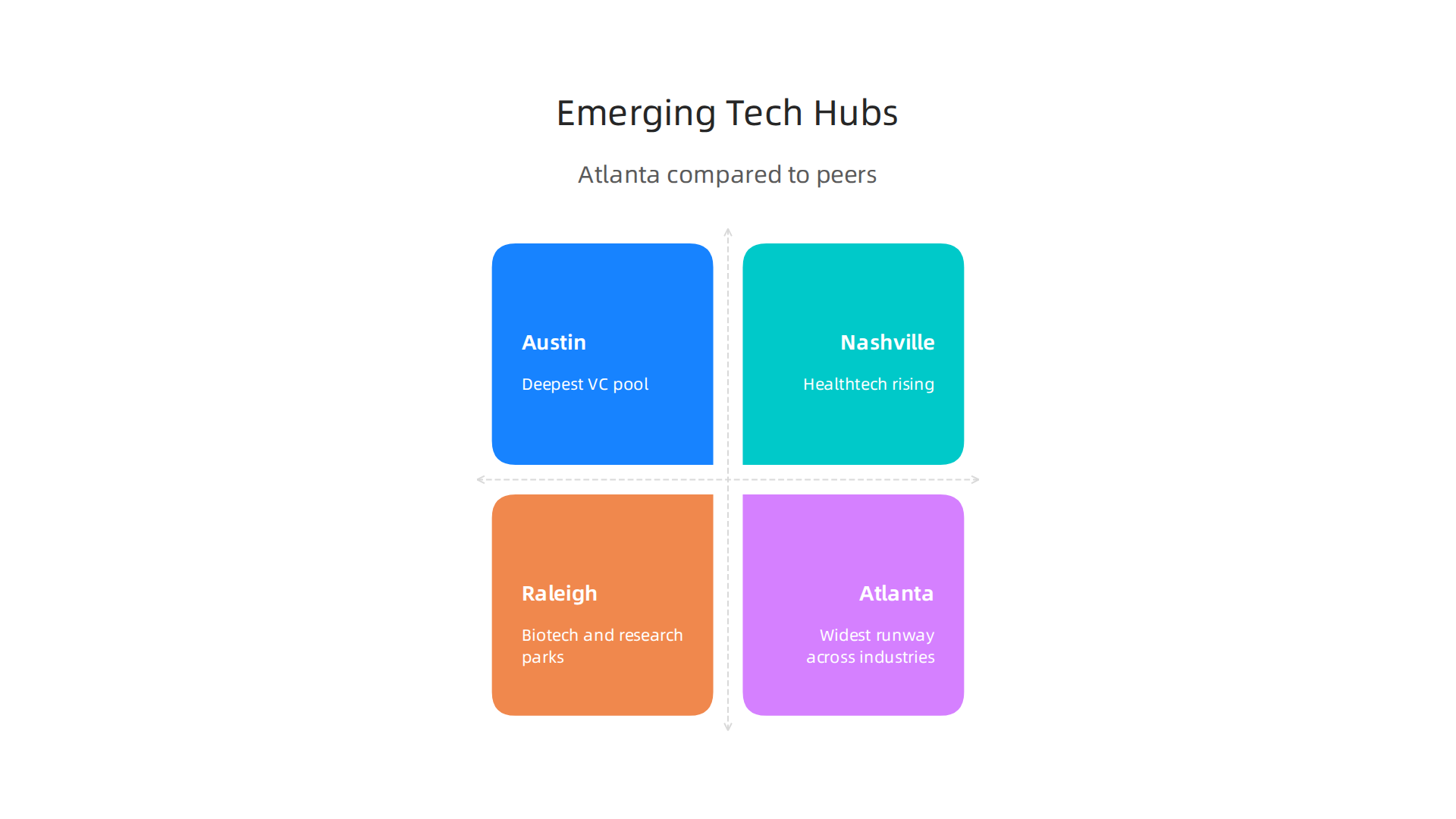
That diversity is what makes it hard to beat.
And because the policy landscape changes fast across every city, staying informed is a full-time job. If you want a simple way to keep up with the rules that affect where and how you build, check out The AI Newsletter Worth Reading from The Deep View. It lands in your inbox with clear daily updates so you never miss a shift that could change your strategy.
Challenges and Future Outlook
Even with all this momentum, Atlanta’s startup scene faces real hurdles. No city grows without growing pains, and Atlanta has a few worth watching.
Talent retention is the first big one. Top graduates from Georgia Tech, Emory, and other local schools are in high demand. Big tech companies like Google, Microsoft, and Amazon offer flashy salaries and stock options. That pulls talent away from early-stage startups that cannot match those numbers. Atlanta needs to keep building programs that help graduates see the value in staying local and joining a young company. If the city cannot hold onto its best engineers and product people, a lot of the region’s potential leaks out.
Regulatory uncertainty is another challenge. The rules around AI and data privacy are changing fast in 2026. New state laws are popping up across the country, and compliance can be a heavy lift for a small team. As noted in a guide on the latest AI regulations and practical guidance, companies using AI need to track requirements from multiple states at once. A startup building an AI product could face different rules in Georgia, California, and Colorado. That complexity eats up time and legal budget that a young company would rather spend on building product.
But the future looks bright despite these challenges. Atlanta is projected to keep growing, especially in deep tech and climate tech. Investors are paying attention to the whole southeastern region. According to a recent report on the 2025 State of Startups in the Southeast, the region continues to outperform most other parts of the US in deal activity. Atlanta sits right in the middle of that wave. Local strengths in logistics, supply chain, and industrial tech give founders a solid base to build on.
The city is also seeing more government support for startups focused on climate solutions and hard science. Research partnerships with universities and federal labs are growing. That kind of infrastructure takes years to build, and Atlanta already has a head start.
If you are thinking about starting or moving a company, the window is open. The challenges are real, but the long-term momentum in Atlanta is hard to ignore. And if you want to stay ahead of the regulatory shifts that could affect your business, it helps to keep up with focused policy coverage. One good resource is a guide that breaks down how to navigate major regulatory changes in tech policy in 2026. It can save you hours of digging through scattered legislation.
No city is perfect. But for founders who want a diverse economy, growing investor interest, and a real chance to build something lasting, Atlanta is worth a long look.
Summary
This article offers a data-driven look at why Atlanta is emerging as a major U.S. startup hub, highlighting record funding, deep industry clusters, and a supportive policy environment. It reviews 2025 milestones—including roughly $3.0 billion in local venture funding and a notable $756.5 million year-over-year raise—then explains the city’s strengths in fintech, healthtech, and enterprise SaaS. The piece outlines practical advantages like Georgia’s R&D tax credit, a robust talent pipeline from Georgia Tech and other schools, dense fiber infrastructure, and the global connectivity of Hartsfield‑Jackson airport. It also examines the funding landscape, key local players (incubators, accelerators, corporate labs), and how Atlanta stacks up against Austin, Nashville, and Raleigh. Finally, the article flags challenges—talent retention and evolving AI/data regulation—and points founders and policy professionals to where they can track changing rules and opportunities.