

Introduction
You’ve probably heard the buzz about Harvey AI. It is quickly becoming the go-to large language model for lawyers and law firms. But with that fast growth comes some serious questions. How do firms maintain client confidentiality when using AI? What rules should govern these tools? In 2026, these are not just tech questions. They are policy questions that affect every legal professional.

The adoption of legal AI is happening faster than most expected. Analysts now say that AI adoption in law is becoming mandatory, not optional. In fact, 85 predictions for AI and the law in 2026 show that legal AI tech will continue to spread rapidly, especially among small and midsize firms. Harvey AI leads this charge by offering specialized tools for legal research, contract analysis, and document drafting.
But Harvey AI is not alone. Other tools like Magic AI, Amplify AI, and ElevenLabs AI are also making waves in different parts of the legal world. Each raises its own set of policy concerns around data privacy, bias, and accountability.
This article will break down what makes Harvey AI different. We will look at its core innovations, how it fits into the current market, and the regulatory challenges shaping its future. Because when a tool becomes this essential, the rules around it matter just as much as the technology itself.
If you want to stay ahead of these fast moving policy changes, we recommend subscribing to a daily newsletter that tracks AI governance and tech policy closely. It can help you turn headlines into actionable insights.
Let us start by understanding what Harvey AI actually does and why so many law firms are betting on it.
What is Harvey AI? From Startup to Legal Tech Leader
Harvey AI started in 2022 with a simple but bold idea. Winston Weinberg and Gabriel Pereyra wanted to build a large language model built specifically for the legal world. Not a general chatbot. Not a toy. A tool that could actually understand legal language, contracts, and case law the way a lawyer would.
Weinberg was a first-year legal associate when he saw the gap. He and Pereyra teamed up to build something that could change how law firms work. And they did. According to TechCrunch, the journey from idea to industry leader happened faster than almost anyone expected.
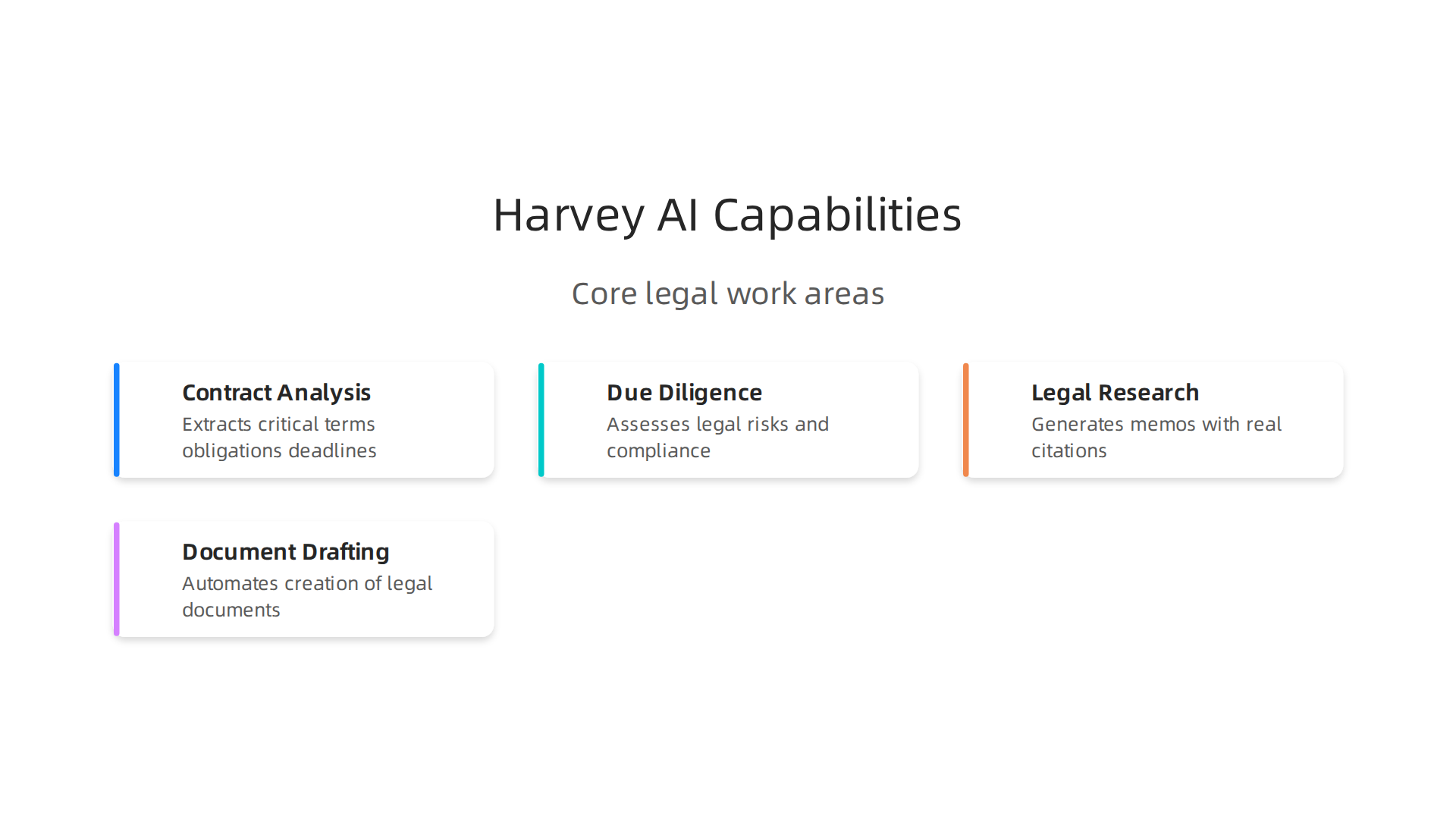
The company’s official name is Counsel AI Corporation. But everyone calls it Harvey. The company’s website explains that Harvey focuses on domain-specific AI for legal and professional services. That means it does not try to do everything. It just does legal work really well. Contract analysis, due diligence, legal research, document drafting. Those are its sweet spots.
Now here is where the numbers get interesting. In 2025, Harvey raised $190 million from top investors. By March 2026, the company announced a new funding round that values Harvey at $11 billion. Yes, billion with a B. The round included heavy hitters like Andreessen Horowitz, Coatue, Conviction Partners, and Elad Gil. You can read the full details on the official Harvey blog.
So who is actually using Harvey? The list includes some of the biggest law firms in the world. O’Melveny & Myers, Latham & Watkins, and many others have already integrated Harvey into their daily workflows. For a tool that did not exist four years ago, that is serious momentum.
Harvey is not the only player in the legal AI space. Tools like Magic AI, Amplify AI, and ElevenLabs AI are also pushing into different corners of the legal market. But Harvey stands out because of its laser focus on legal domain expertise.
What does this mean for you? If you work in law, tech policy, or compliance, Harvey AI is a tool you need to understand. Its rapid adoption means the rules and policies around legal AI are being written right now. Staying ahead of those changes matters.
That is why we recommend subscribing to The Deep View Newsletter. It gives you clear daily updates on AI policy and governance. No fluff. Just actionable insights to help you make smarter decisions.
Key Innovations: How Harvey AI Stands Apart from Generic LLMs
Here is the thing most people do not realize about general purpose AI tools like ChatGPT. They are incredibly smart at many things. But when it comes to legal work, they can miss the mark in dangerous ways. Legal language is precise. Case law is nuanced. A wrong citation or misinterpreted clause can cost a client millions.
That is exactly where Harvey AI changes the game.
Domain-specific training is the secret sauce.
Harvey AI does not just rely on general internet data. It was trained on millions of legal documents, contracts, court filings, and case law databases. According to Ironclad’s 2026 review of legal AI tools, Harvey uses GPT-based generative AI that has been fine-tuned specifically on legal materials. This means it understands legal terminology and reasoning the way a trained lawyer does.
Think of it this way. A general LLM is like a smart friend who reads a lot. Harvey is like a junior associate who has already reviewed thousands of contracts. The difference in accuracy and reliability is huge.

What can Harvey actually do?
The platform handles three big areas that law firms care about most:
- Automated document review. Harvey scans contracts and legal documents to flag risks, inconsistencies, and key clauses. It does this in minutes, not hours.
- Contract analysis. The tool extracts critical terms, obligations, and deadlines from dense agreements. It then summarizes them in plain language.
- Legal research with citations. This is the big one. Harvey generates legal research memos with real citations to case law and statutes. You do not have to wonder if the source is real. It gives you the reference.
The Harvey AI website confirms that these features are designed for leading law firms and corporate legal teams worldwide. And they are using it. A lot.
The numbers back up the hype.
In 2026, Harvey released an open-source benchmark called the Legal Agent Benchmark (LAB). As LawNext reported, this tool evaluates how well AI agents perform on real legal tasks. Harvey also shared the details behind its evaluation approach through a comprehensive case study on building and evaluating legal AI at scale.
The results are worth noting. Harvey AI consistently outperforms GPT-4 on bar exam questions and legal reasoning tests. Independent benchmarks from GC AI’s In-House Legal Bench also show that Harvey scores higher than competitors on real in-house legal tasks like contract review and compliance analysis.
For policy professionals, this level of accuracy matters. When AI can reliably cite the right statute or flag a regulatory risk, it transforms how teams approach compliance. That is why understanding tools like Harvey is becoming essential for anyone working at the intersection of law and technology.
If you want to stay ahead of how AI is reshaping legal and policy work, we recommend subscribing to The Deep View Newsletter. It gives you clear daily insights on AI governance and legal tech trends without the noise.
The bottom line? Harvey AI is not just another chatbot dressed in a suit. It is a domain expert that actually knows the law. And that changes everything.
Impact on the Legal Profession: Efficiency, Ethics, and Evolving Roles
Okay, so Harvey AI is clearly a powerful tool. But what does that actually mean for lawyers, law firms, and the people they serve? In 2026, the legal profession is going through a major shift. Let’s break it down into three big areas: efficiency, ethics, and the changing roles of legal professionals.
Efficiency gains are real and measurable. Harvey AI automates the boring, repetitive tasks that used to eat up hours of a lawyer’s day. Things like reviewing contracts for key clauses, doing initial legal research, and flagging potential risks. According to a 2026 analysis from Wolters Kluwer, legal AI adoption is directly linked to time savings and revenue growth. Lawyers can now focus on higher-value work like strategy, client counseling, and complex negotiations. This does challenge the old billable hour model.

When an AI does in minutes what used to take hours, firms have to rethink how they charge. Some experts predict a move toward flat fees or value-based billing.
What about jobs? Are lawyers getting replaced? This is the big fear. But the reality in 2026 is more nuanced. Predictions from The National Law Review show that adoption of legal AI tech will continue to spread rapidly, especially among in-house counsel and small to mid-sized firms. New roles are emerging. Law firms now need AI oversight specialists, prompt engineers who know the law, and ethics compliance officers focused on AI tools. The job is not disappearing. It is evolving. The paralegal who used to spend all day reviewing documents might now supervise an AI that does the first pass. That is a big change in skills, but not a loss of value.
Ethical concerns cannot be ignored. Three issues stand out. First, confidentiality. When you feed client data into Harvey AI, where does it go? The Harvey company page emphasizes security and domain-specific use, but law firms must still vet any AI tool for compliance with attorney-client privilege. Second, bias. Harvey AI is trained on legal documents, but if those documents reflect past biases, the AI could perpetuate them. Firms need to audit outputs regularly. Third, liability. Who is responsible if Harvey AI gives bad advice? The lawyer is still the one signing off. As Jones Walker noted in their 2026 predictions, surgical redlining with 95% accuracy is coming, but that last 5% still needs a human eye. For policy professionals, understanding these ethical layers is critical. The EU AI Act sets a framework that many jurisdictions are watching closely. For more on how government compliance is evolving alongside AI, check out this piece on AI policy in the public sector.
As AI reshapes legal work, staying informed is essential. That is why we recommend The Deep View Newsletter. It delivers daily clarity on AI governance and legal tech trends without the fluff. If you want to navigate this new landscape with confidence, it is a great resource.
Regulatory and Policy Challenges: Navigating AI in a Highly Regulated Industry
So Harvey AI offers big efficiency gains, but it also brings serious ethical questions. Now let’s look at the biggest hurdle: regulation. The legal profession is one of the most heavily regulated industries in the world. Every tool that lawyers use must protect client secrets, avoid bias, and pass strict ethical rules. That makes adopting AI like Harvey AI a tricky balancing act.
The most sacred rule in law is attorney-client privilege. Everything a client tells a lawyer stays private. When a lawyer feeds that information into Harvey AI, where does it go? Is the data used to train the model? Does it stay encrypted? The Justia 50-State Survey on AI and Attorney Ethics shows that many state bars now require lawyers to get client consent before using AI on their data. A lawyer who expects to use AI may need to cover data confidentiality in the representation agreement. That is a big shift in how lawyers talk to clients at the start of a case.
States are moving fast. As of 2026, most bar associations have issued formal opinions on AI. The GC.ai blog on AI Legal Ethics outlines four key conditions lawyers must meet: confidentiality, supervision, billing transparency, and honest advertising. If a lawyer uses Harvey AI to do legal research, they still have to check every citation themselves. They cannot just trust the output.
Across the United States, regulators are watching closely. The FTC has signaled that deceptive AI claims could fall under consumer protection laws. State bar associations are actively auditing firms for AI misuse. A 2026 AI Quarterly Review from Alston & Bird notes that new federal and state rules, combined with global privacy shifts, are creating a complex compliance web. Law firms cannot just buy Harvey AI and turn it on. They need a realistic AI policy. As the North Carolina Bar Association argues in 2026, a ban on AI is not the answer. A clear, enforceable policy is.
Now look across the Atlantic. The European Union’s AI Act classifies legal AI as high-risk. That means any tool Harvey AI uses for legal advice, contract analysis, or case prediction in Europe must meet strict transparency, accuracy, and oversight requirements. The AI Act demands human oversight and regular audits. That is a heavy lift for American firms serving European clients.
It is not just Harvey AI facing these rules. Tools like Magic AI, Amplify AI, and ElevenLabs AI also need to comply with sector-specific regulations. Every industry has its own guardrails. For policy professionals, staying on top of these shifting rules is a full-time job. That is why we recommend The Deep View Newsletter. It delivers daily clarity on AI governance and legal tech trends without the noise. If you want to navigate this regulatory maze with confidence, it is a resource you can count on.
Market Competition: Harvey AI vs. Other Legal Tech Giants
So Harvey AI is not alone in the legal AI sandbox. Far from it. The market is filling up fast with big names and new challengers. And in 2026, the competition is heating up.
The heavy hitters you need to know
The biggest competitors include Casetext with its tool CoCounsel, LexisNexis with Lexis+ AI, and Thomson Reuters with Westlaw AI. These are not startups. They are established giants with decades of trust, deep customer relationships, and huge data sets. Harvey AI wins on pure large language model power and the ability to handle complex reasoning. But the incumbents win on reach. Most law firms already use LexisNexis or Westlaw for research. Switching to a new tool takes effort. The independent buyer guide for 2026 notes that law firms often stick with vendors they know unless the new tool offers a clear leap in value.
Market size and growth
The legal AI space is growing fast. According to a 2026 market report, the LegalTech AI market is valued at $3.7 billion in 2026 and is expected to hit $11.06 billion by 2030, growing at a 31.5% compound annual rate. That kind of growth draws more players. Law firms alone represent over 56% of the AI software market share in the legal industry. And corporate legal departments are the fastest growing segment, with an 11.21% CAGR according to Mordor Intelligence.
North America leads the pack, holding 42.2% of the global market in 2025. That means Harvey AI’s home turf is also the most competitive.
Where Harvey AI stands
Harvey AI shines when you need deep, conversational analysis of complex legal documents. Its OpenAI backbone gives it strong language understanding. But tools like Magic AI, Amplify AI, and ElevenLabs AI are also pushing into legal use cases. Even tools not built for law are being repurposed. That means Harvey AI must keep innovating to stay ahead.
The real battle is not just about tech. It is about trust, ease of use, and showing clear return on investment. As the 2026 AI and legal tech forecast from Relativity explains, competitive advantage will come from teams that blend generative AI with defensible review methods. Firms want tools they can trust, not just tools that sound smart.
What this means for policy professionals
If you are advising a law firm or a legal department, you need to watch these competitors closely. The choice of tool affects everything from compliance to billing.

And as regulations tighten, the winner may be the tool that makes it easiest to meet ethical rules. That is why understanding the full landscape matters. For deeper insight into how policy shifts shape these competitive dynamics, check out our article on how AI policy in the public sector is transforming government compliance in 2026. It covers the regulatory forces that give some tools an edge over others.
The market is crowded. But Harvey AI has a real shot at leading it, if it can prove its value against the giants and keep up with fast changing rules.
The Future of AI in Legal Services: Predictions and Preparations
The market is crowded, but the real story is where things are heading next. In 2026, AI is not just a tool for law firms anymore. It is becoming part of the legal system itself.
Courts, arbitration, and compliance get an AI upgrade
We are already seeing AI used in courtrooms, arbitration hearings, and regulatory filings. Some courts now allow judges to use AI for legal research and draft writing. But this raises big questions. How do you make sure the AI is fair and unbiased? In January 2025, new ethical guidelines took effect that let legal professionals use AI, but they must carefully supervise it every step of the way. The evolving ethical guidelines show that every state is writing its own rules. Law firms and corporate legal teams need to stay ahead of these changes. That is why having a clear AI policy for your law firm is no longer optional.
Specialized AI models are on the way
Big general purpose AI tools like Harvey AI are powerful. But the future belongs to small, specialized models trained for niche areas of law. Think immigration, tax, or even patent law. These smaller models use less data, cost less to run, and can be more accurate in their narrow focus. Tools like Magic AI, Amplify AI, and ElevenLabs AI are already showing how targeted models can handle specific tasks better than a one size fits all approach. Harvey AI itself is pushing the field forward by releasing an open source benchmark called LAB (Long Horizon Legal Agent Benchmark) to help everyone measure how well AI agents perform on real legal work. This kind of open development will speed up the shift to specialized models.
Proactive policy frameworks are a must
As AI becomes more common in legal work, the rules need to catch up. Some states have already passed laws about AI use in court. Others are still figuring it out. The risk is that we end up with a patchwork of rules that confuse lawyers and hurt clients. What we really need is a proactive approach. Policy professionals and legal teams should work together to create clear guidelines before problems happen. The 2026 legal tech trends report from Summize shows that corporate legal adoption of AI more than doubled from 2024 to 2025, reaching 54%. That fast growth means the time to act is now.
Staying informed on these changes is tough. The rules shift fast, and new tools appear every month. That is why thousands of policy professionals rely on The Deep View Newsletter for daily AI updates that cut through the noise. It helps you spot what matters before it becomes a crisis.
For a deeper look at how policy is reshaping technology across the board, check out our guide to the biggest information technology policy shifts of 2026.
Summary
This article explains why Harvey AI has become a leading, domain-specific large language model for the legal profession and what that means for firms, clients, and policymakers. It covers Harvey’s origin, how its legal-focused training and benchmarks let it outperform general LLMs on tasks like contract analysis and research, and the concrete features law teams use to save time. The piece also examines efficiency gains and the shifting nature of legal roles while highlighting persistent ethical risks such as client confidentiality, bias, and professional liability. Regulation is a major theme: U.S. state bars, the EU AI Act, and federal authorities are creating rules that shape how firms deploy AI. The article compares Harvey to incumbents and rivals, outlines competitive and market dynamics, and argues that proactive AI policies and oversight are essential. Readers will finish with a clear sense of Harvey’s capabilities, the compliance steps firms must take, and how to prepare for legal AI’s next wave.