

The AI Landscape Is No Longer Warming Up—It’s Boiling
You have probably noticed it. Every morning brings a new headline about an AI system that can do something no machine could do last year. Maybe an AI that writes code better than junior developers. Or a model that diagnoses rare diseases from a single scan. Or autonomous agents that make decisions without human oversight. The pace is not just fast. It is overwhelming.
Here is the thing: The years of speculation are over. Advanced AI concepts are moving from research labs into real-world deployment at a speed that few predicted. By 2026, AI is already acting as a trusted advisor in corporate boardrooms, helping executives make major strategic choices. According to predictions from industry experts, AI is now firmly embedded in leadership decision-making processes. This is not a future trend. It is happening right now.
For policy professionals and technology leaders, this creates a serious challenge.

How do you track what matters when everything moves this fast? How do you separate real breakthroughs from hype? And most importantly, how do you build a governance framework that keeps up with a technology that changes every few weeks?
This article provides a structured guide to the most impactful AI trends and what they mean for governance. We will explore the different types of AI reshaping industries, from vision AI systems that understand images to agentic AI that acts independently. You will get a clear AI roadmap that helps you understand where the field is heading. And we will focus on the practical steps you can take today to prepare for a smart future.
If you want to keep up with these changes daily, consider subscribing to The AI Newsletter Worth Reading. It delivers clear daily AI updates straight to your inbox, so you never miss a critical development.
For a deeper dive into how the most advanced systems are reshaping policy, check out our guide to the smartest AI in 2026. It lays out a data-driven roadmap for leaders like you.
Beyond Generative AI: The Next Wave of Foundational Models
You might think generative AI that writes text or creates images is the peak. But 2026 is showing us something bigger. The next wave of foundational models goes far beyond simple generation. Two shifts define this new era.
First, multimodal models are now the standard. These systems don’t just handle text. They understand images, video, and audio all at once. According to Stanford’s 2026 AI Index Report, frontier models now meet or exceed human baselines on PhD-level science questions and multimodal reasoning. This means an AI can watch a video, read the transcript, and explain what happened in real time. For policy professionals, this changes how you analyze public statements, monitor events, or review evidence.
Second, reasoning models are a giant leap forward. These systems don’t just predict the next word. They plan, reason through logic problems, and execute multi-step tasks. They can break down a complex regulation, compare it to existing laws, and flag conflicts without human guidance. This is where the hot AI action really is in 2026. If you want to understand how these reasoning capabilities connect to real-world action, read our guide on how autonomous systems work.
These advances mean the different types of AI you need to track are expanding fast. Multimodal and reasoning models are not future experiments. They are here and they are reshaping what governance must account for.
Multimodal and Reasoning Models
Let’s look at the actual models driving this change. Flagship systems like GPT-5, Gemini Ultra, and Claude 4 now process text, images, and video natively. This matters for vision AI because one model can watch a video, read a document, and connect the dots in seconds. According to the 22 AI Frontier Models Compared for 2026 analysis, multimodal support is now table stakes. Every major model handles it.
The truly hot AI news is in reasoning. These models use chain-of-thought logic to solve problems step by step. They can plan a compliance check, verify each step against regulations, and catch conflicts without human help. This changes how policy work gets done. For a deeper look at what comes next, check our AI roadmap for 2026 built for leaders navigating this shift.
Multimodal plus reasoning equals a smart future where AI understands context across formats and acts on complex instructions.

If you want to track these developments daily, get clear updates from The AI Newsletter Worth Reading.
The Rise of AI Agents and Autonomous Systems
The most exciting development in hot ai right now is the rise of AI agents. These are not just chatbots that answer questions. They are autonomous systems that can plan, act, and learn on their own. Think of an agent as a digital worker that can handle a multi-step task like reviewing a policy document, checking it against regulations, and sending you a report. All without you clicking a button.
Enterprise teams are adopting these agents fast. They use them to automate workflows, reduce manual work, and speed up decisions. This is a different types of ai moment, because agents represent a leap beyond simple prediction models. They combine reasoning with action.
If you want to understand how these systems work, check out our guide on how autonomous systems work and why they matter. It breaks down the mechanics in plain language.
There are now dozens of frameworks to build these agents. According to the AI agent frameworks for 2026 guide from Salesforce, choosing the right one depends on your team’s needs. Some prioritize speed, others focus on security and compliance.
This shift is a big part of any ai roadmap for this year. Agents are not a future concept. They are already in use across industries.
Safety and Control in Agentic AI
As AI agents grow more capable, safety becomes the biggest question. How do we make sure these autonomous systems act within our rules?
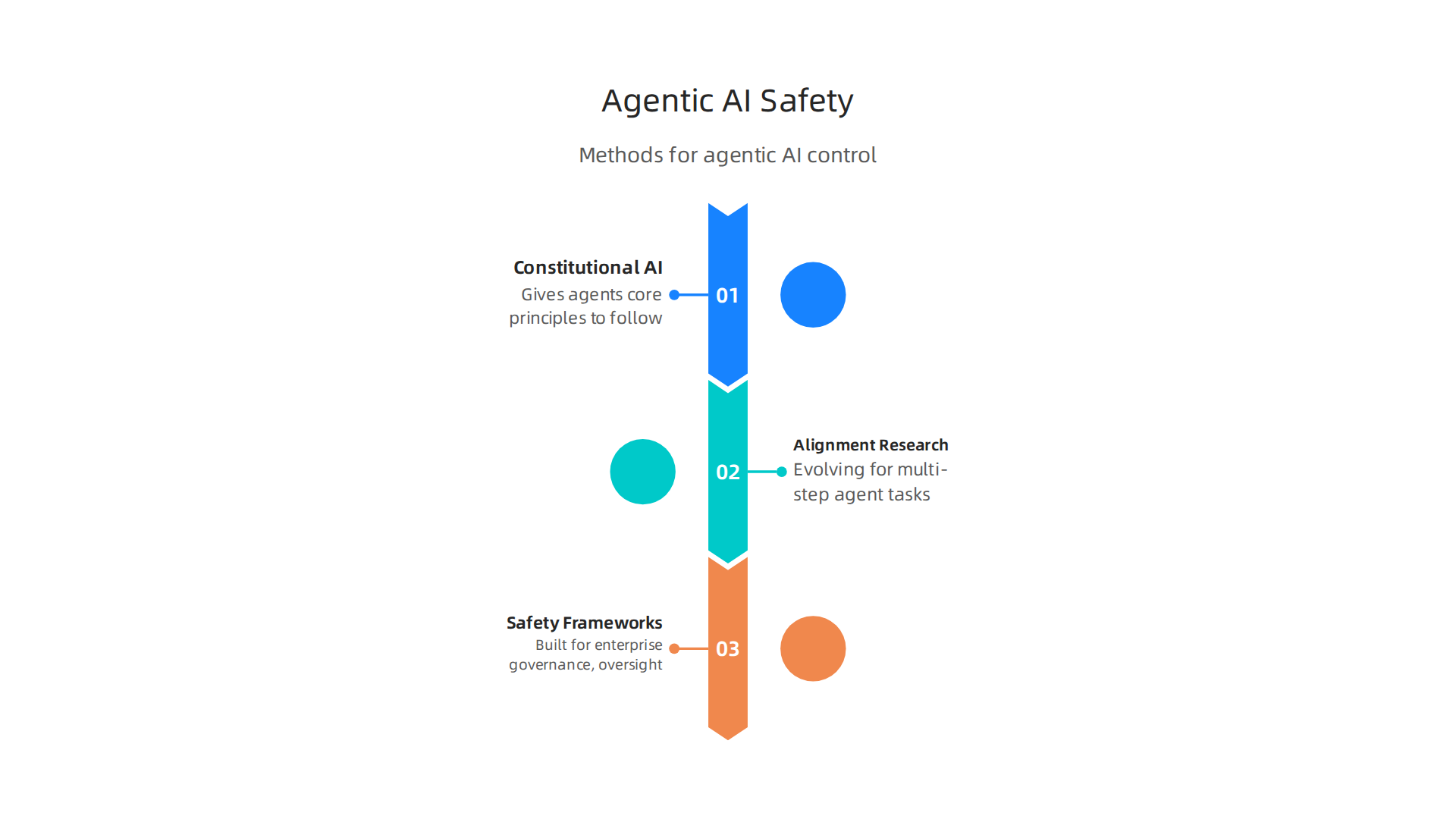
Developers are adapting a technique called Constitutional AI. This method gives agents a set of core principles to follow, much like a code of conduct. Alignment research is also evolving to handle multi-step agent tasks.
Some frameworks already put safety first. For example, Semantic Kernel was built with enterprise governance, safety, and human oversight in mind, as explained in the top agentic frameworks for building applications 2026 article. This means agents can be more predictable and auditable.
Regulators are also stepping up. New frameworks for autonomous decision-making are being discussed across governments. If you work in policy, you need to understand these emerging rules. Our guide on human-AI interaction guidelines for safety can help you prepare.
To keep up with daily changes in AI safety and governance, subscribe to The AI Newsletter Worth Reading. It delivers clear, actionable updates straight to your inbox.
AI x Science: Accelerating Discovery in Biology, Climate, and Materials
AI is no longer just for chatbots and image generators. It is now one of the hot AI fields driving real breakthroughs in science.

In biology, models like AlphaFold 3 can predict protein structures and movements with up to 98% accuracy, opening doors for faster drug discovery. A new wave of vision AI tools also helps scientists analyze medical scans and satellite data at scale.
Governments and organizations are pouring money into these efforts. Google launched a AI for Science funding initiative with $30 million to support health and climate research. Meanwhile, the 2026 AI Index Report from Stanford shows that industry now produces over 90% of frontier AI models, many of which exceed human baselines on PhD-level science questions.
Different types of AI work together in these systems. Self-driving labs run thousands of experiments per week, while generative models suggest new materials and drug candidates. For policy professionals, understanding this acceleration helps shape regulations that keep pace with progress.
If you want to explore where the AI roadmap is headed, check out our breakdown of the smartest AI in 2026. It connects these scientific leaps to the broader governance and investment landscape.
Building a smart future means supporting AI that solves real-world problems. The science sector is just getting started.
AI-Driven Drug Discovery and Materials Science
AlphaFold 3 is just one piece of the hot AI puzzle in science. New platforms like Gemini for Science combine AI agents with more than 30 life science databases to help researchers find drug candidates faster. According to Google’s New AI Tools for the Future of Science, these tools integrate insights from sources like the AlphaFold Database and UniProt to expand scientific exploration. If you want to understand how these autonomous systems work, read our coverage on AI agents explained.
In materials science, vision AI now analyzes microscope images to spot new compounds. Self-driving labs run thousands of experiments per week and suggest new materials up to 10 times faster than older methods. Some AI-designed materials are already moving into industrial production, as highlighted in the CAS report on Scientific breakthroughs: 2026 emerging trends to watch.
These advances showcase different types of AI working together. They are a big part of the AI roadmap toward a smart future.
For daily updates on how AI is reshaping science and policy, get The AI Newsletter Worth Reading.
The Emerging Governance Framework for Frontier AI
As powerful as these hot AI breakthroughs are, they raise serious questions about safety, fairness, and control. That is why 2026 is a pivotal year for AI governance. Governments around the world are now putting real rules in place to make sure this different types of ai landscape stays safe for everyone.
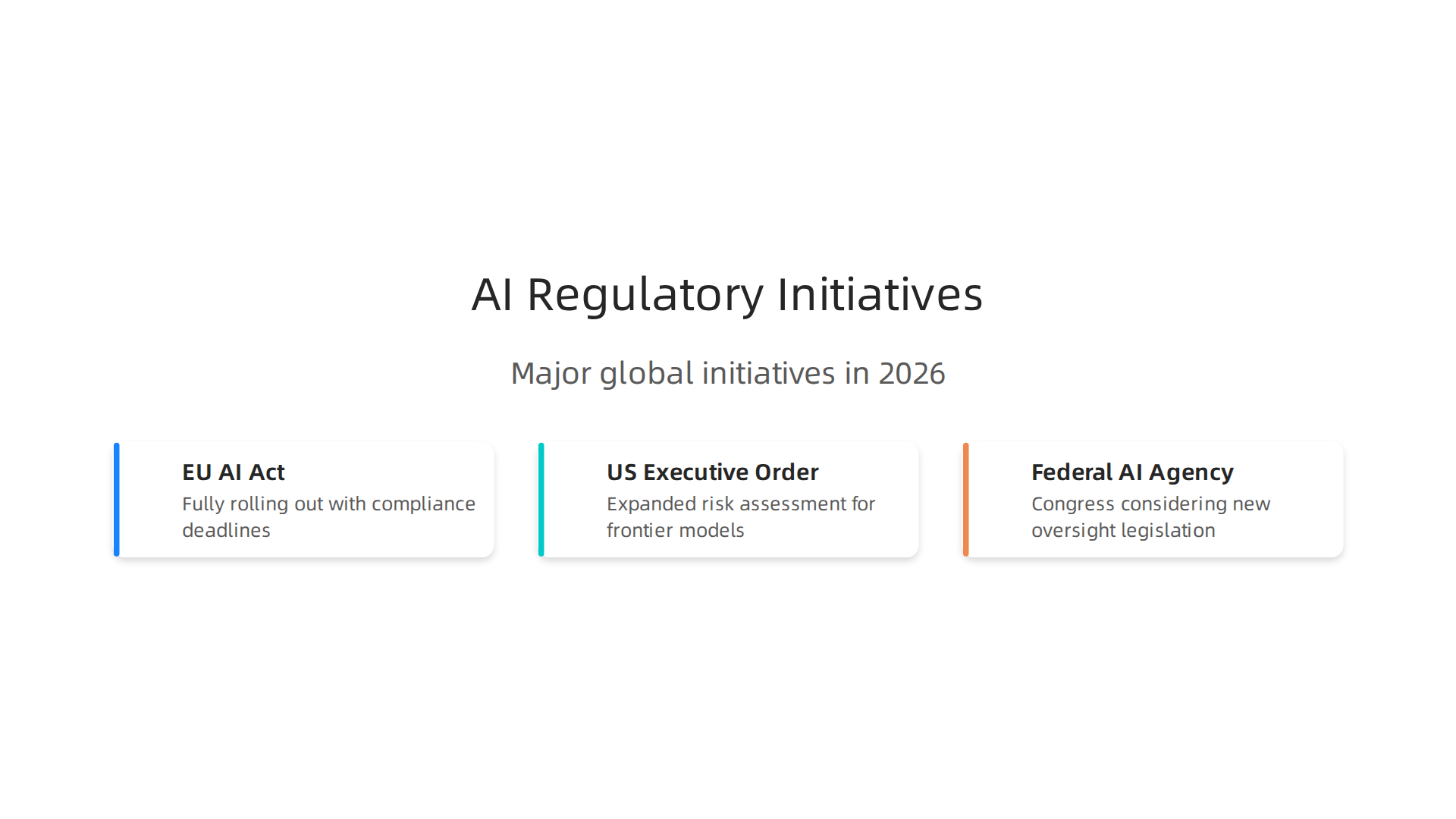
The biggest change comes from Europe. The EU AI Act is now fully rolling out with major compliance deadlines. August 2, 2026 is the binding date for high-risk AI systems. That includes things like biometric identification, hiring tools, and critical infrastructure. Companies that fail to meet the rules face fines up to €35 million or 7 percent of their global annual turnover. If you have customers in the EU, this matters to you. You can read more in this overview of the EU AI Act compliance deadline for US companies.
The United States is not far behind. The White House updated its Executive Order on AI in early 2026, expanding risk assessment requirements for frontier models. Meanwhile, Congress is actively considering new legislation that could create a federal AI oversight agency. The goal is to build a clear ai roadmap that balances innovation with public trust.
If you are trying to keep up with all these changes, you are not alone. Policy professionals and tech executives alike are working hard to understand what applies to their work. A good place to start is this guide on navigating AI privacy and cybersecurity policy changes in 2026. It breaks down the key rules you need to watch.
The bottom line: we are moving toward a smart future, but only if the rules stay clear and enforceable. The next few months will decide how fast that future arrives.
Key Regulatory Initiatives in 2026
The EU AI Office is now fully operational. It is actively enforcing rules for high-risk AI systems. These hot AI systems must follow strict requirements on data governance, transparency, and human oversight. Companies that ignore the rules face heavy fines. You can read more in this new guidance on EU AI Act compliance.
Across the Atlantic, the UK AI Safety Institute is publishing technical safety evaluations for frontier models. These reports help developers and policymakers understand the risks of powerful AI. Together, these initiatives form a global ai roadmap that aims to keep innovation safe and accountable.
Staying on top of these changes is tough. That is why many professionals rely on curated news. For a deeper look at how regulation is evolving, check out this analysis of the biggest information technology policy shifts of 2026. And if you want daily updates delivered to your inbox, The AI Newsletter Worth Reading gives you clear, daily AI policy insights.
National Security and Geopolitical Dimensions of Advanced AI
Beyond regulatory initiatives, another critical layer of the hot ai landscape in 2026 is national security. The competition between the United States and China is intensifying over AI chips, talent, and technical standards.
This rivalry is not just about business. It is about global power.
The Chip and Talent Arms Race
Advanced AI chips power the most capable models. The United States controls much of the high-end chip supply through companies like Nvidia. In late 2025, Washington eased some export restrictions, allowing Nvidia to sell its H200 chips to approved Chinese customers. This move aimed to balance economic interests with security concerns, as explained in this analysis of the US–China AI semiconductor rivalry. In response, China pushed harder to build its own domestic chip industry.
But chips are only part of the story. The real battle is now over people. Chinese tech giants like ByteDance and Baidu are actively recruiting top AI and semiconductor talent in the United States. This overseas hiring spree highlights how valuable skilled workers have become in this hot ai race. You can read more about this trend in this report on how China’s tech giants pursue AI talent in the US.
Dual-Use AI and Military Concerns
Many AI technologies are dual-use. They can improve civilian life or strengthen military power. This creates deep worry for governments. For example, vision ai systems used in self-driving cars could also guide autonomous weapons. The same is true for different types of ai, from natural language processing to predictive analytics.
To understand how one company navigates these national security issues, check out this piece on Palantir’s national security role and AI governance. It shows how AI tools built for intelligence and defense raise tough policy questions.
What This Means for the Global AI Roadmap
The U.S.–China competition is shaping the entire ai roadmap for the rest of the world. Countries in Europe, Asia, and elsewhere must decide whose standards to follow. They must manage their own security risks while still benefiting from AI innovation. A smart future depends on finding ways to compete and cooperate at the same time. That is one of the hardest challenges in technology policy today.
Strategic Intelligence for Decision-Makers: Navigating the Hot AI Landscape
Staying on top of the hot ai landscape in 2026 feels like drinking from a firehose. Every day brings new model releases, regulatory updates, and geopolitical moves. For decision-makers, the risk is not falling behind. It is drowning in noise.

That is why curated intelligence feeds and expert networks have become essential. You cannot read everything. But you can build a smart filter. Start by subscribing to a few high-signal sources that track AI policy, chip developments, and talent flows. Pair that with a small network of analysts who specialize in different parts of the field. This combination turns raw headlines into actionable knowledge.
For example, the US China AI race is not just about chips. It is also about where top researchers choose to work. Understanding this shift matters for your own talent planning. According to this analysis of competing US and China AI strategies, the competition now spans compute, models, adoption, and deployment. You need eyes on all four fronts.
Developing an AI policy monitoring process helps you cut through overload. Set up a weekly scan of rulemaking updates from key jurisdictions: the EU AI Act, US executive orders, and China’s outbound investment rules. Track them in a shared dashboard. That way your team knows what changed without each person hunting for updates.
One practical tool is to use a dedicated newsletter that condenses daily AI developments. This saves hours of manual scrolling. For a smart starting point, check out The AI Newsletter Worth Reading. It delivers clear daily updates focused on the policy and business angles of the hot ai race.
To go deeper on how to build your own monitoring system, read this guide on tech news analysis for policy professionals. It walks you through turning headlines into policy intelligence that supports decisions.
Remember, the goal is not to know everything. It is to know the right things at the right time. A smart future depends on good information habits today.
Summary
AI development in 2026 has moved from steady progress to breakneck change, and this article maps what leaders need to know to keep up. It explains the new generation of multimodal and reasoning models, the rise of autonomous AI agents, and how those advances are already accelerating science, drug discovery, and enterprise automation. The piece also lays out emerging governance pressures — from the EU AI Act and US executive actions to national security concerns around chips and talent — and why those rules matter for compliance and risk. Practical guidance covers safety methods for agents, how to build a monitoring process that filters noise into intelligence, and the policy steps organizations should start now to stay compliant and competitive. After reading, you will understand the core AI types to track, the governance checklist for high-risk systems, and simple strategies to turn daily AI headlines into actionable decisions.